

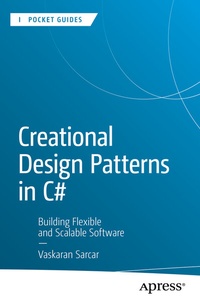
Creational Design Patterns in C#
Description

Unlock the power of design patterns to elevate your software architecture. This pocket book provides an in-depth guide to five essential creational design patterns, crucial for building robust, scalable, and maintainable applications in C#.
With step-by-step implementation in C# and a focus on practical applications, this book will empower you to enhance your software solutions and sharpen your design skills. The book starts by covering the simple factory pattern first where you will learn object creation with clear, single-responsibility classes followed by the factory method pattern. Next, you will go through the prototype, singleton, and builder patterns. In the end, you will demonstrate dependency injection with real-life examples.
The book breaks down complex concepts into practical examples and concise explanations, making it an invaluable resource at every level of experience.
What You Will Learn:
- Gain insights into the concepts of design patterns.
- Will be familiar with real-world applications of design patterns
- Gets a hands-on experience for each of the patterns using the latest version of C#.
- Some of the alternatives to these patterns with their pros and cons.
Who This Book Is For:
OOP, C# developers who want to learn and practice design patterns to upgrade their development skills.
More details
Other editions
Additional editions
Person
Vaskaran Sarcar obtained his master's of engineering from Jadavpur University, Kolkata (India), and his master's of computer application from Vidyasagar University, Midnapore (India). He was a National Gate Scholar (2007-2009) and has over 12 years of experience in education and the IT industry. He devoted his early years (2005-2007) to the teaching profession at various engineering colleges, and later, he joined HP India PPS R&D Hub in Bangalore. He worked there for more than 10 years and became a senior software engineer and team lead.
After that, he pursued his passion and has already authored 15 Apress books that can be found at Amazon or SpringerLink.
Content
Chapter 1: Factory Method Pattern.- Chapter 2: Singleton Pattern.- Chapter 3: Builder Pattern.- Chapter 4: Prototype Pattern.- Chapter 5: Dependency Injection Pattern.- Appendix A: What's Next?.- Appendix B: Other Books by the Author.
