

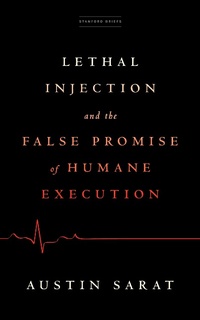
Lethal Injection and the False Promise of Humane Execution
Published on 28. June 2022
194 pages
978-1-5036-3451-0 (ISBN)
Description

With a history marked by incompetence, political maneuvering, and secrecy, America's "most humane" execution method is anything but.
From the beginning of the Republic, this country has struggled to reconcile its use of capital punishment with the Constitution's prohibition of cruel punishment. Death penalty proponents argue both that it is justifiable as a response to particularly heinous crimes, and that it serves to deter others from committing them in the future. However, since the earliest executions, abolitionists have fought against this state-sanctioned killing, arguing, among other things, that the methods of execution have frequently been just as gruesome as the crimes meriting their use. Lethal injection was first introduced in order to quell such objections, but, as Austin Sarat shows in this brief history, its supporters' commitment to painless and humane death has never been certain.
This book tells the story of lethal injection's earliest iterations in the United States, starting with New York state's rejection of that execution method almost a century and half ago. Sarat recounts lethal injection's return in the late 1970s, and offers novel and insightful scrutiny of the new drug protocols that went into effect between 2010 and 2020. Drawing on rare data, he makes the case that lethal injections during this time only became more unreliable, inefficient, and more frequently botched. Beyond his stirring narrative history, Sarat mounts a comprehensive condemnation of the state-level maneuvering in response to such mishaps, whereby death penalty states adopted secrecy statutes and adjusted their execution protocols to make it harder to identify and observe lethal injection's flaws.
What was once touted as America's most humane execution method is now its most unreliable one. What was once a model of efficiency in the grim business of state killing is now marked by mayhem. The book concludes by critically examining the place of lethal injection, and the death penalty writ large, today.
From the beginning of the Republic, this country has struggled to reconcile its use of capital punishment with the Constitution's prohibition of cruel punishment. Death penalty proponents argue both that it is justifiable as a response to particularly heinous crimes, and that it serves to deter others from committing them in the future. However, since the earliest executions, abolitionists have fought against this state-sanctioned killing, arguing, among other things, that the methods of execution have frequently been just as gruesome as the crimes meriting their use. Lethal injection was first introduced in order to quell such objections, but, as Austin Sarat shows in this brief history, its supporters' commitment to painless and humane death has never been certain.
This book tells the story of lethal injection's earliest iterations in the United States, starting with New York state's rejection of that execution method almost a century and half ago. Sarat recounts lethal injection's return in the late 1970s, and offers novel and insightful scrutiny of the new drug protocols that went into effect between 2010 and 2020. Drawing on rare data, he makes the case that lethal injections during this time only became more unreliable, inefficient, and more frequently botched. Beyond his stirring narrative history, Sarat mounts a comprehensive condemnation of the state-level maneuvering in response to such mishaps, whereby death penalty states adopted secrecy statutes and adjusted their execution protocols to make it harder to identify and observe lethal injection's flaws.
What was once touted as America's most humane execution method is now its most unreliable one. What was once a model of efficiency in the grim business of state killing is now marked by mayhem. The book concludes by critically examining the place of lethal injection, and the death penalty writ large, today.
Reviews / Votes
"This book does more to unmask lethal injection's everyday cruelty than any other book that I know. Sarat writes with clarity and compassion, and anyone interested in justice would be well advised to read his words."-Sister Helen Prejean, author of Dead Man Walking "Macabre and painstakingly detailed, this book puts to rest any illusions that lethal injection is clean, safe or painless. This little book doesn't let us get away with abstract debates and intellectual complacency. It lands like a gut punch."-Congressman Jamie Raskin (MD-8), "This enormously readable book uncovers the troubled history and failed promise of lethal injection, and is sure to help change our national conversation about capital punishment."-Harlan Coben, #1 New York Times-bestselling author "Sarat vividly delineates the historical, social, legal, and ideological forces governing capital punishment and their implications and ramifications for individuals, the criminal justice system, and society. In a highly charged political era, this book is a timely education in capital punishment, executions, law, race relations, and social and legal reform-a must-read for all people interested in better understanding the application of the death penalty and those vested in positive transformation. Highly recommended."-M. G. Urbina, CHOICE "Lethal Injection and the False Promise of Humane Executionchronicles a significant, comprehensive, and insightful analysis of the history and evolutionary process of lethal injection executions in the United States, as well as the false promise of the perceived humanity of this method of execution. This ground-breaking book provides a thoughtful analysis including: the origins of lethal injection in this country, collapse of the original protocol of three-drugs (at issue in theBaze v. Reescase), a decade of botched executions from 2010-2020, state responses to these flagrant errors, and implications for futile reform and the future of capital punishment itself."-Talia Roitberg Harmon, Criminal Law and Criminal Justice BooksAll prices
More details
Edition
New edition
Language
English
Place of publication
United States
Publishing group
Stanford University Press
Target group
Professional and scholarly
Edition type
New edition
ISBN-13
978-1-5036-3451-0 (9781503634510)
Copyright in bibliographic data and cover images is held by Nielsen Book Services Limited or by the publishers or by their respective licensors: all rights reserved.
Schweitzer Classification
Other editions
Additional editions
Book
07/2022
Stanford Briefs
€17.50
Shipment within 15-20 days
Book
06/2022
Stanford Briefs
€17.50
Shipment within 15-20 days
Person
Austin Sarat is William Nelson Cromwell Professor of Jurisprudence and Political Science and Chair of Political Science at Amherst College. He is the author, most recently, of Gruesome Spectacles: Botched Executions and America's Death Penalty (Stanford, 2014) and The Death Penalty on the Ballot (2019).
Content
1. One Week in the World of Lethal Injection
2. The Origins of Lethal Injection
3. The Collapse of the Original Paradigm
4. A Decade of Mishaps
5. State Responses
6. Failure, Reform, and the Future
2. The Origins of Lethal Injection
3. The Collapse of the Original Paradigm
4. A Decade of Mishaps
5. State Responses
6. Failure, Reform, and the Future

