

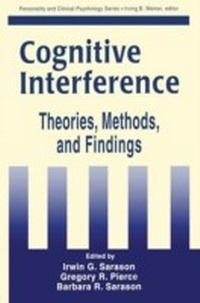
Cognitive Interference
Theories, Methods, and Findings
1st Edition
Published on 3. June 2014
456 pages
978-1-317-84388-7 (ISBN)
Description

In this volume, the first synthesis of work on cognitive interference, leading researchers, theorists, and clinicians from around the world confront a number of important questions about intrusive thoughts and suggest a challenging agenda for the future.
Reviews / Votes
"Human cognitive processing is the core issue facing psychologists of multiple orientations and specialties. Our processing of information influences our interpersonal adjustment, behavioral performance, stress levels, sense of control, ability to self-regulate, anxious and depressive states, and social interactions. To their credit, Sarason, Pierce, and Sarason bring together a collection of luminaries to describe and examine the role of cognitive interference in these and other important topics in a seasoned and reasoned analysis."-Philip C. Kendall
Temple University
"This important book presents a comprehensive analysis of cognitive interference and research. The individual chapters are exceptionally well written by leading experts in this field, and provide insightful reviews of a research that is spread over a wide range of the psychology literature.
Recognizing that cognitive interference encompasses much more than cognitive phenomena, this volume examines the effects of stress, emotions, and motivational process on thought and behavior. It also provides needed linkages between cognitive interference theory and significant clinical conditions such as anxiety disorders, phobias, and depression, and thus provides highly useful information invaluable for counselors and psychotherapists."
-Charles D. Spielberger, Ph.D., Distinguished Research Professor of Psychology
Director, Center for Research in Behavioral Medicine and Health Psychology
"Cognitive Interference: Theories, Methods, and Findings represents the state of the art with respect to cognitive interference. This book, written by various experts in the field of cognition empirically examines the effects of intrusive thinking on behavior, particularly how stress can distort cognitions and performance. Not only does this book examine empirical and applied aspects of cognitive interference, but it also illuminates the theoretical parameters of cognition. This book will prove useful not only to clinicians, educators, and researchers, but to advanced undergraduates and graduates as well."
More details
Language
English
Place of publication
London
United Kingdom
Publishing group
Taylor & Francis Ltd
Target group
Professional and scholarly
Product notice
Reflowable
File size
2,75 MB
ISBN-13
978-1-317-84388-7 (9781317843887)
Copyright in bibliographic data and cover images is held by Nielsen Book Services Limited or by the publishers or by their respective licensors: all rights reserved.
Schweitzer Classification
Other editions
Additional editions
Irwin G. Sarason | Gregory R. Pierce | Barbara R. Sarason
Cognitive Interference
Theories, Methods, and Findings
Book
07/2016
1st Edition
Routledge
€75.90
Shipment within 10-20 days
Irwin G. Sarason | Gregory R. Pierce | Barbara R. Sarason
Cognitive Interference
Theories, Methods, and Findings
Book
01/1996
Routledge
€183.50
Shipment within 10-20 days
Persons
Irwin G. Sarason, Gregory R. Pierce, Barbara R. Sarason
Content
Contents: Preface. Part I: Cognitive Interference and Information Processing.E. Klinger, The Contents of Thoughts: Interference as the Downside of Adaptive Normal Mechanisms in Thought Flow. C.S. Carver, Cognitive Interference and the Structure of Behavior. C. MacLeod, Anxiety and Cognitive Processes. P.L. Yee, J. Vaughan, Integrating Cognitive, Personality, and Social Approaches to Cognitive Interference and Distractibility. R. Schwarzer, Thought Control of Action: Interfering Self-Doubts. M.W. Vasey, E.L. Daleiden, Information-Processing Pathways to Cognitive Interference in Childhood. I.G. Sarason, G.R. Pierce, B.R. Sarason, Domains of Cognitive Interference. R. Kanfer, P.L. Ackerman, A Self-Regulatory Skills Perspective to Reducing Cognitive Interference. Part II: Cognitive Interference, Stress, and Performance.S.M. Miller, Monitoring and Blunting of Threatening Information: Cognitive Interference and Facilitation in the Coping Process. M. Mikulincer, Mental Rumination and Learned Helplessness: Cognitive Shifts During Helplessness Training and Their Behavioral Consequences. M.A. Bruch, Cognitive Interference and Social Interaction: The Case of Shyness and Nonassertiveness. J.V. Wood, P. Dodgson, When Is Self-Focused Attention an Adaptive Coping Response?: Rumination and Overgeneralization Versus Compensation. R.E. Smith, Performance Anxiety, Cognitive Interference, and Concentration Enhancement Strategies in Sports. G.R. Pierce, C.A. Henderson, J.H. Yost, C.M. Loffredo, Cognitive Interference, and Personality: Theoretical and Methodological Issues. Part III: Cognitive Interference and Clinical Problems.M.J. Dombeck, G.J. Siegle, R.E. Ingram, Cognitive Interference and Coping Strategies in Vulnerability to Negative Affect. Z.V. Segal, Cognitive Interference in Depressive and Anxiety-Based Disorders. I.H. Gotlib, J.E. Roberts, E. Gilboa, Cognitive Interference in Depression. W. Nasby, J.L. Yates, Toward a Network Model of Dissociative Mechanisms. K.J. Craig, J.A. Heisler, A. Baum, Intrusive Thought and the Maintenance of Chronic Stress.
