

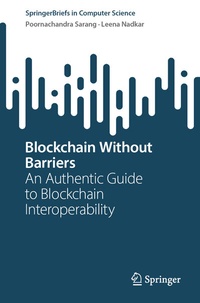
Blockchain Without Barriers
Description

Blockchain interoperability is revolutionizing how digital assets and data move across decentralized networks. This book provides a comprehensive exploration of the protocols and frameworks that enable seamless interaction between diverse blockchains. With a focus on leading solutions such as LayerZero ULN, Polkadot XCM, Cosmos IBC, and Chainlink CCIP, readers gain a deep understanding of the mechanisms driving cross-chain communication.
Blockchain Without Barriers also deals with the vulnerabilities that have challenged the industry, examining incidents such as the Wormhole and Nomad exploits that resulted in significant financial losses. Addressing these challenges, the book offers a practical guide to simulating and enhancing interoperability technologies. Detailed code walkthroughs demonstrate how to replicate bridges, relayers, and event-driven contracts using Truffle, Ganache, and Solidity, empowering readers to experiment and innovate on their own desktops.
A highlight of the book is the introduction of the Cross-Domain Trust Mesh (CDTM), a novel, modular framework designed for governance-aware systems that emphasize safety, compatibility, and decomposability. Key topics include replay protection, compliance, Oracle manipulation, and developer abstractions, all presented with clarity and technical depth.
By establishing clear standards and practical guidance, this book lays the foundation for the next era of Web 3.0 - a truly decentralized and interoperable digital world. It is an essential resource for scholars, researchers, developers, and anyone eager to master the complexities of blockchain interoperability.
More details
Other editions
Additional editions
Persons
Poornachandra Sarang in his IT career spanning four decades, has been consulting large IT organizations on the design and architecture of systems using state-of-the-art technologies. He has authored several books covering a wide range of emerging technologies. Dr. Sarang is a Ph.D. advisor for Computer Science and Engineering and is on the thesis advisory committee for aspiring doctoral candidates. He has designed and delivered courses/curricula for universities at the postgraduate level, including courses and workshops on emerging technologies for industry. He is a known face at technical and research conferences delivering both keynote and technical talks.
Leena Nadkar is a researcher and educator specializing in blockchain. Currently pursuing a Ph.D. in Computer Engineering at NMIMS, Mumbai, she has taught Blockchain Technology, Cryptography and Network Security, Advanced Web Technologies, Database Management Systems, Cloud Computing, and other Computer Engineering subjects as an Assistant Professor and Visiting Faculty. She has authored research papers, Udemy courses, and copyrighted content on blockchain and emerging technologies. A speaker at technical conferences and workshops, she actively shares insights on Udemy, YouTube, LinkedIn, and Medium, contributing to blockchain education and research.
Content
Chapter 1 Blockchain Interoperability-Foundations.- Chapter 2 Security Challenges.- Chapter 3 Role of Regulatories.- Chapter 4 Developer Guide.- Chapter 5 Key Takeaways for Researchers.
