

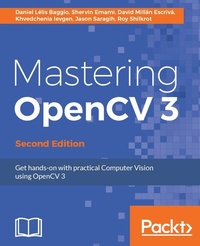
Mastering OpenCV 3
Get hands-on with practical Computer Vision using OpenCV 3
2nd Edition
Published on 8. July 2025
250 pages
978-1-78646-656-3 (ISBN)
Description

Practical Computer Vision Projects
Key Features
[*] Updated for OpenCV 3, this book covers new features that will help you unlock the full potential of OpenCV 3
[*] Written by a team of 7 experts, each chapter explores a new aspect of OpenCV to help you make amazing computer-vision aware applications
[*] Project-based approach with each chapter being a complete tutorial, showing you how to apply OpenCV to solve complete problems
Book DescriptionAs we become more capable of handling data in every kind, we are becoming more reliant on visual input and what we can do with those self-driving cars, face recognition, and even augmented reality applications and games. This is all powered by Computer Vision. This book will put you straight to work in creating powerful and unique computer vision applications. Each chapter is structured around a central project and deep dives into an important aspect of OpenCV such as facial recognition, image target tracking, making augmented reality applications, the 3D visualization framework, and machine learning. You'll learn how to make AI that can remember and use neural networks to help your applications learn. By the end of the book, you will have created various working prototypes with the projects in the book and will be well versed with the new features of OpenCV3.What you will learn
[*] Execute basic image processing operations and cartoonify an image
[*] Build an OpenCV project natively with Raspberry Pi and cross-compile it for Raspberry Pi.text
[*] Extend the natural feature tracking algorithm to support the tracking of multiple image targets on a video
[*] Use OpenCV 3's new 3D visualization framework to illustrate the 3D scene geometry
[*] Create an application for Automatic Number Plate Recognition (ANPR) using a support vector machine and Artificial Neural Networks
[*] Train and predict pattern-recognition algorithms to decide whether an image is a number plate
[*] Use POSIT for the six degrees of freedom head pose
[*] Train a face recognition database using deep learning and recognize faces from that database
Who this book is forThis book is for those who have a basic knowledge of OpenCV and are competent C++ programmers. You need to have an understanding of some of the more theoretical/mathematical concepts, as we move quite quickly throughout the book.
Key Features
[*] Updated for OpenCV 3, this book covers new features that will help you unlock the full potential of OpenCV 3
[*] Written by a team of 7 experts, each chapter explores a new aspect of OpenCV to help you make amazing computer-vision aware applications
[*] Project-based approach with each chapter being a complete tutorial, showing you how to apply OpenCV to solve complete problems
Book DescriptionAs we become more capable of handling data in every kind, we are becoming more reliant on visual input and what we can do with those self-driving cars, face recognition, and even augmented reality applications and games. This is all powered by Computer Vision. This book will put you straight to work in creating powerful and unique computer vision applications. Each chapter is structured around a central project and deep dives into an important aspect of OpenCV such as facial recognition, image target tracking, making augmented reality applications, the 3D visualization framework, and machine learning. You'll learn how to make AI that can remember and use neural networks to help your applications learn. By the end of the book, you will have created various working prototypes with the projects in the book and will be well versed with the new features of OpenCV3.What you will learn
[*] Execute basic image processing operations and cartoonify an image
[*] Build an OpenCV project natively with Raspberry Pi and cross-compile it for Raspberry Pi.text
[*] Extend the natural feature tracking algorithm to support the tracking of multiple image targets on a video
[*] Use OpenCV 3's new 3D visualization framework to illustrate the 3D scene geometry
[*] Create an application for Automatic Number Plate Recognition (ANPR) using a support vector machine and Artificial Neural Networks
[*] Train and predict pattern-recognition algorithms to decide whether an image is a number plate
[*] Use POSIT for the six degrees of freedom head pose
[*] Train a face recognition database using deep learning and recognize faces from that database
Who this book is forThis book is for those who have a basic knowledge of OpenCV and are competent C++ programmers. You need to have an understanding of some of the more theoretical/mathematical concepts, as we move quite quickly throughout the book.
More details
Edition
2nd Revised edition
Language
English
Place of publication
Birmingham
United Kingdom
Target group
Professional and scholarly
US School Grade: College Graduate Student
Edition type
Revised edition
File size
18,28 MB
ISBN-13
978-1-78646-656-3 (9781786466563)
Copyright in bibliographic data and cover images is held by Nielsen Book Services Limited or by the publishers or by their respective licensors: all rights reserved.
Schweitzer Classification
Other editions
Additional editions
Daniel Lélis Baggio | Shervin Emami | David Millán Escrivá
Mastering OpenCV 3
Book
04/2017
Packt Publishing
€55.70
Shipment within 3-4 weeks
Person
Saragih Jason :
Jason Saragih received his BEng degree in mechatronics (with honors) and PhD in computer science from the Australian National University, Canberra, Australia, in 2004 and 2008, respectively. From 2008 to 2010, he was a Postdoctoral fellow at the Robotics Institute of Carnegie Mellon University, Pittsburgh, PA. From 2010 to 2012 he worked at the Commonwealth Scientific and Industrial Research Organization (CSIRO) as a Research Scientist. He is currently a Senior Research Scientist at Visual Features, an Australian tech start-up company. Dr. Saragih has made a number of contributions to the field of computer vision, specifically on the topic of deformable model registration and modeling. He is the author of two non-profit open source libraries that are widely used in the scientific community; DeMoLib and FaceTracker, both of which make use of generic computer vision libraries including OpenCV.
Jason Saragih received his BEng degree in mechatronics (with honors) and PhD in computer science from the Australian National University, Canberra, Australia, in 2004 and 2008, respectively. From 2008 to 2010, he was a Postdoctoral fellow at the Robotics Institute of Carnegie Mellon University, Pittsburgh, PA. From 2010 to 2012 he worked at the Commonwealth Scientific and Industrial Research Organization (CSIRO) as a Research Scientist. He is currently a Senior Research Scientist at Visual Features, an Australian tech start-up company. Dr. Saragih has made a number of contributions to the field of computer vision, specifically on the topic of deformable model registration and modeling. He is the author of two non-profit open source libraries that are widely used in the scientific community; DeMoLib and FaceTracker, both of which make use of generic computer vision libraries including OpenCV.
Content
Table of Contents
CARTOONIFIER AND SKIN CHANGER FOR RASPBERRY PI
NATURAL IMAGE TRACKING FOR AUGMENTED REALITY
EXPLORING STRUCTURE FROM MOTION USING OPENCV
NUMBER PLATE RECOGNITION USING SVM AND NEURAL NETWORKS
NON-RIGID FACE TRACKING
3D HEAD POSE ESTIMATION USING AAM AND POSIT
FACE RECOGNITION USING DEEP LEARNING
CARTOONIFIER AND SKIN CHANGER FOR RASPBERRY PI
NATURAL IMAGE TRACKING FOR AUGMENTED REALITY
EXPLORING STRUCTURE FROM MOTION USING OPENCV
NUMBER PLATE RECOGNITION USING SVM AND NEURAL NETWORKS
NON-RIGID FACE TRACKING
3D HEAD POSE ESTIMATION USING AAM AND POSIT
FACE RECOGNITION USING DEEP LEARNING
