

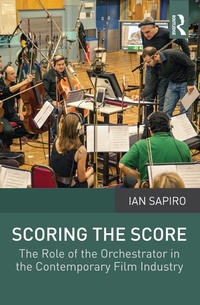
Scoring the Score
The Role of the Orchestrator in the Contemporary Film Industry
Published on 10. November 2016
244 pages
978-1-317-93488-2 (ISBN)
Description

Scoring the Score is the first scholarly examination of the orchestrator's role in the contemporary film industry. Orchestrators are crucial to the production of a film's score, yet they have not received significant consideration in film-music research. This book sheds light on this often-overlooked yet vital profession. It considers the key processes of orchestrating and arranging and how they relate, musical and filmic training, the wide-ranging responsibilities of the orchestrator on a film-scoring project, issues related to working practices, the impact of technology, and the differences between the UK and US production processes as they affect orchestrators.
Drawing on interviews with American and British orchestrators and composers, Scoring the Score aims to expose this often hidden profession through a rigorous examination of the creative process and working practices, and analysis of the skills, training and background common to orchestrators. It will appeal to scholars, students, and practitioners of film music.
Drawing on interviews with American and British orchestrators and composers, Scoring the Score aims to expose this often hidden profession through a rigorous examination of the creative process and working practices, and analysis of the skills, training and background common to orchestrators. It will appeal to scholars, students, and practitioners of film music.
Reviews / Votes
"Drawing on historical and commercial contexts as well as technological and creative processes, Scoring the Score is a pioneering tome and veritable guide to modern film scoring. A comprehensive reference for both scholar and practitioner, grounded by extensive research, interviews with leading practitioners, and a close consideration of industrial practices, this book explores the myriad interactions that transpire between composer, orchestrator, copyist, and music editor. Sapiro delivers a robust and cogent account of the collaborative art of film orchestration."-Ronald Sadoff, New York University, USA
"The role of the orchestrator in the film industry has long been shrouded in mystery, lacking rigorous scholarly attention. But in this engaging book, Ian Sapiro examines the porous boundaries between transcription, arrangement, and orchestration to reveal the vital role the orchestrator plays. Numerous first-hand accounts shine light on a little-understood profession, providing great insight into the film-scoring process."
-Miguel Mera, City University London, UK
"Meticulously researched and expertly written, Scoring the Score fills an often overlooked gap in film music studies, providing a thorough exploration of the purpose and significance the craft of orchestration has in the film industry. Charting the changes the profession has undergone since the classical era to meet the demands of contemporary scoring practices informed by music technology, Sapiro's book offers much-needed insight into the responsibilities of the job, the working practices, and the often hidden or unacknowledged contributions orchestrators make to the film industry."
-Danijela Kulezic-Wilson, University College Cork, Ireland
More details
Language
English
Place of publication
London
United Kingdom
Publishing group
Taylor & Francis Ltd
Target group
College/higher education
Illustrations
17 Line drawings, black and white
File size
3,66 MB
ISBN-13
978-1-317-93488-2 (9781317934882)
Copyright in bibliographic data and cover images is held by Nielsen Book Services Limited or by the publishers or by their respective licensors: all rights reserved.
Schweitzer Classification
Other editions
Additional editions
Book
11/2016
1st Edition
Routledge
€205.60
Shipment within 15-20 days
Book
11/2016
1st Edition
Routledge
€72.40
Shipment within 15-20 days
Person
Content
Foreword
Preface
Acknowledgements
Introduction
Chapter 1: Interviews and Interviewees
Chapter 2: Orchestrating and Arranging
Chapter 3: Becoming an Orchestrator
Chapter 4: The Impact of Technology
Chapter 5: Involvement in a Film-Scoring Project
Chapter 6: Working Practices
Chapter 7: Local Differences in a Global Industry
Chapter 8: The Role of the Orchestrator in the Contemporary Film Industry
Appendix A: Outline Interview Schedules
Appendix B: Interviewee Details
Appendix C: Information on Software Packages
Index
Preface
Acknowledgements
Introduction
Chapter 1: Interviews and Interviewees
Chapter 2: Orchestrating and Arranging
Chapter 3: Becoming an Orchestrator
Chapter 4: The Impact of Technology
Chapter 5: Involvement in a Film-Scoring Project
Chapter 6: Working Practices
Chapter 7: Local Differences in a Global Industry
Chapter 8: The Role of the Orchestrator in the Contemporary Film Industry
Appendix A: Outline Interview Schedules
Appendix B: Interviewee Details
Appendix C: Information on Software Packages
Index
