

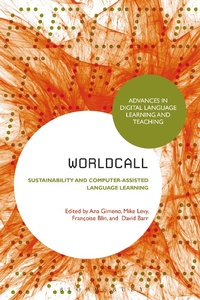
WorldCALL: Sustainability and Computer-Assisted Language Learning
1st Edition
Published on 17. December 2015
368 pages
978-1-4742-4836-5 (ISBN)
Description

This volume focuses on computer- and digitally-assisted language learning in all of its forms: technology-enhanced language learning, network-based language learning, mobile-assisted language learning and so on, in close relation to the topic of sustainability. How can these technologies and techniques be implemented in a sustainable and repeatable way? The book covers a wide range of areas in terms of this "sustainability". These include:
(1) education (teacher/learner training)
(2) normalisation (integration)
(3) systems (reliability, support, development)
(4) mobility (mobile-assisted language leaning)
(5) innovation (trends, research)
The volume samples research and practice in CALL from around the world, organised into sections. It has an introduction and a conclusion written by the editors (Ana Gimeno, Mike Levy, Françoise Blin and David Barr) which covers the state of the art at the moment and directions it is likely to take in the future.
(1) education (teacher/learner training)
(2) normalisation (integration)
(3) systems (reliability, support, development)
(4) mobility (mobile-assisted language leaning)
(5) innovation (trends, research)
The volume samples research and practice in CALL from around the world, organised into sections. It has an introduction and a conclusion written by the editors (Ana Gimeno, Mike Levy, Françoise Blin and David Barr) which covers the state of the art at the moment and directions it is likely to take in the future.
More details
Series
Edition
1. Auflage
Language
English
Place of publication
London
United Kingdom
Publishing group
Bloomsbury Publishing PLC
Target group
Professional and scholarly
ISBN-13
978-1-4742-4836-5 (9781474248365)
Copyright in bibliographic data and cover images is held by Nielsen Book Services Limited or by the publishers or by their respective licensors: all rights reserved.
Schweitzer Classification
Other editions
Additional editions
Ana Maria Gimeno Sanz | Mike Levy | Francoise Blin
WorldCALL: Sustainability and Computer-Assisted Language Learning
Book
06/2017
Bloomsbury Academic
€67.03
Shipment within 15-20 days
Ana Maria Gimeno Sanz | Mike Levy | Francoise Blin
WorldCALL: Sustainability and Computer-Assisted Language Learning
Sustainability and Computer-Assisted Language Learning
Book
12/2015
Bloomsbury Academic
€173.50
Shipment within 15-20 days
Persons
Ana Gimeno-Sanz is Professor of English Language in the Department of Applied Linguistics at the Universitat Politècnica de València (UPV), Spain.
Mike Levy is Honorary Professor of Second Language Studies in the School of Languages and Cultures at the University of Queensland, Brisbane, Australia.
Françoise Blin is Senior Lecturer at Dublin City University, Ireland.
David Barr is Head of the School of Modern Languages at the University of Ulster, Northern Ireland.
Mike Levy is Honorary Professor of Second Language Studies in the School of Languages and Cultures at the University of Queensland, Brisbane, Australia.
Françoise Blin is Senior Lecturer at Dublin City University, Ireland.
David Barr is Head of the School of Modern Languages at the University of Ulster, Northern Ireland.
Content
Foreword, Ana Gimeno-Sanz and David Barr
Introduction, Mike Levy, Ana Gimeno-Sanz, David Barr and Françoise Blin
PART I: TEACHER EDUCATION AND CALL
1. Learning for the long haul: Developing perceptions of learning affordances in CALL teachers
Karen Haines, Unitec, Auckland, New Zealand
2. Designing digitally-based didactic proposals for English teacher education programs: an analysis of a Brazilian experience with podcasts
Lucas Moreira dos Anjos-Santos, Monash University, Victoria, Australia
Vera Lúcia Lopes Cristovão, State University of Londrina, Paraná, Brazil
3. Creating pedagogical knowledge through electronic materials in a distance telecollaboration project for pre-service teacher trainees
Marcin Kleblan, Jagiellonian University, Krakow, Poland
Mª Camino Bueno-Alastuey, Universidad Pública de Navarra, Spain
4. Promoting Student Collaborative Reflective Interaction Using Wikis and VoiceThreads
Sabrina Priego, Université Laval, Québec, Canada
5. Transformative learning: The developmental processes of L2 teachers as effective users of online resources for language teaching and learning
Sandra Morales and Scott Windeatt, Newcastle University, UK
PART II: NORMALISATION OF CALL
6. Factors that determine CALL integration into Modern Languages Courses in Brazil
Claudia Beatriz M.J. Martins and Herivelto Moreira, Universidade Tecnológica Federal do Paraná, Curitiba, Brazil
7. Data and elicitation methods in interaction-based research
Marie-Josée Hamel, University of Ottawa, Canada
Françoise Blin, Dublin City University, Ireland
Catherine Caws, University of Victoria, Canada
Trude Heift, Simon Fraser University, Burnaby, Canada
Mathias Schulze, University of Waterloo, Canada
Bryan Smith, Arizona State University, USA
8. Factors for sustainable CALL
Monica Ward, Dublin City University, Ireland
PART III: CALL SYSTEMS
9. From a vision to reality: paving the way for CALL sustainability by harmonizing theory, practice and technology in the creation of an EFL b-learning environment for Chilean learners
Emerita Bañados, Universidad de Concepción, Chile
10. Sustaining and building online communities of practice through language economy
Jonathan White, Högskolan Dalarna, Sweden
11. The development of self-regulated learning behaviour in out-of-class CALL activities in a university EFL blended learning course
Yasushige Ishikawa and Craig Smith, Kyoto University of Foreign Studies, Japan
Reiko Akahane-Yamada and Misato Kitamura, ATR Intelligent Robotics and Communication Laboratories, Japan
Yasushi Tsubota and Masatake Dantsuji, Academic Center for Computing and Media Studies, Kyoto University, Japan
PART IV: MOBILE-ASSISTED LANGUAGE LEARNING
12. An evidence-based study of Hong Kong university students' mobile-assisted language learning experience
Qing Ma, The Hong Kong Institute of Education, Hong Kong
13. Students' perspectives on the benefits and constraints of using mobile apps for learning languages
Caroline Steel, The University of Queensland, Brisbane, Australia
14. What to consider for effective mobile-assisted language learning: design implications from an empirical analysis
Heyoung Kim, Chung-Ang University, South Korea
15. Improving learners' reading skills through instant short messages: a sample study using WhatsApp
Mar Gutiérrez-Colon Plana, Universitat Rovira i Virgili, Tarragona, Spain
Ana Gimeno, Universitat Politècnica de València, Spain
Christine Appel and Joseph Hopkins, Universitat Oberta de Catalunya, Spain
PART V: INNOVATION IN CALL
16. Eyetracking in CALL - present and future
Breffni O'Rourke and Claire Prendergast, The University of Dublin, Ireland
Lijing Shi, The London School of Economics and Political Science, UK
Btyan Smith, Arizona State University, USA
Ursula Stickler, Open University, UK
17. Using text analysers as an aid to examining the effects of task complexity on academic L2 writing
Erifili Roubou, Aristotle University of Thessaloniki, Greece
18. How to tell digital stories with handcrafted video clips
Eva Wilden, Ruhr-Universität Bochum, Germany
Conclusion
Françoise Blin, David Barr, Ana Gimeno and Mike Levy
Introduction, Mike Levy, Ana Gimeno-Sanz, David Barr and Françoise Blin
PART I: TEACHER EDUCATION AND CALL
1. Learning for the long haul: Developing perceptions of learning affordances in CALL teachers
Karen Haines, Unitec, Auckland, New Zealand
2. Designing digitally-based didactic proposals for English teacher education programs: an analysis of a Brazilian experience with podcasts
Lucas Moreira dos Anjos-Santos, Monash University, Victoria, Australia
Vera Lúcia Lopes Cristovão, State University of Londrina, Paraná, Brazil
3. Creating pedagogical knowledge through electronic materials in a distance telecollaboration project for pre-service teacher trainees
Marcin Kleblan, Jagiellonian University, Krakow, Poland
Mª Camino Bueno-Alastuey, Universidad Pública de Navarra, Spain
4. Promoting Student Collaborative Reflective Interaction Using Wikis and VoiceThreads
Sabrina Priego, Université Laval, Québec, Canada
5. Transformative learning: The developmental processes of L2 teachers as effective users of online resources for language teaching and learning
Sandra Morales and Scott Windeatt, Newcastle University, UK
PART II: NORMALISATION OF CALL
6. Factors that determine CALL integration into Modern Languages Courses in Brazil
Claudia Beatriz M.J. Martins and Herivelto Moreira, Universidade Tecnológica Federal do Paraná, Curitiba, Brazil
7. Data and elicitation methods in interaction-based research
Marie-Josée Hamel, University of Ottawa, Canada
Françoise Blin, Dublin City University, Ireland
Catherine Caws, University of Victoria, Canada
Trude Heift, Simon Fraser University, Burnaby, Canada
Mathias Schulze, University of Waterloo, Canada
Bryan Smith, Arizona State University, USA
8. Factors for sustainable CALL
Monica Ward, Dublin City University, Ireland
PART III: CALL SYSTEMS
9. From a vision to reality: paving the way for CALL sustainability by harmonizing theory, practice and technology in the creation of an EFL b-learning environment for Chilean learners
Emerita Bañados, Universidad de Concepción, Chile
10. Sustaining and building online communities of practice through language economy
Jonathan White, Högskolan Dalarna, Sweden
11. The development of self-regulated learning behaviour in out-of-class CALL activities in a university EFL blended learning course
Yasushige Ishikawa and Craig Smith, Kyoto University of Foreign Studies, Japan
Reiko Akahane-Yamada and Misato Kitamura, ATR Intelligent Robotics and Communication Laboratories, Japan
Yasushi Tsubota and Masatake Dantsuji, Academic Center for Computing and Media Studies, Kyoto University, Japan
PART IV: MOBILE-ASSISTED LANGUAGE LEARNING
12. An evidence-based study of Hong Kong university students' mobile-assisted language learning experience
Qing Ma, The Hong Kong Institute of Education, Hong Kong
13. Students' perspectives on the benefits and constraints of using mobile apps for learning languages
Caroline Steel, The University of Queensland, Brisbane, Australia
14. What to consider for effective mobile-assisted language learning: design implications from an empirical analysis
Heyoung Kim, Chung-Ang University, South Korea
15. Improving learners' reading skills through instant short messages: a sample study using WhatsApp
Mar Gutiérrez-Colon Plana, Universitat Rovira i Virgili, Tarragona, Spain
Ana Gimeno, Universitat Politècnica de València, Spain
Christine Appel and Joseph Hopkins, Universitat Oberta de Catalunya, Spain
PART V: INNOVATION IN CALL
16. Eyetracking in CALL - present and future
Breffni O'Rourke and Claire Prendergast, The University of Dublin, Ireland
Lijing Shi, The London School of Economics and Political Science, UK
Btyan Smith, Arizona State University, USA
Ursula Stickler, Open University, UK
17. Using text analysers as an aid to examining the effects of task complexity on academic L2 writing
Erifili Roubou, Aristotle University of Thessaloniki, Greece
18. How to tell digital stories with handcrafted video clips
Eva Wilden, Ruhr-Universität Bochum, Germany
Conclusion
Françoise Blin, David Barr, Ana Gimeno and Mike Levy
