

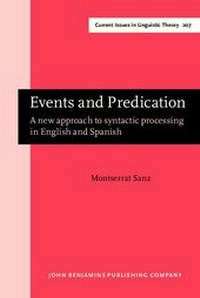
Events and Predication
A new approach to syntactic processing in English and Spanish
1st Edition
Published on 20. October 2000
XIV, 219 pages
978-90-272-8444-0 (ISBN)
Description

Studies on the syntactic consequences of event type in languages have shown that Aktionsart plays a role in Universal Grammar. This book contributes to the exploration of the syntax/semantics interface by presenting a thorough comparison of event and predicate types in English and Spanish. The mapping between event and syntactic predicate types, including detransitives, is given a minimalist account based on the functional categories that embed event features and on a careful analysis of the features checked by objects. As the book delves into the theoretical issue of how parameters are characterized, it presents the most comprehensive account to date of event type phenomena in Spanish, an innovative analysis of the clitic SE and a re-definition of unaccusativity. The theory is then applied to the ongoing issues in the sentence processing literature. A proposal is made for an update of the current data in light of these latest linguistic discoveries.
More details
Other editions
Additional editions
Book
10/2000
John Benjamins Publishing Co
€111.30
Shipment within 10-15 days
Person
Content
- EVENTS AND PREDICATION
- Editorial page
- Title page
- Copyright page
- PREFACE
- Table of contents
- CHAPTER 1: PRELIMINARIES
- 1.1 Introduction
- 1.2 The syntax/semantics interface
- 1.2.1 From thematic roles to Aktionsart
- 1.2.2 Syntactic positions'. A minimalist account
- 1.2.3 An interface puzzle: Unaccusatives
- 1.3 Aktionsart in minimal terms: A proposal
- 1.4 The present proposal and its coverage
- 1.4.1 Middle constructions
- 1.4.2 The resultative construction and verb-particle combinations
- 1.4.3 Passives
- 1.4.4 Spanish transitives with se and transitive/uncausative alternations
- 1.4.5 Differences between unaccusatives in English and Spanish
- 1.4.6 Goal phrase delimitation in English and its absence in Spanish
- 1.4.7 Corollary of this section
- 1.5 Action Types and Predicate Types
- 1.5.1 Action Types
- 1.5.2 Mapping onto predicate types
- 1.6 The Framework
- 1.6.1 Goals and Computation Operations
- 1.6.2 Checking and eliminating features from the derivation
- 1.6.3 The structure of the VP
- 1.6.4 Objects
- 1.6.5 Summary of this section
- 1.7 Summary and Conclusions
- CHAPTER 2: TRANSITIVITY AND AKTIONSART DATA FROM SPANISH
- 2.1 Introduction
- 2.1.1 Accomplishment constructions with se in Spanish
- 2.1.2 The clitic se and other predicate types
- 2.2 Delimitedness of events
- 2.2.1 Incremental Themes (Dowty 1991)
- 2.2.2 Aspectual Roles (Jenny 1987, 1988, 1994)
- 2.2.3 Incremental Event Types (Filip 1993, 1996)
- 2.3 Spanish Telic se in transitive constructions
- 2.3.1 The properties of the construction
- 2.3.2 Previous accounts of transitive sentences with se
- 2.3.3 The properties of the clitic and its position
- 2.3.4 The object position in Spanish (Torrego 1998)
- 2.3.5 Summary of previous sections
- 2.3.6 Analysis of transitive sentences with the telic clitic
- 2.4 Transitive/uncausative alternations
- 2.5 Unaccusatives with se
- 2.6 Accomplishment sentences without the clitic
- 2.6.1 Sentences with animate objects
- 2.6.2 Verbs of creation
- 2.7 Remaining questions
- 2.7.1 Verbs of inherently directed motion
- 2.7.2 Stative verbs
- 2.7.3 Verbs that require a preposition on their objects
- 2.7.4. Accomplishment interpretation of ambiguous sentences
- 2.8 Summary and Conclusions
- CHAPTER 3: TRANSITIVITY AND AKTIONSART DATA FROM ENGLISH
- 3.1 Introduction
- 3.2 Accomplishments vs. achievements: A review
- 3.3 The object position in English (Basilico 1998)
- 3.4 Telicity and measure in English
- 3.4.1 The resultative construction
- 3.4.2 Verb-particle combinations
- 3.4.3 Delimitation by goal phrases
- 3.4.4 Middle and uncausative constructions
- 3.5 Categorical predication and measure in English
- 3.6 Consequences of the analysis for the categorical and thetic predications in telic and atelic constructions
- 3.6.1 Scope ambiguities
- 3.6.2 Ambiguity with frequency adverbs
- 3.6.3 There-constructions
- 3.7 Summary and Conclusions
- CHAPTER 4: UNACCUSATIVES AND PASSIVES IN ENGLISH AND SPANISH
- 4.1 Introduction
- 4.2 Transitive achievements
- 4.3 Unaccusativity
- 4.3.1 Perlmutter's initial approach to unaccusativity
- 4.3.2 Burzio's generalization
- 4.3.3 Aktionsart properties of unaccusatives
- 4.4 Syntactic tests of unaccusativity
- 4.4.1 Italian
- 4.4.2 Dutch
- 4.4.3 Japanese
- 4.5 Unaccusative alternations
- 4.6 Unaccusatives in English
- 4.6.1 The locative inversion and the There-insertion constructions
- 4.6.2 Alternatives to the view that there are unaccusatives in English
- 4.7 Unaccusatives in Spanish
- 4.7.1 Past participles
- 4.7.2 Bare Noun Phrases
- 4.7.3 Nominal derivations
- 4.8 Passives
- 4.9 Checking interpretable features of lexical items
- 4.10 Summary and conclusions
- CHAPTER 5: ON THE ROLE OF SYNTAX IN PROCESSING A CROSS-LINGUISTIC STUDY
- 5.1 Introduction
- 5.2 NP-trace experiments
- 5.3 Problems with previous studies on NP-trace
- 5.4 The copy theory of movement
- 5.4.1 Reconstruction facts
- 5.4.2 The numeration
- 5.5 Justification of the technique
- 5.6 Experiments on unaccusatives in English and Spanish
- 5.6.1 Materials
- 5.6.2 Procedure
- 5.6.3 Subjects
- 5.6.4 Results
- 5.6.4.1 Experiment 1.
- 5.6.4.2 Discussion of Experiment 1.
- 5.6.4.3 Experiment 2.
- 5.6.4.4 Discussion of Experiment 2.
- 5.6.5 General Discussion
- 5.7 Garden path effects
- 5.7.1 A new turn of the screw
- 5.7.2 Some Categorical and Terminological Concerns
- 5.7.3 Reduced Relatives and Measuring
- 5.8 Some preliminary application of the theory to garden-path effects
- 5.9 Summary and Conclusions
- APPENDIX
- REFERENCES
- INDEX OF SUBJECTS
