


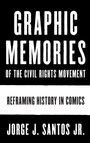
Graphic Memories of the Civil Rights Movement
Reframing History in Comics
1st Edition
Published on 15. May 2019
277 pages
978-1-4773-1829-4 (ISBN)
Description

The history of America's civil rights movement is marked by narratives that we hear retold again and again. This has relegated many key figures and turning points to the margins, but graphic novels and graphic memoirs present an opportunity to push against the consensus and create a more complete history. Graphic Memories of the Civil Rights Movement showcases five vivid examples of this:
Ho Che Anderson's King (2005), which complicates the standard biography of Martin Luther King Jr.; Congressman John Lewis's three-volume memoir, March (2013-2016); Darkroom (2012), by Lila Quintero Weaver, in which the author recalls her Argentinian father's participation in the movement and her childhood as an immigrant in the South; the bestseller The Silence of Our Friends, by Mark Long, Jim Demonakos, and Nate Powell (2012), set in Houston's Third Ward in 1967; and Howard Cruse's Stuck Rubber Baby (1995), whose protagonist is a closeted gay man involved in the movement.
In choosing these five works, Jorge Santos also explores how this medium allows readers to participate in collective memory making, and what the books reveal about the process by which history is (re)told, (re)produced, and (re)narrativized. Concluding the work is Santos's interview with Ho Che Anderson.
Ho Che Anderson's King (2005), which complicates the standard biography of Martin Luther King Jr.; Congressman John Lewis's three-volume memoir, March (2013-2016); Darkroom (2012), by Lila Quintero Weaver, in which the author recalls her Argentinian father's participation in the movement and her childhood as an immigrant in the South; the bestseller The Silence of Our Friends, by Mark Long, Jim Demonakos, and Nate Powell (2012), set in Houston's Third Ward in 1967; and Howard Cruse's Stuck Rubber Baby (1995), whose protagonist is a closeted gay man involved in the movement.
In choosing these five works, Jorge Santos also explores how this medium allows readers to participate in collective memory making, and what the books reveal about the process by which history is (re)told, (re)produced, and (re)narrativized. Concluding the work is Santos's interview with Ho Che Anderson.
Reviews / Votes
"An important and thoughtful work which has far-reaching impacts beyond the world of comics studies...Santos looks at five graphic novels and considers the X-Men series in an effort to look at how collective memory is constructed and the ways that comics can be particularly useful in retelling and re-contextualizing history." (Smash Pages) "[Graphic Memories of the Civil Rights Movement] refashions how the Civil Rights Movement can (and should) be remembered more accurately and completely through graphic novels...This is essential reading for comics teachers and also serves as a historical method 'refresher' for historians." (CHOICE) "Graphic Memories not only brings attention to gaps and problems within the collective memory of the Civil Rights Movement but contributes to the shifting perception of the role of comics in the reevaluation of historical discourse. Santos's reading of the graphic novels is frank and rigorous and does not shy away from providing criticism. His book, which elicits essential questions beyond the field of comics studies, is a timely contribution to answering pressing matters on racial and minority justice in the U.S." (International Journal of Comic Art) "[A] well-researched literary and cultural study...This study should interest literary and historical scholars of civil rights narrative pasts in the United States as well as students of graphic novel forms generally. In particular, Graphic Memories helps explain the evolution of the graphic historical narrative form and the ways such narratives can help advance the popular study of U.S. civil rights generally." (Labour / Le Travail) "A delight to read...In Graphic Memories, Santos offers careful, critical analyses. He builds mountains of evidence for each claim...The pages of the book are full of rich details and thought-provoking insights that bleed off the page and have stayed with me after reading it. Santos shows why we should consider comic books as a site of interaction at which history is co-produced and why we should take history writing in graphic novel form and the analysis of it seriously." (Visual Studies) "Through an expansion of the visual and textual narratives that underpin consensus memories of the civil rights movement, Graphic Memories demonstrates how comics can be fruitful in reenvisioning the history of civil rights in various ways...Graphic Memories is an intensely readable and accessible text, with clear explication of both comics theory and civil rights history alike...Graphic Memories is an important contribution to both comics scholarship and civil rights history." (Inks: The Journal of the Comics Studies Society) "[Santos] is a careful observer with much to say. Particularly notable is his analysis of authorial and artist perspectives, encompassing the views of the comics' protagonists and of the artist's visual techniques...[Graphic Memories of the Civil Rights Movement is] a volume with much intense observation." (Journal of American History)More details
Language
English
Place of publication
Austin, TX
United States
Target group
Professional and scholarly
ISBN-13
978-1-4773-1829-4 (9781477318294)
Copyright in bibliographic data and cover images is held by Nielsen Book Services Limited or by the publishers or by their respective licensors: all rights reserved.
Schweitzer Classification
Other editions
Additional editions
Book
06/2019
University of Texas Press
€101.00
Shipment within 15-20 days
Content
Acknowledgments
Introduction. Graphic Memories in "Black and White"
Chapter 1. The Icon of the Once and Future King
Chapter 2. Bleeding Histories on the March
Chapter 3. On Photo-Graphic Narrative: "To Look-Really Look" into the Darkroom
Chapter 4. The Silence of Our Friends and Memories of Houston's Civil Rights History
Chapter 5. Tropes, Transfer, Trauma: The Lynching Imagery of Stuck Rubber Baby
Epilogue. Cyclops Was Right: X-Lives Matter!
Appendix. A Conversation with Ho Che Anderson, Author-Artist of King
Notes
Works Cited
Index
Introduction. Graphic Memories in "Black and White"
Chapter 1. The Icon of the Once and Future King
Chapter 2. Bleeding Histories on the March
Chapter 3. On Photo-Graphic Narrative: "To Look-Really Look" into the Darkroom
Chapter 4. The Silence of Our Friends and Memories of Houston's Civil Rights History
Chapter 5. Tropes, Transfer, Trauma: The Lynching Imagery of Stuck Rubber Baby
Epilogue. Cyclops Was Right: X-Lives Matter!
Appendix. A Conversation with Ho Che Anderson, Author-Artist of King
Notes
Works Cited
Index
