

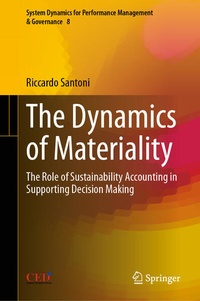
The Dynamics of Materiality
Description

This book presents a System Dynamics based model that rethinks the role of sustainability accounting in business contexts to highlight its role in supporting long-term corporate decision-making. It explores how materiality assessments both shape and are shaped by resource allocation decisions, stakeholder expectations, communication strategies, and financial outcomes, offering an innovative boundary-spanning and systemic perspective. Through a generic and quantitative model, the book captures the feedback-driven nature of materiality and sustainability reporting, overcoming static approaches in favour of dynamic and forward-looking ones. This reveals how misalignment between internal practices and the external role attributed to the report can lead to short-termism, showing the inner causes of greenwashing and stakeholder scepticism.
The book bridges the gap between sustainability reporting theory and practice, supporting firms in integrating materiality into their core strategic processes, while aligning with emerging international standards such as ESRS and IFRS ones. For doing this, the book is grounded in rigorous research methods, yet designed for practical applications for strategy development, performance management, and academic or executive training - for the interest of academics, professionals, students, and, more in general, readers in sustainability accounting and corporate management.
More details
Other editions
Additional editions
Person
Riccardo Santoni is a Research Assistant at the University of Siena, Italy. He obtained his PhD in Business Administration and Management from the joint doctoral program of the Universities of Pisa, Florence, and Siena. His academic work includes publications in both Italian and international journals, as well as numerous conference presentations. His research focuses on the systemic and managerial dimensions of sustainability reporting, with particular attention to the dynamics of materiality and their long-term impact on corporate sustainability performance.
Content
Sustainability reporting history and current challenges.- From materiality to performance - the integration of sustainability reporting in managerial processes.- The "sustainability reporting model".- Revisiting sustainability reporting through system dynamics.
