

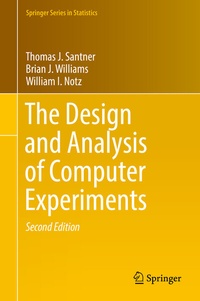
The Design and Analysis of Computer Experiments
Description

This book describes methods for designing and analyzing experiments that are conducted using a computer code, a computer experiment, and, when possible, a physical experiment. Computer experiments continue to increase in popularity as surrogates for and adjuncts to physical experiments. Since the publication of the first edition, there have been many methodological advances and software developments to implement these new methodologies. The computer experiments literature has emphasized the construction of algorithms for various data analysis tasks (design construction, prediction, sensitivity analysis, calibration among others), and the development of web-based repositories of designs for immediate application. While it is written at a level that is accessible to readers with Masters-level training in Statistics, the book is written in sufficient detail to be useful for practitioners and researchers.
New to this revised and expanded edition:
An expanded presentation of basic material on computer experiments and Gaussian processes with additional simulations and examples
A new comparison of plug-in prediction methodologies for real-valued simulator output
An enlarged discussion of space-filling designs including Latin Hypercube designs (LHDs), near-orthogonal designs, and nonrectangular regions
A chapter length description of process-based designs for optimization, to improve good overall fit, quantile estimation, and Pareto optimization
A new chapter describing graphical and numerical sensitivity analysis tools
Substantial new material on calibration-based prediction and inference for calibration parameters
Lists of software that can be used to fit models discussed in the book to aid practitioners
More details
Other editions
Additional editions
Previous edition
Persons
Thomas J. Santner is Professor Emeritus in the Department of Statistics at The Ohio State University. At Ohio State, he has served as department Chair and Director of the Department's Statistical Consulting Service. Previously, he was a professor in the School of Operations Research and Industrial Engineering at Cornell University. His research interests include the design and analysis of experiments, particularly those involving computer simulators, Bayesian inference, and the analysis of discrete response data. He is a Fellow of the American Statistical Association, the Institute of Mathematical Statistics, the American Association for the Advancement of Science, and is an elected ordinary member of the International Statistical Institute. He has held visiting appointments at the National Cancer Institute, the University of Washington, Ludwig Maximilians Universität (Munich, Germany), the National Institute of Statistical Science (NISS), and the Isaac Newton Institute (Cambridge, England).
Brian J. Williams has been Statistician at the Los Alamos National Laboratory RAND Corporation since 2003. His research interests include experimental design, computer experiments, Bayesian inference, spatial statistics and statistical computing. Williams was named a Fellow of the American Statistical Association in 2015 and is also the recipient of the Los Alamos Achievement Award for his leadership role in the Consortium for Advanced Simulation of Light Water Reactors (CASL) Program. He holds a doctorate in statistics from The Ohio State University.
William I. Notz is Professor Emeritus in the Department of Statistics at The Ohio State University. At Ohio State, he has served as acting department chair, associate dean of the College of Mathematical and Physical Sciences, and as director of the department's StatisticalConsulting Service. His research focuses on experimental designs for computer experiments and he is particularly interested in sequential strategies for selecting points at which to run a computer simulator in order to optimize some performance measure related to the objectives of the computer experiment. A Fellow of the American Statistical Association, Notz has also served as Editor of the journals Technometrics and the Journal of Statistics Education.
