

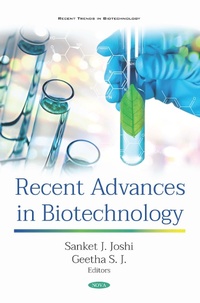
Recent Advances in Biotechnology
Published on 13. August 2019
290 pages
978-1-5361-5861-8 (ISBN)
Description

The biotechnology as we know today is the perfect amalgam of 'Biology' and its applications by utilizing advances in different fields such as engineering, physics, chemistry, and mathematics/information technology. Recent advances and developments in areas such as nanotechnology, molecular biology and OMICS, synthetic-biology, and genetic engineering tools further pave the way to achieve different selective criteria and development of 'tailor-made' microbe-metabolites that can be effectively applied for different applications. The presence of biotechnology has reached beyond academics research in microorganisms, plants and animals to different 'day-to-day' applications in pharmaceuticals, cosmetics, green-nanotechnology, petroleum industry and environmental applications, to list a few. It is worth mentioning the impact of substantial academic and industrial research and developments in last decade on several attributes of different branches of biotechnology, especially in nanotechnology for health and enzyme research, environmental applications, applications of extremophiles, proteomics, uses of toxins, and many more remarkable fields. In the current book, researchers highlighted such emerging technological advances and their applications. The current book was compiled with the help of leading biotechnologists from the Middle East and India, with the objective of providing recent developments in global status and opportunities of biotechnology. This book will prove to be a useful and timely contribution to both academic and industrial researchers from diverse biological background all over the world.
More details
Other editions
Additional editions
Sanket J. Joshi | Geetha S J
Recent Advances in Biotechnology
Book
08/2019
Nova Science Publishers Inc
€303.05
Shipment within 15-20 days
Content
- Intro
- Contents
- Foreword
- Preface
- Chapter 1
- Applications of Metal Nanoparticles to Combat Biofilm Forming ESKAPE Pathogens
- Abstract
- General Overview of Biofilms and ESKAPE Pathogens
- Other Strategies to Combat Biofilms Formed by ESKAPE Pathogens
- Necessity of Metallic Nanomaterials against ESKAPE Pathogens
- Synergistic Activity of Various Metallic Nanoparticles against ESKAPE Pathogens
- Applications of Metal Nanoparticles
- Targeted Drug Delivery
- Wound Healing
- Dental Composites
- Bone Implants and Other Medical Devices
- Conclusion
- Future Prospects
- Acknowledgments
- References
- Chapter 2
- Laccases in Nano-Biotechnology: Recent Trends and Advanced Applications
- Abstract
- Introduction
- Nanobiotechnology
- Nanomaterials
- Nanoimmobilization
- Immobilization of Laccase with Nanoparticles
- Metal NPs
- Metal Oxide NPs
- Organic NPs
- Laccase Immobilization with Carbon Nanomaterials
- Types of Carbon Nanomaterials
- Immobilization of Laccase with Nanogels
- Laccase Hybrid Nanoflowers
- Polydopamine Based Laccase Nanocarriers
- Conclusion
- References
- Chapter 3
- Botox®: Paragon for a Common Person Concerning Cosmetic and Clinical Therapies
- Abstract
- Introduction
- Technique for the Use of Botox®
- Optimal Conditions Responsible for Toxin Production in Clostridium botulinum
- The History of Botulinum Toxin
- History behind Human Botulism Disease
- Diagnosis
- Complication of Brain Hypoxia
- Structure of Botulinum Toxin (BoNT)
- Few Physical and Chemical Characteristics of Botox®
- Preventing Toxicity by Changing the Structure
- Mechanism of Action of Botulinum Toxin
- How Botox® Affects Nervous System?
- Applications of Botulinum Toxin
- Cosmetic Applications of Botox®
- Botox® Application for Preventing Drooling (Clinical Therapy)
- Study Result
- Studies on the Mode of Injection
- Botox® for Gummy Smile
- Case Study
- Results
- Botox® for Treating Migraine Headaches
- Method
- Outcome
- Botox® for Depression
- Method
- Outcome
- Potential Harm and Side-Effects of Botulinum Toxin (Botox®)
- Conclusion and Discussion
- Inference
- Way Forward
- References
- Chapter 4
- Protein Modeling: A Review of Procedures
- Abstract
- Introduction
- National Center for Biotechnology Data
- GenBank
- BLAST: Basic Native Alignment Search Tool
- Entrez
- Gene
- Protein
- PubChem BioAssay Info
- UniProt
- The UniProt Consortium
- The Roots of UniProt Databases
- Protein Sequencing
- Ligand-Receptor Interactions
- Molecular Docking
- Methods Used to Study Binding
- Homology Modeling
- Motive
- Steps in Model Production
- Template Choice and Sequence Alignment
- Model Generation
- Fragment Assembly
- Segment Matching
- Satisfaction of Spatial Restraints
- Loop Modeling
- Model Assessment
- Structural Comparison Strategies
- Benchmarking
- Accuracy
- Sources of Error
- Utility
- GROMACS
- Features
- Applications
- References
- Chapter 5
- Diversity and Importance of Halophiles in Fermented Foods
- Abstract
- Introduction
- Halophilic Microorganisms in the Fish Fermentation Process
- Application of Halophiles in Other Salt Based Fermented Foods
- Quality and Safety of Fermented Foods
- Conclusion
- Future Prospects
- References
- Chapter 6
- Global Status of Biotechnology: Opportunities for GCC
- Abstract
- Introduction
- Biotechnology
- Sub-Sectors of Biotechnology
- Biopharma as Biotech-Investors' View: Where is the Biotech Data?
- MSCI Index for Global Pharmaceuticals, Biotechnology and Life Sciences
- The Top Performers of the Biotech Sector
- Tools to Assess Biotechnology - An Applied Field
- Key Performance Indicators of Biotechnology
- Sectors of Economy and Biotechnology: The Foremost KPI
- Economics and Biotechnology
- Global Industry Classification Standard (GICS) and Biotechnology Status
- Mapping of Biotechnology to the GICS Industries
- OECD and 7 KPIs for Biotechnology: The KBIs
- GCC
- GCC Investment and Market Reports
- GCC Development Strategies and Opportunities for Biotechnology
- Conclusion and Recommendations
- References
- Chapter 7
- Chemistry and Applications of Microemulsion Based Organogel: A Way Forward to Future Sciences
- Abstract
- Introduction
- Microemulsions
- Gel
- Organogel
- Preparation of Organogel
- Common Types of Organogels
- Lecithin Based Organogel
- Limonene GP1/PG Organogel
- Fatty-Acid-Derived Sorbitan Organogels
- In-Situ Forming Organogel of L-Alanine Derivative
- Supramolecular Organogels
- Gelatin Stabilized Microemulsion-Based Organogels
- Microemulsion Based Organogel Preparation
- Applications of Microemulsion Based Organogel
- Drug Delivery
- Enzyme Immobilization
- Vaccine Carrier
- Efficiency Enhancer of Dermo-Cosmetics
- Oil Spill Recovery
- References
- Chapter 8
- Recent Advances in Cellulase Production
- Abstract
- Introduction
- Lignocellulose
- Cellulose
- Cellulase
- Catalytic Mechanisms of Cellulases
- Classification of Cellulase
- Microorganisms Producing Cellulases
- Recent Advances in Cellulase Production
- Production of Cellulase Using Recombinant DNA Technology
- Expression of Cellulase
- References
- Chapter 9
- Methane Recovery From Landfills: Recent Technological Advances
- Abstract
- Introduction
- Landfill Development
- LFG Utilization
- The Advancement in Microbiology of Landfill Technologies: Genomics and Metagenomics Approaches
- Govt. Initiatives and Regulation for Landfill Disposal of MSW - International and National Status
- Advancement in Municipal Solid Waste (MSW) Management and Bioenergy Production Landfill Technologies
- Advancement in LBRs Technologies for LFG
- Advancement in LBRs Process Modeling and Simulation
- Advanced Integrated Automated Control System of LBRs
- Conclusion
- References
- Chapter 10
- The Degradation of Plastic by Microorganisms: A Way for a Bright Future
- Abstract
- Introduction
- Plastic and Its Components
- Classification of Plastic
- Types of Plastics and Their Applications
- Environmental Impacts of Plastic
- Land
- Oceans
- Biodegradation
- History
- What Is a "Biodegradable Plastic"?
- Factors Influencing Plastic Degradation
- Mechanism of Plastic Biodegradation
- Microorganisms Involved in the Degradation of Plastic
- Characterization of Plastic Degradation
- Degradation of Polythene by Bacteria and Fungi
- Degradation of Polythene by Bacillus cereus
- Polyethylene Terepthalate (PET)
- Polyurethane
- Conclusion and Discussion
- Way Forward
- References
- Chapter 11
- Potential of Bacteria for Biological Decolorization and Degradation of Synthetic Dyes
- Abstract
- Introduction
- Dyes
- Classification of Dyes
- Synthetic Dyes: Environmental and Eco-Toxicological Concerns
- Technologies Available for Dye Removal
- Biological Method - An Attractive Alternative to Decolorize/Degrade Dyes
- Bacterial Decolorization and Degradation of Dyes
- Decolorization and Degradation of Synthetic Dyes by Pure Culture of Bacteria
- Decolorization and Degradation of Synthetic Dyes by Mixed Culture/Consortium of Bacteria
- Mechanisms of Color Removal by Bacteria
- Bioaccumulation and Biosorption
- Enzymatic Decolorization
- Anaerobic Decolorization and Degradation of Dyes
- Aerobic Decolorization and Degradation of Dyes
- Anaerobic/Aerobic (Combined) Decolorization and Degradation of Dyes
- References
- About the Editors
- Index
- Blank Page
