

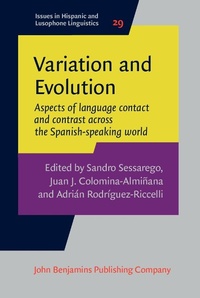
Variation and Evolution
Aspects of language contact and contrast across the Spanish-speaking world
1st Edition
Published on 11. August 2020
285 pages
978-90-272-6089-5 (ISBN)
Description

This book is a collection of original studies analyzing how different internal and external factors affect Spanish language variation and evolution across a number of (socio)linguistic scenarios. Its primary goal is to expand our understanding of how native and non-native varieties of Spanish co-exist with other languages and dialects under the influence of several linguistic and extra-linguistic forces. While some papers analyze the linguistic dynamics affecting Spanish grammars from a cross-dialectal perspective, others focus more closely on the relations established between Spanish and other languages with which it is in contact. In particular, some of these studies show how power and prestige may support (or not) the use of Spanish in different social contexts and educational realities, given that the attitudes toward this language vary greatly across the Spanish-speaking world. On the one hand, in some regions, Spanish represents the variety spoken by the majority of the population, typically related to prestige and power (Spain and Latin America). On the other hand, in other contexts, the same language is conceived as a minority variety, which may or may not be associated with stigmatized immigrant groups (i.e., in the US).
More details
Other editions
Additional editions
Sandro Sessarego | Juan J. Colomina-Alminana | Adrian Rodriguez-Riccelli
Variation and Evolution
Aspects of language contact and contrast across the Spanish-speaking world
Book
08/2020
John Benjamins Publishing Co
€112.35
Shipment within 10-15 days
Content
- Intro
- Variation and Evolution
- Editorial page
- Title page
- Copyright page
- Dedication page
- Table of contents
- Social and linguistic factors shaping language dynamics across the Spanish-speaking world
- References
- Part I. Morpho-syntax & semantics
- Chapter 1. Cross-dialectal productivity of the Spanish subjunctive in nominal clause complements
- 1. Introduction
- 2. Previous literature
- 2.1 The Spanish subjunctive
- 2.2 Morphological productivity
- 3. Research questions and hypotheses
- 4. Methods
- 5. Results
- 6. Discussion and conclusions
- References
- Appendix
- Chapter 2. Mood selection in a contact variety: The case of Yucatec Spanish
- 1. Introduction
- 2. Previous semantic accounts of mood in Spanish
- 2.1 Mood selection in contact varieties
- 2.2 Yucatec Spanish
- 2.3 Yucatec Maya and the subjunctive
- 3. Methodology
- 3.1 Data collection
- 3.2 Forced choice task
- 3.3 Task design
- 3.4 Participants
- 3.5 Data analysis
- 4. Results
- 4.1 Volitional predicates
- 4.2 Emotive predicates
- 4.3 Epistemic predicates
- 5. Discussion
- 6. Conclusion
- References
- Chapter 3. A corpus analysis of the structural elaboration of Spanish heritage language learners
- 1. Introduction
- 2. Literature review
- 2.1 Core and peripheral grammatical knowledge of advanced heritage language learners
- 2.2 On the need to expand our understanding of the cognition of HLL performance
- 2.3 Expanding the pool of HLL data
- 3. Research questions
- 3.1 Method
- 3.2 General assessment of HLLs' proficiency
- 3.3 Tagging and parsing
- 3.4 Analysis
- 4. Results
- 5. Discussion and conclusions
- References
- Chapter 4. Evidentiality and epistemic modality in the Andean Spanish verb
- 1. Introduction
- 2. Evidentiality, epistemic modality, and their complex relationship
- 3. Evidentiality and epistemic modality in the Andean Spanish verb
- 3.1 Pluperfect
- 3.2 Present perfect
- 3.3 Future forms
- 3.4 Subjunctive present correlated with verbs in past tense
- 4. Conclusions and further research
- References
- Part II. Phonetics & phonology
- Chapter 5. Realizations of /b/ in the Spanish of Lima, Peru
- 1. Introduction
- 2. Literature review
- 2.1 Orthography and phonetics of /b/
- 2.2 Modern day use of [v]
- 3. Methodology
- 3.1 Participants
- 3.2 Procedure
- 3.3 Materials
- 4. Analysis
- 5. Results
- 6. Discussion and conclusions
- References
- Appendix A. Experiment word list
- Appendix B. Samples of experimental screen
- Appendix C. Multinomial log-linear regression outputs
- Chapter 6. Did you say peso or beso?: The perception of prevoicing by L2 Spanish learners
- 1. Introduction
- 2. Literature review
- 2.1 Perceptual acquisition in the language classroom
- 2.2 The acoustic space of monolingual Spanish and English speakers
- 2.3 Acoustic and acquisitional tendencies of bilinguals
- 2.4 Theoretical models of L2 perception
- 2.5 Research questions
- 3. Methodology
- 3.1 Participants
- 3.2 Production and manipulation of stimuli
- 3.3 Instrument design
- 3.4 Data analysis
- 4. Results
- 4.1 Qualitative description of Spanish stops
- 5. Discussion
- 5.1 RQ1: To what extent do L1 English speakers follow native-like perception norms when identifying Spanish stops, and how does this reflect the two types of perceptual classifications described by PAM L2 or SLM?
- 5.2 RQ2: What social and linguistic constraints govern listeners' perceptions of stop constraints, and how important was VOT specifically to their classification?
- 6. Conclusion
- References
- Appendix 1. Consent and demographic survey questions
- Appendix 2. Mixed-effects logistic regression results of factors
- Chapter 7. Sheísmo in Montevideo Spanish: Not (yet) identical to Buenos Aires
- 1. Rioplatense Spanish
- 2. Zheísmo and sheísmo in Rioplatense Spanish
- 3. Methodology
- 3.1 Participants
- 3.2 Analysis
- 4. Results
- 4.1 Variants of /?/
- 4.2 Analysis of voicing
- 4.3 Completion of the change in Montevideo and comparisons with BA
- 5. Discussion
- 6. Conclusions
- Acknowledgements
- Funding
- References
- Part III. Language attitudes & choice
- Chapter 8. 'Debemos aprender y manejar un poco mejor el español': An approach to the linguistic attitudes of the Afro-Peruvian people in the district of El Carmen (Chincha)
- 1. Introduction
- 2. Theoretical approach
- 3. Previous studies
- 4. Methodology
- 4.1 Participants
- 4.2 Instruments
- 5. Results
- 5.1 What do you understand by speaking Spanish correctly?
- 5.2 In which areas of Peru do people speak Spanish incorrectly?
- 5.3 In which areas of Peru do people speak the worst Spanish?
- 5.4 In which areas of Peru do you like how Spanish is spoken?
- 5.5 What is your opinion on the manner of speaking in El Carmen district?
- 5.6 Do you feel identified with the way of speaking Spanish in El Carmen?
- 5.7 Do you think that in El Carmen district people speak Spanish correctly?
- 5.8 If you could change your way of speaking, what accent would you like to have?
- 6. Analysis
- 7. Conclusions
- 8. Further research
- Acknowledgements
- References
- Appendix. Sociolinguistic questionnaire
- Chapter 9. Language choice and use by bilingual preschoolers: Evidence from a Spanish immersion preschool context
- 1. Introduction
- 2. The setting and participants
- 3. Research questions
- 4. Methods
- 5. Results and discussion
- 5.1 Language choice
- 5.2 Factors that affect language choice
- 6. Implications and future avenues
- References
- Chapter 10. Decolonial sociolinguistics gestures of Andean Quechua-Spanish bilingual college students promoting Quechua
- 1. Introduction
- 1.1 Policy versus practice
- 1.2 Researcher's positionality
- 1.3 Conceptual framework
- 2. Methodology
- 2.1 Choice of methodology
- 2.2 Community-based participatory research and design overview
- 2.3 Photovoice participants
- 2.4 Data analysis
- 3. Findings
- 4. Discussion and conclusions
- References
- Chapter 11. New Mochica and the challenge of reviving an extinct language
- 1. Introduction
- 2. New Mochica and language revival
- 3. Characteristics of New Mochica
- 4. Discussion and conclusions
- References
- Appendix 1. Phonological interpretations of Colonial Mochica (Eloranta, 2019b)
- Index
