

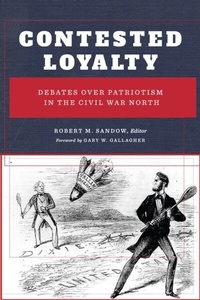
Contested Loyalty
Debates Over Patriotism in the Civil War North
Published on 5. June 2018
360 pages
978-0-8232-7977-7 (ISBN)
Description

Embroiled in the Civil War, northerners wrote and spoke with frequency about the subject of loyalty. The word was common in newspaper articles, political pamphlets, and speeches, appeared on flags, broadsides, and prints, was written into diaries and letters and the stationary they appeared on, and even found its way into sermons. Its ubiquity suggests that loyalty was an important concept...but what did it mean to those who used it? Contested Loyalty examines the significance of loyalty across fault lines of gender, social class, and education, race and ethnicity, and political or religious affiliation. These differing vantage points reveal the complicated ways in which loyalties were defined, prioritized, acted upon, and related.
While most of the scholarly work on Civil War Era nationalism has focused on southern identity and Confederate nationhood, the essays in Contested Loyalty examine the variable, fluid constructions of these concepts in the north. Essays explore the limitations and incomplete nature of national loyalty and how disparate groups struggled to control its meaning. The authors move beyond the narrow partisan debate over Democratic dissent to examine other challenges to and competing interpretations of national loyalty.
Today's leading and emerging scholars examine loyalty through: the frame of politics at the state and national level; the viewpoints of college educated men as well as the women they courted; the attitudes of northern Protestant churches on issues of patriotism and loyalty; working class men and women in military industries; how employers could use the language of loyalty to take away the rights of workers; and the meaning of loyalty in contexts of race and ethnicity.
The Union cause was a powerful ideology committing millions of citizens, in the ranks and at home, to a long and bloody war. But loyalty to the Union cause imperfectly explains how citizens reacted to the traumas of war or the ways in which conflicting loyalties played out in everyday life. The essays in this collection point us down the path of greater understanding.
While most of the scholarly work on Civil War Era nationalism has focused on southern identity and Confederate nationhood, the essays in Contested Loyalty examine the variable, fluid constructions of these concepts in the north. Essays explore the limitations and incomplete nature of national loyalty and how disparate groups struggled to control its meaning. The authors move beyond the narrow partisan debate over Democratic dissent to examine other challenges to and competing interpretations of national loyalty.
Today's leading and emerging scholars examine loyalty through: the frame of politics at the state and national level; the viewpoints of college educated men as well as the women they courted; the attitudes of northern Protestant churches on issues of patriotism and loyalty; working class men and women in military industries; how employers could use the language of loyalty to take away the rights of workers; and the meaning of loyalty in contexts of race and ethnicity.
The Union cause was a powerful ideology committing millions of citizens, in the ranks and at home, to a long and bloody war. But loyalty to the Union cause imperfectly explains how citizens reacted to the traumas of war or the ways in which conflicting loyalties played out in everyday life. The essays in this collection point us down the path of greater understanding.
More details
Series
Edition
New edition
Language
English
Place of publication
NY
United States
Target group
Professional and scholarly
Edition type
New edition
Illustrations
2, 2 s/w Abbildungen
2
File size
2,92 MB
ISBN-13
978-0-8232-7977-7 (9780823279777)
Copyright in bibliographic data and cover images is held by Nielsen Book Services Limited or by the publishers or by their respective licensors: all rights reserved.
Schweitzer Classification
Other editions
Additional editions
Book
06/2018
Fordham University Press
€74.50
Shipment within 10-20 days
Persons
Robert M. Sandow (Edited By)
Robert M. Sandow is an associate professor of history at Lock Haven University of Pennsylvania. He is the author of Deserter Country: Civil War Opposition in the Pennsylvania Appalachians (Fordham University Press, 2009) and has presented numerous articles and conference papers. His recent work addresses issues of political dissent and rural protest on the northern home front.
Robert M. Sandow is an associate professor of history at Lock Haven University of Pennsylvania. He is the author of Deserter Country: Civil War Opposition in the Pennsylvania Appalachians (Fordham University Press, 2009) and has presented numerous articles and conference papers. His recent work addresses issues of political dissent and rural protest on the northern home front.
Content
Foreword by Gary W. Gallagher
Introduction
Robert M. Sandow
1. "Dedicated to the Proposition": Principle, Consequence, and Duty to the Egalitarian Nation, 1848-1865
Melinda Lawson
2. Connecticut Copperhead Constitutionalism: A Study of Peace Democratic Political Ideology during the Civil War
Matthew Warshauer
3. "I Do Not Understand What the Term 'Loyalty' Means": The Debate in Pennsylvania over Compensating Victims of Rebel Raids
Jonathan W. White
4. "We Are Setting the Terms Now": Loyalty Rhetoric in Courtship
Julie A. Mujic
5. Loyal to the Union: College-Educated Soldiers, Military Leadership, Politics, and the Question of Loyalty
Kanisorn Wongsrichanalai
6. "Patriotism Will Save Neither You Nor Me": William S. Plumer's Defense of an Apolitical Pulpit
Sean A. Scott
7. "American Matrons and Daughters": Sewing Women and Loyalty in Civil War Philadelphia
Judith Giesberg
8. "A Source of Mortification to All Truly Loyal Men": Allegheny Arsenal's Disloyal Worker Purge of 1863
Timothy J. Orr
9. "All of That Class That Infest N.Y.": Perspectives on Irish American Loyalty and Patriotism in the Wake of the New York City Draft Riots
Ryan W. Keating
10. "Deeds of Our Own": Loyalty, Soldier Rights, and Protest in Northern Regiments of the United States Colored Troops
Thaddeus Romansky
List of Contributors
Index
Introduction
Robert M. Sandow
1. "Dedicated to the Proposition": Principle, Consequence, and Duty to the Egalitarian Nation, 1848-1865
Melinda Lawson
2. Connecticut Copperhead Constitutionalism: A Study of Peace Democratic Political Ideology during the Civil War
Matthew Warshauer
3. "I Do Not Understand What the Term 'Loyalty' Means": The Debate in Pennsylvania over Compensating Victims of Rebel Raids
Jonathan W. White
4. "We Are Setting the Terms Now": Loyalty Rhetoric in Courtship
Julie A. Mujic
5. Loyal to the Union: College-Educated Soldiers, Military Leadership, Politics, and the Question of Loyalty
Kanisorn Wongsrichanalai
6. "Patriotism Will Save Neither You Nor Me": William S. Plumer's Defense of an Apolitical Pulpit
Sean A. Scott
7. "American Matrons and Daughters": Sewing Women and Loyalty in Civil War Philadelphia
Judith Giesberg
8. "A Source of Mortification to All Truly Loyal Men": Allegheny Arsenal's Disloyal Worker Purge of 1863
Timothy J. Orr
9. "All of That Class That Infest N.Y.": Perspectives on Irish American Loyalty and Patriotism in the Wake of the New York City Draft Riots
Ryan W. Keating
10. "Deeds of Our Own": Loyalty, Soldier Rights, and Protest in Northern Regiments of the United States Colored Troops
Thaddeus Romansky
List of Contributors
Index
