

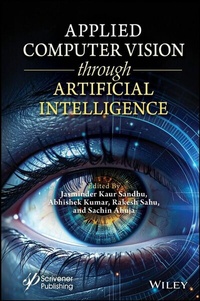
Applied Computer Vision through Artificial Intelligence
Description

Master the cutting-edge field of computer vision and artificial intelligence with this accessible guide to the applications of machine learning and deep learning for real-world solutions in robotics, healthcare, and autonomous systems.
Applied Computer Vision through Artificial Intelligence provides a thorough and accessible exploration of how machine learning and deep learning are driving breakthroughs in computer vision. This book brings together contributions from leading experts to present state-of-the-art techniques, tools, and frameworks, while demonstrating this technology's applications in healthcare, autonomous systems, surveillance, robotics, and other real-world domains. By blending theory with hands-on insights, this volume equips readers with the knowledge needed to understand, design, and implement AI-powered vision solutions.
Structured to serve both academic and professional audiences, the book not only covers cutting-edge algorithms and methodologies but also addresses pressing challenges, ethical considerations, and future research directions. It serves as a comprehensive reference for researchers, engineers, practitioners, and graduate students, making it an indispensable resource for anyone looking to apply artificial intelligence to solve complex computer vision problems in today's data-driven world.
More details
Other editions
Additional editions
Persons
Jasminder Kaur Sandhu, PhD is a professor and the Head of the Department of Machine Learning and Data Science at IILM University. With over 13 years of academic and research experience, she has published more than 70 research papers in reputed international journals. Her research interests include machine learning, ensemble modelling, artificial intelligence, wireless sensor networks, and soft computing.
Abhishek Kumar, PhD is a professor and the Assistant Director of the Computer Science and Engineering Department at Chandigarh University, Punjab with over 13 years of teaching experience. He is an award-winning researcher that has published more than 170 peer-reviewed papers in international journals of repute. His research interests span artificial intelligence, renewable energy systems, image processing, and data mining.
Rakesh Sahu, PhD is a dedicated academician and researcher with over a decade of experience. He has made significant contributions as a post-doctoral scholar at IIT Bombay and as a faculty member at esteemed institutions, where his work focuses on Himalayan glacier dynamics. His research interests include glacier mapping, modelling, and climate change.
Sachin Ahuja, PhD has an illustrious academic and research career, marked by numerous impactful contributions. An accomplished editor, he has contributed to numerous books and served as a guest editor for special issues in reputed international journals. His research focuses on artificial intelligence, machine learning, and data mining.
Content
Preface xxi
1 An Overview of Medical Diagnostics through Artificial Intelligence-Powered Histopathological Imaging and Video Analysis 1
Atul Rathore, Praveen Lalwani, Pooja Lalwani and Rabia Musheer
1.1 Introduction 2
1.2 Background 11
1.3 Preliminaries 14
1.4 Experimental Results 24
1.5 Conclusion 30
2 Generative Adversarial Networks: Theory and Application in Synthesis 39
Manoj Kumar Pandey, Priyanka Gupta, Triveni Lal Pal and Ayush Kumar Agrawal
2.1 Introduction 40
2.2 Ideologies of GAN 45
2.3 Architecture of GAN 47
2.4 Applications of GAN 49
2.5 Conclusion 55
3 From Pixels to Predictions: Deep Learning for Glaucoma Detection 59
Tushar Verma, Sachin Ahuja and Jasminder Kaur Sandhu
3.1 Introduction 60
3.2 Literature Review 67
3.3 Problem Statement 74
3.4 Hybrid Approach for Glaucoma Detection 75
3.5 Result and Discussion 78
3.6 Conclusion 84
3.7 Future Scope 84
4 Advancements in Computer Vision for Object Detection and Recognition using DenseNet Deep Learning Model 89
N. Deepa, Padmapriya L., Priyadarshini V. and Shree Harini S.
4.1 Introduction 89
4.2 Literature Survey 90
4.3 Proposed System 91
4.4 Results and Discussion 93
4.5 Conclusion 96
5 Deep Learning-Based Detection of Cyber Extortion 99
Mohana Preya R., Ramya M. and A. Abdhur Rahman
5.1 Introduction 100
5.2 Related Works 101
5.3 Existing System 105
5.4 Proposed System 106
5.5 System Architecture 107
5.6 Methodology 107
5.7 Results and Discussion 112
5.8 Conclusion 114
5.9 Future Work 114
6 GANs Unleashed: From Theory to Synthetic Realities 117
Rakhi Chauhan, Priya Batta and Km Meenakshi
6.1 Introduction 117
6.2 Related Works 122
6.3 Limitations that are Enforced by GAN 129
6.4 Conclusion 130
7 RFID and Computer Vision-Enhanced Automotive Authentication Verification System 133
V. Vidya Lakshmi, Sowmya M. B., Archanaa R., Shreenidhi G. and Naveena R.
7.1 Introduction 134
7.2 Literature Survey 136
7.3 Proposed System 137
7.4 Working 139
7.5 Block Diagram 141
7.6 Hardware Components 142
7.7 Result 151
7.8 Conclusion 153
8 Synergizing Ensemble Learning Techniques for Robust Emotion Detection using EEG Signals 157
Pulkit Dwivedi, Jasminder Kaur Sandhu and Rakesh Sahu
8.1 Introduction 158
8.2 Ensemble Learning Techniques 160
8.3 Methodology 176
8.4 Experimental Results 178
8.5 Discussion 183
8.6 Conclusion 185
9 Understanding the Unseen: Explainability in Deep Learning for Computer Vision 187
Apoorva Jain, Jasminder Kaur Sandhu and Pulkit Dwivedi
9.1 Introduction 188
9.2 The Need for Interpretation in Computer Vision 190
9.3 Understanding Interpretability in Deep Learning 192
9.4 Visualization Techniques 195
9.5 Maps of the Headland 200
9.6 Model Simplification 203
9.7 Meaning of Function 204
9.8 Feature Importance 206
9.9 Methods Based on Prototypes 208
9.10 Challenges and Future Directions 208
9.11 Conclusion 210
9.12 Future Vision 211
10 Prefatory Study on Landslide Susceptibility Modeling Based on Binary Random Forest Classifier 213
Arpitha G. A. and Choodarathnakara A. L.
10.1 Introduction 214
10.2 Materials and Methodology 215
10.3 Result Analysis 221
10.4 Conclusion 224
11 Improving Digital Interactions using Augmented Reality and Computer Vision 229
Priya Batta and Rakhi Chauhan
11.1 Introduction 229
11.2 Literature Survey 234
11.3 Methodology 237
11.4 Results 239
11.5 Conclusion and Future Scope 240
12 The Evolutionary Dynamics of Machine Learning and Deep Learning Architectures in Computer Vision 243
Palvadi Srinivas Kumar
12.1 Introduction to Computer Vision and Its Evolution 244
12.2 Foundations of Machine Learning in Computer Vision 245
12.3 Rise of Deep Learning in Computer Vision 246
12.4 Key Architectures and Techniques in Deep Learning for Computer Vision 248
12.5 CNN Architectures 249
12.6 Transfer Learning and Fine-Tuning 249
12.7 Object Detection, Image Segmentation, and Image Classification 250
12.8 Evolution of Image Processing Models 251
12.9 Challenges and Future Directions 256
12.10 Applications and Impacts 261
12.11 Conclusion 265
13 Real-World Applications: Transforming Industries with Computer Vision 269
Seema B. Rathod, Pallavi H. Dhole and Sivaram Ponnusamy
13.1 Introduction 270
13.2 Healthcare 273
13.3 Manufacturing 277
13.4 Retail 281
13.5 Automotive 286
13.6 Agriculture 289
13.7 Security and Surveillance 292
13.8 Challenges and Future Directions 295
13.9 Future Trends 296
13.10 Conclusion 296
14 Revolutionizing Vision Perception with Multimodal Fusion Technologies 299
Priya Batta, Rakhi Chauhan and Gagandeep Kaur
14.1 Introduction 300
14.2 Literature Survey 302
14.3 Methodology 304
14.4 Results and Discussions 306
14.5 Conclusion and Future Scope 308
15 Object Detection and Localization: Identifying and Pinpointing With Precision 311
Seema B. Rathod, Pallavi H. Dhole and Sivaram Ponnusamy
15.1 Introduction 312
15.2 Background and Literature Review 315
15.3 Methodologies and Techniques 316
15.4 Evaluation Metrics and Benchmarks 320
15.5 Applications and Case Studies 323
15.6 Challenges and Future Directions 326
15.7 Conclusion 328
16 Uncertainty Estimation in Deep Learning Based Computer Vision 331
Palvadi Srinivas Kumar
16.1 Introduction 332
16.2 Basics of Uncertainty 333
16.3 Uncertainty Estimation Techniques 334
16.4 Uncertainty in Object Detection 337
16.5 Challenges and Considerations in Detecting Objects with Uncertain Predictions 338
16.6 Case Studies and Practical Examples 338
16.7 Uncertainty in Semantic Segmentation 339
16.8 Pixel-Wise Uncertainty Estimation Techniques 340
16.9 Incorporating Uncertainty Into Segmentation Models for Improved Performance 340
16.10 Practical Implications and Case Studies 340
16.11 Uncertainty in Image Classification 341
16.12 Applications and Case Studies 341
16.13 Evaluating Uncertainty Estimates 342
16.14 Future Directions and Challenges 342
16.15 Conclusion 346
17 Overcoming Occlusions in Visual Data using Long Short-Term Memory Networks (LSTMs) 349
Sivaram Ponnusamy, K. Swaminathan, Nandha Gopal S. M., Ambika Jaiswal and Suhashini Chaurasia
17.1 Introduction 350
17.2 Literature Survey 352
17.3 Proposed System 353
17.4 Results and Discussion 357
17.5 Conclusion 360
18 Transformative Role of Machine Learning and Deep Learning Architecture in Computer Vision 363
Neetu Amlani, Swapnil Deshpande, Suhashini Chaurasia, Ambika Jaiswal and Sivaram Ponnusamy
18.1 Introduction 364
18.2 Literature Review 365
18.3 Methodology 368
18.4 Conclusion 374
19 A Comprehensive Analysis of Deep Learning and Machine Learning for Semantic Segmentation, and Object Detection in Machine and Robotic Vision 377
Pragati V. Thawani, Prafulla E. Ajmre, Suhashini Chaurasia and Sivaram Ponnusamy
19.1 Introduction 378
19.2 Machine Learning/Deep Learning Algorithms 378
19.3 Object Detection, Semantic Segmentation, and Human Action Recognition Methods 382
19.4 Human and Computer Vision Systems 386
19.5 Case Studies 388
19.6 Challenges 389
19.7 Conclusion 389
20 From Theoretical Foundations to Data Synthesis: Advanced Applications of Generative Adversarial Networks (GANs) 393
Pulkit Dwivedi, Jasminder Kaur Sandhu and Apoorva Jain
20.1 Introduction 393
20.2 Theoretical Foundations of Gans 395
20.3 Applications of GANs in Synthesis 399
20.4 Case Studies and Practical Implementations 403
20.5 Implementation of GANs for Synthetic Image Generation 404
20.6 Transfer Learning in GANs 409
20.7 Advanced Training Techniques for GANs 413
20.8 Security Implications of GANs 418
20.9 GANs for Sustainable AI Development 423
20.10 Challenges and Future Directions 42720.11 Conclusion 430
21 Optimization Techniques in Training Deep Neural Networks for Vision 433
Shantanu Bindewari, Sumit Singh Dhanda and Anand Singh
21.1 Introduction to Deep Neural Networks for Vision 434
21.2 Fundamentals of Optimization in Neural Networks 436
21.3 Advanced Gradient-Based Optimization Techniques 438
21.4 Regularization Techniques for Vision Models 443
21.5 Learning Rate Schedules and Optimizers for Efficient Training 447
21.6 Techniques for Handling Vanishing and Exploding Gradients 448
21.7 Model Compression and Optimization for Inference 450
21.8 Transfer Learning and Fine-Tuning Techniques 451
21.9 Hyperparameter Tuning and Optimization Techniques 452
21.10 Case Studies and Applications 453
Architectures 454
References 455
About the Editors 459
Index 461
1
An Overview of Medical Diagnostics through Artificial Intelligence-Powered Histopathological Imaging and Video Analysis
Atul Rathore1*, Praveen Lalwani1, Pooja Lalwani1 and Rabia Musheer2
1School of Computing Science and Engineering, VIT University, Bhopal, M.P., India
2School of Advance Science and Language, VIT University, Bhopal, M.P., India
Abstract
Histopathological imaging has a substantial impact on the diagnosis and prognosis of many illnesses, including cancer, infectious infections, and autoimmune disorders. The introduction of artificial intelligence (AI) techniques to histological analysis, such as mammography, endoscopy, ultrasound, and MRI, has recently transformed medical diagnostics. The intent of this research is to give the lector with a thorough accepting of the present state of video analysis also AI-assisted histopathological imaging in the context of medical diagnosis. This article demonstrates how deep learning and machine learning algorithms can be used to automate data analysis and activities like segmentation, detection, and classification. The importance of interpretability in medical applications, as well as the usage of artificial intelligence (AI) in medical picture analysis, are also discussed. To obtain the best results, it will be necessary to give clinical decision support, disease diagnostics, and customized treatment strategies. The researchers thoroughly reviewed previous studies on the use of AI-contributed histopathology imaging for the diagnosis and treatment of medical illnesses. Furthermore, we advocate for increased multidisciplinary collaboration and research in this area.
Keywords: Medical diagnostics, artificial intelligence, medical image analysis, classification, machine learning, disease diagnostics, metaheuristics algorithm, deep learning
1.1 Introduction
In order to provide patients with the best medical and nursing care possible, the field of healthcare has to prioritize efficiently and sustainability. It is estimated that artificial intelligence (AI) will have a significant influence on healthcare in numerous of diverse areas, like drug development, personalized treatment plans, diagnostic support, preventive medicine, and extending healthy lifespans. Among the healthcare sectors where AI and ML are anticipated to be quickly implemented are drug discovery, genomic medical procedures, diagnosis and treatment support, and imaging diagnostic support (medical image analysis). Medical field is a vast and complicated commercial industry, making it an attractive target for the world's premier information technology (IT) firms [1]. In 2018, Over 11 billion US dollars were invested in digital healthcare startups by US investors, a 16% rise from the year before.
Managing large amounts of data, such as patient records, exam results, and medical imaging, has always been necessary for doctors practicing clinical medicine [2]. Artificial intelligence (AI) is increasingly invading the medical domain, having a substantial influence on medical managerial, disease diagnostics, and automation [3]. The ability of AI to analyze massive datasets from various sources can greatly advance research in the pharmaceutical and healthcare industries [4]. Recent research evaluates whether AI is being used in many industries, most notably healthcare. The healthcare industry is implementing technologies like robotic process automation, natural language processing (NLP), physical robots, and machine learning (ML) [5]. In machine learning, different features are analyzed using neural network models and deep learning techniques to identify clinically significant elements early on, particularly in cancer diagnosis [6, 7]. To analyze and interpret human communication, NLP applies computer methodologies. Recently, natural language processing (NLP) is increasingly using machine learning techniques to analyze unstructured data from databases, like lab reports and doctor's notes. lab reports, and so forth by outlining important information from diverse visual and textual data, which supports the decision-making process for diagnosis and possible treatments [8]. Patient access to timely and accurate diagnosis as well as individualized treatment options is being made possible by ongoing disruptive innovation [9]. AI-powered solutions are recognized, including systems that can use a wide range of data sources, such as symptoms reported by patients, biometrics, imaging, biomarkers, and so on. With advancements in artificial intelligence, it is now possible to predict impending illness, increasing the likelihood of prevention due to early identification. Corporal robots are being employed in a range of healthcare settings, including nursing, telemedicine, cleaning, imaging, surgery, and rehabilitation [10, 11]. Medical picture elucidation has always been accomplished by human medical practitioners in ordinary clinical practices; nevertheless, it has begun to profit from computer-assisted therapies due to the vast amount of data produced by various clinical exams. Big data and artificial intelligence (AI) technologies have improved and been applied quickly, which has resulted in the widespread use of data-driven methods that enable precise, real-time predictions of a variety of diseases [12]. Healthcare is transforming right before our eyes as a result of breakthroughs in computational medical technologies, such as artificial intelligence (AI), 3D printing, robots, nanotechnology, and others. Among the several advantages of digitizing healthcare are the numerous opportunities it offers to decrease human error, enhance treatment outcomes, and collect data over time. AI approaches ranging from machine learning to deep learning are critical in a number of health-related areas, including the development of new healthcare systems, patient information and records, and the treatment of various ailments [13]. AI techniques are also the most successful at recognizing and diagnosing a wide range of illnesses. The application of artificial intelligence (AI) as a technique for improving medical services offers unprecedented opportunities to improve patient and clinical group outcomes, reduce costs, and so on. The models used are not limited to computerization; for example, patients can be given "family" [14, 15]. Recent decades have seen a major increase in the amount of research focused on machine learning (ML), which is used in numerous areas, such as text mining, multimedia concept retrieval, spam detection, video recommendations, and image classification [16-19]. Additionally, the deficiency of radiologists can make it difficult and time-consuming to analyze medical images. One possible remedy for this problem is artificial intelligence (AI). A subset of artificial intelligence called machine learning (ML) uses data to learn from and make predictions or decisions based on past knowledge without the need for explicit programming. ML makes use of three types of learning methods: supervised learning, unsupervised learning, and semi-supervised learning. ML techniques include feature extraction, and picking appropriate attributes for a certain problem needs the expertise of a domain expert. To overcome the challenge of feature selection, deep learning (DL) algorithms are applied. DL is a subclass of ML that can extract essential characteristics automatically from raw input data [18].
1.1.1 A Focus on Digital Image and Video Analysis
Several terminologies have been used to identify, prevent, and treat various disorders [20-27]. These technologies include digital image analysis and video analysis, which can be utilized to identify various medical disorders. Histopathological images and films, which are microscopic photographs of breast tissue and cardiographs, considerably improve diagnosis and treatment of diseases such as cancer, heart attacks, and others. Furthermore, techniques like biopsy, ultrasound imaging, mammography, echocardiography, endoscopy, and ultrasonography produce these types of movies and images for identifying illnesses including polyps in bodily organs and cardiomyopathy. There are several types of videos used for analysis and instruction, including surgery and training videos [23-27].
Below are the various techniques employed in imaging and videos modalities (Figure 1.1):
Figure 1.1 Various medical diseases diagnoses techniques.
Mammography: A mammogram is a radiographic picture of the breast and other body organs made by x-rays. Its major goal is to help doctors discover early signs of cancer and heart diseases. Regular mammograms are the most effective early detection method for cancer and other diseases, typically finding abnormalities up to three years before they become palpable or apparent through other means.
Thermography: A non-invasive technology called thermography uses an infrared camera to detect heat radiating from specific regions of the body. Through digital infrared thermal imaging, it aids in the diagnosis of cancer and other diseases. By capturing and analyzing temperature trends, this method of detecting illnesses has been shown to be both exact and cost-effective, providing vital data for early diagnosis and screening.
Ultrasound: Ultrasound is a low-cost technique that is commonly used to diagnose the reasons of discomfort, edema, and inflammation in many bodily locations such as the kidney, gallbladder, and liver. It examines numerous organs...
