

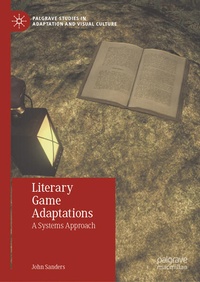
Literary Game Adaptations
Description

What would a theory of adaptation look like if it was constructed around literary games rather than novels on film? Bridging disciplinary gaps between adaptation studies, game scholarship, and literary theory, this book presents a framework for understanding adaptations as dynamic systems of experience whose meaning arises from the playful interactions between their formal and intertextual components. Such an approach not only reframes the disciplinary ghosts that haunt each field - the intractable concept of "fidelity criticism" in adaptation studies and games studies' perennial "ludology/narratology debate" - but also provides new tools with which to examine the under-theorized phenomenon of games based on literary works. Whether it is a Shakespearian choose-your-own-adventure book, a text-adventure version of The Hobbit, a Jane Austen roleplaying game, or an immersive first-person simulation of Thoreau's Walden , literary game adaptations are uniquely suited to teach us how to play with texts and culture in our hypermediated digital world.
More details
Other editions
Additional editions
Person
John Sanders is an Assistant Professor of English at Appalachian State University, where he researches and teaches classes on literature, film, games, and adaptation. He happily resides in the mountains of North Carolina with his partner and their two dogs: Henry and Mr. Darcy.
Content
Chapter 1: Introduction.- Chapter 2: To Be (Or Not to Be) A Game Adaptation: Intertexts,Systems, and Disciplinary Ghosts.- Chapter 3: A Game of Riddles: Knowledge, Experience, and Fidelity in The Hobbit.- Chapter 4: Abstracting Austen: Playing with the Possible in Good Society.- Chapter 5: A Real Walk in the Virtual Woods: Walden, Immersion, Players, and Play.
