

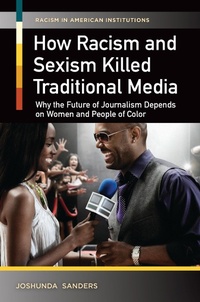
How Racism and Sexism Killed Traditional Media
Why the Future of Journalism Depends on Women and People of Color
1st Edition
Published on 11. August 2015
216 pages
978-1-4408-3082-2 (ISBN)
Description

An evaluative examination that challenges the media to rise above the systematic racism and sexism that persists across all channels, despite efforts to integrate.
The Internet and social networks have opened up new avenues of communication for women and people of color, but the mainstream news is still not adequately including minority communities in the conversation. Part of the Racism in America series, How Racism and Sexism Killed the Traditional Media: Why the Future of Journalism Depends on Women and People of Color reveals the lack of diversity that persists in the communication industry. Uncovering and analyzing the racial bias in the media and in many newsrooms, this book reveals the lesser-known side of the media-newsrooms and outlets that are often fraught with underlying racist and sexist tension.
Written by a veteran journalist of color, this title brings an insider's perspective combined with interviews from industry experts. The book analyzes the traditional media's efforts to integrate both women and people of color into legacy newsrooms, highlighting their defeats and minor successes. The author examines the future of women and people of color in the mainstream media.
The Internet and social networks have opened up new avenues of communication for women and people of color, but the mainstream news is still not adequately including minority communities in the conversation. Part of the Racism in America series, How Racism and Sexism Killed the Traditional Media: Why the Future of Journalism Depends on Women and People of Color reveals the lack of diversity that persists in the communication industry. Uncovering and analyzing the racial bias in the media and in many newsrooms, this book reveals the lesser-known side of the media-newsrooms and outlets that are often fraught with underlying racist and sexist tension.
Written by a veteran journalist of color, this title brings an insider's perspective combined with interviews from industry experts. The book analyzes the traditional media's efforts to integrate both women and people of color into legacy newsrooms, highlighting their defeats and minor successes. The author examines the future of women and people of color in the mainstream media.
More details
Series
Edition
1. Auflage
Language
English
Place of publication
United States
Publishing group
Bloomsbury Publishing Plc
Target group
Interest Age: From 7 to 17 years
ISBN-13
978-1-4408-3082-2 (9781440830822)
Copyright in bibliographic data and cover images is held by Nielsen Book Services Limited or by the publishers or by their respective licensors: all rights reserved.
Schweitzer Classification
Other editions
Additional editions
Joshunda Sanders
How Racism and Sexism Killed Traditional Media
Why the Future of Journalism Depends on Women and People of Color
Book
08/2015
Praeger Publishers Inc
€68.50
Shipment within 10-20 days
Person
Joshunda Sanders is a speechwriter and veteran journalist whose writing has appeared in many other print and online publications.
Content
Series Foreword
Acknowledgments
Introduction
1. Traditional Media, Race, and Gender before the 1970s
2. The Early Failures of Racial and Gender Integration in Traditional Media
3. Communities of Color and Media Bias
4. Examples of Racism and Sexism in Legacy Media
5. The Apex of Inclusion for Traditional Media
6. How Social Media Replaced Traditional Media for Women and People of Color
7. Conclusion: The Progress of Women and People of Color since Integration in Journalism
Notes
Bibliography
Index
Acknowledgments
Introduction
1. Traditional Media, Race, and Gender before the 1970s
2. The Early Failures of Racial and Gender Integration in Traditional Media
3. Communities of Color and Media Bias
4. Examples of Racism and Sexism in Legacy Media
5. The Apex of Inclusion for Traditional Media
6. How Social Media Replaced Traditional Media for Women and People of Color
7. Conclusion: The Progress of Women and People of Color since Integration in Journalism
Notes
Bibliography
Index
