

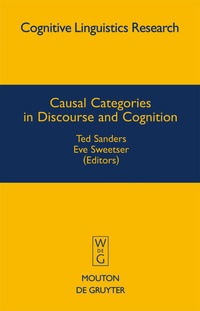
Causal Categories in Discourse and Cognition
Description

All languages of the world provide their speakers with linguistic means to express causal relations in discourse. Causal connectives and causative auxiliaries are among the salient markers of causal construals. Cognitive scientists and linguists are interested in how much of this causal modeling is specific to a given culture and language, and how much is characteristic of general human cognition. Speakers of English, for example, can choose between because and since or between therefore and so . How different are these from the choices made by Dutch speakers, who speak a closely related language, but (unlike English speakers) have a dedicated marker for non-volitional causality ( daardoor )?
The central question in this volume is: What parameters of categorization shape the use of causal connectives and auxiliary verbs across languages? The book discusses how differences between even quite closely related languages (English, Dutch, Polish) can help us to elaborate the typology of levels and categories of causation represented in language. In addition, the volume demonstrates convergence of linguistic, corpus-linguistic and psycholinguistic methodologies in determining cognitive categories of causality. The basic notion of causality appears to be an ideal linguistic phenomenon to provide an overview of methods and, perhaps more importantly, invoke a discussion on the most adequate methodological approaches to study fundamental issues in language and cognition.
Reviews / Votes
"With all these contributions, this collection definitely constitutes a high quality volume in this research area and is a valuable reference to anyone who is interested in discourse and cognition."Han-wei in: Discourse Studies 3/2011More details
Other editions
Additional editions
Persons
Content
2 - Table of contents [Seite 7]
3 - Introduction: Causality in language and cognition - what causal connectives and causal verbs reveal about the way we think [Seite 11]
4 - Causality, cognition and communication: A mental space analysis of subjectivity in causal connectives [Seite 29]
5 - Causal Connectives in Dutch Biblical Translations A cognitive linguistic approach [Seite 71]
6 - Causes and consequences: Evidence from Polish, English, and Dutch [Seite 101]
7 - Categories of subjectivity in Dutch causal connectives: a usage-based analysis [Seite 129]
8 - Causes for causatives: the case of Dutch doen and laten [Seite 183]
9 - Causal categories in discourse - Converging evidence from language use [Seite 215]
10 - Index [Seite 257]
