

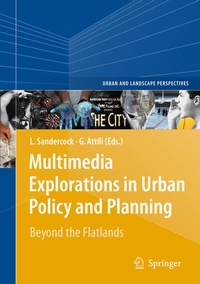
Multimedia Explorations in Urban Policy and Planning
Description

The book is a collection of essays exploring the potential of multimedia to enrich and transform the planning field. By multimedia the authors refer to a broad range of new information and communication technologies (from film and video to digital ethnography and the internet), which are opening up new possibilities in planning practices, processes, pedagogy and research. The authors document the ways in which these ICTs can expand the language of planning and the creativity of planners; can evoke the lived experience (the spirit, memories, desires) of our 21st century mongrel cities by engaging with stories and storytelling; and can democratise planning practices.
The text is epistemologically radical, in presenting an argument for the importance of "multiple languages" (ways of knowing) in the planning field, and making the connection between this epistemology and the almost infinite potential of Multimedia to provide varied tools to accomplish this transformation, displacing the supremacy of the rational, linear and hierarchical with more open, playful and imaginative approaches. Each of the authors brings practical experience with different forms of Multimedia use and reflects on the different potentialities offered by Multimedia for critical intervention in urban and regional issues, and the power dynamics embedded in such interventions.
Reviews / Votes
From the reviews:
"This is a very admirable collection of essays, which greatly advances the intellectual project of treating stories and storytelling as crucial parts of planning and urban transformation. . essays are meritorious, I find several of them to be especially valuable. . the book is well worth reading by anyone interested in this particular frontier. . Sandercock and Attili have provided a very fine piece of work . . I would strongly encourage Sandercock and Attili to expand on this brilliant exploration of the frontier . ." (James Throgmorton, Journal of Planning Education and Research, Vol. 31 (1), 2011)More details
Other editions
Additional editions
Persons
Leonie Sandercock is the author of ten books, the most recent of which include Towards Cosmopolis: Planning for Multicultural Cities (1998) and Cosmopolis 2: Mongrel Cities of the 21st Century (2003). The latter book won the Paul Davidoff Award for best book awarded by the American Collegiate Schools of Planning. She also received the Dale Prize for Community Planning (2005), and the BMW Award for Intercultural Learning (2007), for her paper on 'Cosmopolitan Urbanism'. She co-authored with Giovanni Attili the book and DVD package Where Strangers become Neighbours: Integrating Immigrants in Vancouver, Canada (Springer, 2009).
Giovanni Attili is an Urban Planning PHD, Research Fellow at the University of Rome (La Sapienza) and Postdoctoral Fellow at the University of British Columbia (UBC, Vancouver). He is recipient of the G.Ferraro Award for the best Urban Planning PhD Thesis in Italy in 2005. He is co-editor of the book "Storie di Citta" (Edizioni Interculturali, 2007), author of the book "La citta dei migranti" (Jaca Book, 2008) and co-author of the book and DVD package Where Strangers become Neighbours: Integrating Immigrants in Vancouver, Canada (Springer, 2009).
Content
Giovanni Attili
New technologies represent a system of constraints and possibilities that constitute the foundation of new rhetorical spaces: the spheres of new communicative and persuasive procedures. Nowadays, urban planning has the chance to critically and rigorously experiment with these new spaces.
It has the chance to transgress traditional representational codes and to expand its semantic horizons. This chapter portrays one such challenging exploration: the fecund crossroads between qualitative analytical approaches and digital languages within the planning field. It is a path that embraces diverse dimensions: media and messages, analysis and rhetoric, ethics and aesthetics. A path which springs from a visionary metaphor.
3.1 A Methodological Kidnapping
In 1882, Edwin Abbott writes an imaginary novel about a bi-dimensional reality: Flatland. It is a completely level world, a vast sheet of paper in which houses, inhabitants, and trees are straight lines, triangles, polygons, and other geometric figures. Through a striking narrative, Abbott invents a place and fills it with entities characterized by abstract and linear contours. These figures move freely on a surface but without the power of rising above or sinking below it.
In this reality nobody has the perception of a third dimension. The irruption of a Sphere in Flatland provokes bewilderment in the Square-Narrator who doesn’t accept the existence of a world with another dimension. His reaction is violent: a three-dimensional world is not possible. It is a deceit. The Square tries to kill the Sphere. He wants to hand the Sphere over to justice. For its part the Sphere tries to convince the Square with an analogical reasoning, in vain.
There is no solution for the Sphere but to kidnap the Square and carry it to a higher position, separated from Flatland, from where it is possible to discern new shapes and dimensions. PROOF An unspeakable horror seized me. There was a darkness; then a dizzy, sickening sensation of sight that was not like seeing. I saw a Line that was not a Line; Space that was not Space; I was myself and not myself. When I could find voice, I shrieked aloud in agony: ‘either this is madness or this is hell!’ (Abbott 1993: 124)."
