

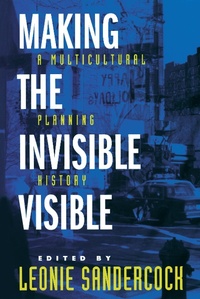
Making the Invisible Visible
A Multicultural Planning History
1st Edition
Published on 28. April 2023
268 pages
978-0-520-91857-3 (ISBN)
Description

The history of planning is much more, according to these authors, than the recorded progress of planning as a discipline and a profession. These essays counter the mainstream narrative of rational, scientific development with alternative histories that reveal hitherto invisible planning practices and agendas. While the official story of planning celebrates the state and its traditions of city building and regional development, these stories focus on previously unacknowledged actors and the noir side of planning.
Through a variety of critical lenses-feminist, postmodern, and postcolonial-the essays examine a broad range of histories relevant to the preservation and planning professions. Some contributors uncover indigenous planning traditions that have been erased from the record: African American and Native American traditions, for example. Other contributors explore new themes: themes of gendered spaces and racist practices, of planning as an ordering tool, a kind of spatial police, of "bodies, cities, and social order" (influenced by Foucault, Lefebvre, and others), and of resistance.
This scrutiny of the class, race, gender, ethnic, or ideological biases of ideas and practices inherent in the notion of planning as a modernist social technology clearly points to the inadequacy of modernist planning histories. Making the Invisible Visible redefines planning as the regulation of the physicality, sociality, and spatiality of the city. Its histories provide the foundation of a new, alternative planning paradigm for the multicultural cities of the future.
This title is part of UC Press's Voices Revived program, which commemorates University of California Press's mission to seek out and cultivate the brightest minds and give them voice, reach, and impact. Drawing on a backlist dating to 1893, Voices Revived makes high-quality, peer-reviewed scholarship accessible once again using print-on-demand technology. This title was originally published in 1998.
The history of planning is much more, according to these authors, than the recorded progress of planning as a discipline and a profession. These essays counter the mainstream narrative of rational, scientific development with alternative histories that re
Through a variety of critical lenses-feminist, postmodern, and postcolonial-the essays examine a broad range of histories relevant to the preservation and planning professions. Some contributors uncover indigenous planning traditions that have been erased from the record: African American and Native American traditions, for example. Other contributors explore new themes: themes of gendered spaces and racist practices, of planning as an ordering tool, a kind of spatial police, of "bodies, cities, and social order" (influenced by Foucault, Lefebvre, and others), and of resistance.
This scrutiny of the class, race, gender, ethnic, or ideological biases of ideas and practices inherent in the notion of planning as a modernist social technology clearly points to the inadequacy of modernist planning histories. Making the Invisible Visible redefines planning as the regulation of the physicality, sociality, and spatiality of the city. Its histories provide the foundation of a new, alternative planning paradigm for the multicultural cities of the future.
This title is part of UC Press's Voices Revived program, which commemorates University of California Press's mission to seek out and cultivate the brightest minds and give them voice, reach, and impact. Drawing on a backlist dating to 1893, Voices Revived makes high-quality, peer-reviewed scholarship accessible once again using print-on-demand technology. This title was originally published in 1998.
The history of planning is much more, according to these authors, than the recorded progress of planning as a discipline and a profession. These essays counter the mainstream narrative of rational, scientific development with alternative histories that re
More details
Other editions
Additional editions

Book
02/1998
1st Edition
University of California Press
€37.08
Article exhausted; check different version
Book
02/1998
1st Edition
University of California Press
€33.43
Article not available at the moment
Content
CONTENTS
LIST OF ILLUSTRATIONS
PREFACE
Introduction: Framing Insurgent Historiographies for Planning
Leonie Sandercock
PART I• HISTORICAL PRACTICES
1. Spaces of Insurgent Citizenship
James Holston
2. Feminist and Multicultural Perspectives on Preservation Planning
Gail Lee Dubrow
3. Regional Blocs, Regional Planning, and the Blues Epistemology in the Lower Mississippi
Delta
Clyde Woods
4. Indigenous Planning: Clans, Intertribal Confederations, and the History of the
All Indian Pueblo Council
Theodore S. Jojola
5. Remember, Stonewall Was a Riot: Understanding Gay and Lesbian Experience in the City
Moira Rachel Kn111ey
PART II• TEXTUAL AND THEORETICAL PRACTICES
6. Knowing Different Cities: Reflections on Recent European Writings on Cities and
Planning History
Iain Borden, Jane Rendell, and Helen Thomas
7. City Planning for Girls: Exploring the Ambiguous Nature of Women's Planning History
Susan Marie Wirka
8. Tropics of Planning Discourse: Stalking the "Constructive Imaginary" of Selected
Urban Planning Histories
Olivier Kramsch
9. Subversive Histories: Texts from South Africa
Robert A. Beauregard
10. Racial Inequality and Empowerment: Necessary Theoretical Constructs for
Understanding U.S. Planning History
June Manning Thomas
11. Afraid/Not: Psychoanalytic Directions for an Insurgent Planning Historiography
Dora Epstein
12. The Poem of Male Desires: Female Bodies, Modernity, and "Paris, Capital of the
Nineteenth Century"
Barbara Hooper
CONTRIBUTORS
INDEX
LIST OF ILLUSTRATIONS
PREFACE
Introduction: Framing Insurgent Historiographies for Planning
Leonie Sandercock
PART I• HISTORICAL PRACTICES
1. Spaces of Insurgent Citizenship
James Holston
2. Feminist and Multicultural Perspectives on Preservation Planning
Gail Lee Dubrow
3. Regional Blocs, Regional Planning, and the Blues Epistemology in the Lower Mississippi
Delta
Clyde Woods
4. Indigenous Planning: Clans, Intertribal Confederations, and the History of the
All Indian Pueblo Council
Theodore S. Jojola
5. Remember, Stonewall Was a Riot: Understanding Gay and Lesbian Experience in the City
Moira Rachel Kn111ey
PART II• TEXTUAL AND THEORETICAL PRACTICES
6. Knowing Different Cities: Reflections on Recent European Writings on Cities and
Planning History
Iain Borden, Jane Rendell, and Helen Thomas
7. City Planning for Girls: Exploring the Ambiguous Nature of Women's Planning History
Susan Marie Wirka
8. Tropics of Planning Discourse: Stalking the "Constructive Imaginary" of Selected
Urban Planning Histories
Olivier Kramsch
9. Subversive Histories: Texts from South Africa
Robert A. Beauregard
10. Racial Inequality and Empowerment: Necessary Theoretical Constructs for
Understanding U.S. Planning History
June Manning Thomas
11. Afraid/Not: Psychoanalytic Directions for an Insurgent Planning Historiography
Dora Epstein
12. The Poem of Male Desires: Female Bodies, Modernity, and "Paris, Capital of the
Nineteenth Century"
Barbara Hooper
CONTRIBUTORS
INDEX
