

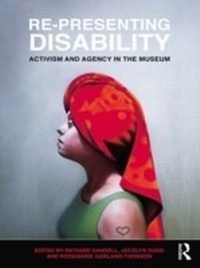
Re-Presenting Disability
Activism and Agency in the Museum
1st Edition
Published on 13. September 2013
304 pages
978-1-136-61648-8 (ISBN)
Description

Re-Presenting Disability addresses issues surrounding disability representation in museums and galleries, a topic which is receiving much academic attention and is becoming an increasingly pressing issue for practitioners working in wide-ranging museums and related cultural organisations.
This volume of provocative and timely contributions, brings together twenty researchers, practitioners and academics from different disciplinary, institutional and cultural contexts to explore issues surrounding the cultural representation of disabled people and, more particularly, the inclusion (as well as the marked absence) of disability-related narratives in museum and gallery displays. The diverse perspectives featured in the book offer fresh ways of interrogating and understanding contemporary representational practices as well as illuminating existing, related debates concerning identity politics, social agency and organisational purposes and responsibilities, which have considerable currency within museums and museum studies.
Re-Presenting Disability explores such issues as:
In what ways have disabled people and disability-related topics historically been represented in the collections and displays of museums and galleries? How can newly emerging representational forms and practices be viewed in relation to these historical approaches?
How do emerging trends in museum practice - designed to counter prejudiced, stereotypical representations of disabled people - relate to broader developments in disability rights, debates in disability studies, as well as shifting interpretive practices in public history and mass media?
What approaches can be deployed to mine and interrogate existing collections in order to investigate histories of disability and disabled people and to identify material evidence that might be marshalled to play a part in countering prejudice? What are the implications of these developments for contemporary collecting?
How might such purposive displays be created and what dilemmas and challenges are curators, educators, designers and other actors in the exhibition-making process, likely to encounter along the way?
How do audiences - disabled and non-disabled - respond to and engage with interpretive interventions designed to confront, undercut or reshape dominant regimes of representation that underpin and inform contemporary attitudes to disability?
This volume of provocative and timely contributions, brings together twenty researchers, practitioners and academics from different disciplinary, institutional and cultural contexts to explore issues surrounding the cultural representation of disabled people and, more particularly, the inclusion (as well as the marked absence) of disability-related narratives in museum and gallery displays. The diverse perspectives featured in the book offer fresh ways of interrogating and understanding contemporary representational practices as well as illuminating existing, related debates concerning identity politics, social agency and organisational purposes and responsibilities, which have considerable currency within museums and museum studies.
Re-Presenting Disability explores such issues as:
In what ways have disabled people and disability-related topics historically been represented in the collections and displays of museums and galleries? How can newly emerging representational forms and practices be viewed in relation to these historical approaches?
How do emerging trends in museum practice - designed to counter prejudiced, stereotypical representations of disabled people - relate to broader developments in disability rights, debates in disability studies, as well as shifting interpretive practices in public history and mass media?
What approaches can be deployed to mine and interrogate existing collections in order to investigate histories of disability and disabled people and to identify material evidence that might be marshalled to play a part in countering prejudice? What are the implications of these developments for contemporary collecting?
How might such purposive displays be created and what dilemmas and challenges are curators, educators, designers and other actors in the exhibition-making process, likely to encounter along the way?
How do audiences - disabled and non-disabled - respond to and engage with interpretive interventions designed to confront, undercut or reshape dominant regimes of representation that underpin and inform contemporary attitudes to disability?
More details
Language
English
Place of publication
London
United Kingdom
Publishing group
Taylor & Francis Ltd
Target group
College/higher education
Illustrations
35 s/w Photographien bzw. Rasterbilder
35 Halftones, black and white
File size
4,26 MB
ISBN-13
978-1-136-61648-8 (9781136616488)
Copyright in bibliographic data and cover images is held by Nielsen Book Services Limited or by the publishers or by their respective licensors: all rights reserved.
Schweitzer Classification
Other editions
Additional editions
Richard Sandell | Jocelyn Dodd | Rosemarie Garland-Thomson
Re-Presenting Disability
Activism and Agency in the Museum
Book
01/2010
1st Edition
Routledge
€206.90
Shipment within 15-20 days
Richard Sandell | Jocelyn Dodd | Rosemarie Garland-Thomson
Re-Presenting Disability
Activism and Agency in the Museum
Book
01/2010
1st Edition
Routledge
€56.50
Shipment within 15-20 days
Persons
Richard Sandell, Jocelyn Dodd, Rosemarie Garland-Thomson
Content
Part 1: New Ways of Seeing 1. Activist Practice Richard Sandell and Jocelyn Dodd 2. Picturing People with Disabilities: Classical Portraiture as Reconstructive Narrative Rosemarie Garland-Thomson 3. Agents at Angkor Lain Hart 4. See No Evil Victoria Phiri 5. Ghosts in the War Museum Ana Carden-Coyne 6. Behind the Shadow of Merrick David Hevey 7. Disability Reframed: Challenging Visitor Perceptions in the Museum Jocelyn Dodd, Ceri Jones, Debbie Jolly and Richard Sandell Part 2: Interpretive Journeys and Experiments 8. To Label the Label? 'Learning Disability' and Exhibiting 'Critical Proximity' Helen Graham 9. Hurting and Healing: Reflections on Representing Mental Illness in Museums. Jo Besley and Carol Low 10. Histories of Disability and Medicine: Reconciling Historical Narratives and Contemporary Values Julie Anderson and Lisa O'Sullivan 11. Revealing Moments: Representations of Disability and Sexuality Elizabeth Mariko Murray and Sarah Jacobs 12. The Red Wheelchair in the White Snowdrift Geraldine Chimirri-Russell 13. Face to Face: Exhibiting and Interpreting Facial Disfigurement in a Museum Context Emma Chambers Part 3: Unsettling Practices 14. 'Out from Under': A Brief History of Everything. Kathryn Church, Melanie Panitch, Catherine Frazee and Phaedra Livingstone 15. Transforming Practice: Disability Perspectives and the Museum Shari Rosenstein Werb and Tari Hartman Squire 16. Reciprocity, Accountability, Empowerment: Emancipatory Principles and Practices in the Museum Heather Hollins 17. Disability, Human Rights and the Public Gaze: the Losheng Story Museum Chia-Li Chen 18. A Museum for All? The Norwegian Museum of Deaf History and Culture Hanna Mellemsether 19. Collective Bodies: What Museums do for Disability Studies. Katherine Ott
