

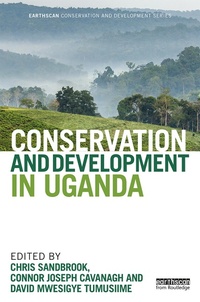
Conservation and Development in Uganda
1st Edition
Published on 21. September 2018
296 pages
978-1-351-77935-7 (ISBN)
Description

Uganda has extensive protected areas and iconic wildlife (including mountain gorillas), which exist within a complex social and political environment. In recent years Uganda has been seen as a test bed and model case study for numerous and varied approaches to address complex and connected conservation and development challenges. This volume reviews and assesses these initiatives, collecting new research and analyses both from emerging scholars and well-established academics in Uganda and around the globe. Approaches covered range from community-based conservation to the more recent proliferation of neoliberalised interventions based on markets and payments for ecosystem services.
Drawing on insights from political ecology, human geography, institutional economics, and environmental science, the authors explore the challenges of operationalising truly sustainable forms of development in a country whose recent history is characterised by a highly volatile governance and development context. They highlight the stakes for vulnerable human populations in relation to of large and growing socioeconomic inequalities, as well as for Uganda's rich, unique, and globally significant biodiversity. They illustrate the conflicts that occur between competing claims of conservation, agriculture, tourism, and the energy and mining industries. Crucially, the book draws out lessons that can be learned from the Ugandan experience for conservation and development practitioners and scholars around the world.
Drawing on insights from political ecology, human geography, institutional economics, and environmental science, the authors explore the challenges of operationalising truly sustainable forms of development in a country whose recent history is characterised by a highly volatile governance and development context. They highlight the stakes for vulnerable human populations in relation to of large and growing socioeconomic inequalities, as well as for Uganda's rich, unique, and globally significant biodiversity. They illustrate the conflicts that occur between competing claims of conservation, agriculture, tourism, and the energy and mining industries. Crucially, the book draws out lessons that can be learned from the Ugandan experience for conservation and development practitioners and scholars around the world.
Reviews / Votes
'This edited volume is a fascinating, useful book as it combines a case study of conservation and development of Uganda with more theoretical and methodological perspectives...So who should read this book? Anyone who is engaged in conservation and development or interested in the varied tools this field uses will find the book to be of value. African scholars will find the book useful for understanding contemporary issues. The book would also be useful for classroom debate, as the studies provide sufficient context to understand the setting and delve into the issues involved'. - Colin A. Chapman, McGill University, Canada in Fauna & Flora International, Cambridge, UK (https://doi.org/10.1017/S0030605319000474)More details
Series
Edition
1. Auflage
Language
English
Place of publication
London
United Kingdom
Publishing group
Taylor & Francis Ltd
Target group
College/higher education
Illustrations
19 Tables, black and white; 7 Line drawings, black and white; 4 Halftones, black and white; 30 Illustrations, black and white
File size
3,34 MB
ISBN-13
978-1-351-77935-7 (9781351779357)
Copyright in bibliographic data and cover images is held by Nielsen Book Services Limited or by the publishers or by their respective licensors: all rights reserved.
Schweitzer Classification
Other editions
Additional editions
Chris Sandbrook | Connor Joseph Cavanagh | David Mwesigye Tumusiime
Conservation and Development in Uganda
Book
06/2020
1st Edition
Routledge
€51.98
Shipment within 15-20 days
Chris Sandbrook | Connor Joseph Cavanagh | David Mwesigye Tumusiime
Conservation and Development in Uganda
Book
09/2018
Routledge
€206.80
Shipment within 10-20 days
Persons
Chris Sandbrook is Senior Lecturer in Geography and Director of the Masters in Conservation Leadership at the University of Cambridge, UK.
Connor Joseph Cavanagh is a Post-Doctoral Research Fellow in the Department of International Environment and Development Studies (Noragric), Norwegian University of Life Sciences.
David Mwesigye Tumusiime is Associate Professor, School of Forestry, Environmental and Geographical Sciences, Makerere University, Kampala, Uganda, and Director, Makerere University Biological Field Station, Uganda.
Connor Joseph Cavanagh is a Post-Doctoral Research Fellow in the Department of International Environment and Development Studies (Noragric), Norwegian University of Life Sciences.
David Mwesigye Tumusiime is Associate Professor, School of Forestry, Environmental and Geographical Sciences, Makerere University, Kampala, Uganda, and Director, Makerere University Biological Field Station, Uganda.
Content
Part I: Introduction 1. Dynamics of uneven conservation and development in Uganda 2. Histories and genealogies of Ugandan forest and wildlife conservation: the birth of the protected area estate 3. An overview of integrated conservation and development in Uganda Part II: Celebrity sites and case studies of conservation, development practice, and research 4. Bwindi Impenetrable National Park: a celebrity site for integrated conservation and development in Uganda 5. Managing the contradictions: conservation, communitarian rhetoric, and conflict at Mount Elgon National Park 6. Budongo Forest: A paradigm shift in conservation? Part III: Conservation and development approaches in policy and practice 7. An environmental justice perspective on the state of Carbon Forestry in Uganda 8. Parks, people, and partnerships: experiments in the governance of nature-based tourism in Uganda 9. Cultural values and conservation: an innovative approach to community engagement Part IV: Cross-sectoral dynamics and their links to conservation and development 10. Conservation and agriculture: finding an optimal balance? 11. Lost in the woods? A political economy of the 1998 forest sector reform in Uganda 12. Dialectics of conservation, extractives, and Uganda's 'land rush' Part V: Conclusion 13. Conservation, development, and the politics of ecological knowledge in Uganda
