

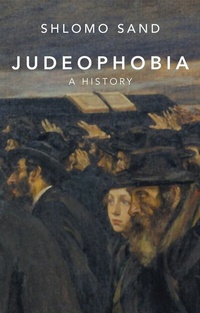
Judeophobia
Description

Throughout the history of the Western world, Jews have suffered various forms of exclusion, stigmatization, and discrimination that have forced them always to be aware of their very particular situation. The Jews became a community under siege and, as Shlomo Sand argues, Judaism was shaped by the hostile gaze of Christian civilization. While the forms of hostility endured by the Jews have varied over the centuries, it is impossible to understand twentieth-century anti-Judaism, or Jewish identity itself, without taking account of the sediments of mental hatred, fuelled by religious belief, which have survived the passage of time. While anti-semitism is the term commonly used today, Sand prefers 'Judeophobia', which predates the appearance of anti-semitismand is more precise. Looking back over the centuries, he seeks to identify some of the stages in the age-old, incandescent hatred of the Jews, and tries to understand what remains today of this trenchant hostility. He also questions whether Zionism, born as a distressed response to modern Judeophobia, has ended up mirroring it. To what extent has Zionism inherited the ideological foundations that have always been characteristic of the persecutors of the Jews? This concise history of anti-Jewish hatred will be of great interest to anyone concerned with one of the most insidious and persistent features of Western civilization. Now available as an audiobook.
More details
Other editions
Additional editions
Persons
Content
2. Curbing Jewish Proselytism
3. 'People-Race' or Religious Community?
4. The Origins of 'Judeo-Christian' Europe
5. Humanism and Foreigners, from Erasmus to Voltaire
6. Revolution, Emancipation, and Nationality
7. The Jews, between Capitalism and Socialism
8. Racialization, Democratization, and Emigration
9. The Dreyfus Affair and the Birth of Zionism
10. The Extermination of the 'Jewish Race'
11. The Rebirth of the 'Jewish Race'?
12. Who is Jewish? From Fingerprints to DNA
13. The 1967 War and 'Ancestral Rights'
14. Judeophobia on the Wane?
15. Is Anti-Zionism the New 'Anti-Semitism'?
Afterword
1
A Subjective Text
- - It's the Jews that are the cause of all our ills!
- - No, cyclists!
- - Why cyclists?
- - Why Jews?
Twentieth-century Yiddish joke
I am a historian. I have therefore written this short book on the basis of knowledge acquired and accumulated over the years, as a student and as a teacher. However, I must warn the reader from the outset that I have never considered the discipline of history to be a science, and I have always known that the reconstruction of the past is not an objective affair. Of course, there are some very good historians and some not so good, just as there are excellent and mediocre carpenters; every narrator of the past is, however, a product of the spirit of their time and the place where they reside; if they are to be honest then they will have to try to reveal, as far as possible, the subjective influences that steer and shape their approach to history.
It would be hypocritical of me to claim neutrality and to adopt a purely 'objective' approach in writing this book. From the very beginning, my biography would immediately invalidate any such claim. I was born in the aftermath of the Second World War, in a camp for displaced Jews near to the Austrian city of Linz. Shortly afterwards I was transferred to another camp in Bavaria, where I lived for two years before my parents emigrated to Palestine, now Israel, in 1948. My mother and father lost their parents (my grandfather and both of my grandmothers), along with other members of their family, in the great Nazi massacre: this event seems to me to be one of the most horrific in human history, but it was also the result of Christian civilization's long history of Judeophobia.
This is why any attempt on my part to present myself as a professional researcher devoid of all subjectivity would quite rightly be seen as hypocritical. This has not, however, prevented me from doing my best to understand the nature of anti-Judaism in its various phases, or from exploring its causes. In no way does this imply any inclination to make excuses for it. Although I am well aware of the impossibility of reaching 'the Truth' in the field of the 'human and social sciences', nonetheless I have never thought that we should give up trying to draw closer to it.
Given that I also tend to be intolerant of all those forms of human ugliness and stupidity that fuel the rejection and discrimination of linguistic, religious, sexual, cultural, or other minorities, I imagine that readers will find numerous failings and weaknesses in these pages. Indeed, I must confess my inability to control my disgust at the partiality and injustice exhibited by the majority who dictate their law to the small, threatened minority. Throughout almost the entire history of the Western world, Jews have suffered various forms of exclusion, stigmatization, and discrimination that have forced them always to be aware of their very particular situation.
The central argument of this work will be that the Jewish faith was not the progenitor of Christianity, but that, contrary to what the chronology might suggest, the character and attitudes of the Jewish minority were shaped by the Christianity within which they lived. Jean-Paul Sartre may have described the modern Jew as a creation of the non-Jewish gaze, but he did not consider that 'authentic Judaism' (in other words, religious Judaism) was already largely the product of a hostile representation produced by Christian civilization.
Anyone can see that living for centuries in close proximity to neighbours who are convinced that you murdered the son of their God is liable to generate an identity that is at the very least closed-off and anxiety-ridden. The daily fear of a hostile environment has given rise to a certain intransigence, and an attitude of rejection towards anyone who tries to come near.
Generally speaking, it might be suggested that, with the exception of the golden Judeo-Arabic period in Spain (of which Maimonides was the direct product), Jewish faith and practice have generally tended to preserve their heritage, keeping it frozen. The accursed have refused to accept cultural renewals or solicitations. Their immersion in the exegesis of the great texts, along with the forlorn hope of salvation, and their tendency to turn away from an alienating environment, has fixed in stone the spiritual universe of the Jews, a community under siege.
Anti-Semitism or Judeophobia?
Of course, this does not imply that the forms of hostility exhibited towards Jews, any more than Jewish identities themselves, have remained entirely unchanged over the centuries. The force with which the Jewish 'other' is rejected has varied from place to place. In Muslim civilization, for example, there has been not so much hatred of Jews as a feeling of superiority, both in legislation and in everyday practice.1 However, it is impossible to understand twentieth-century anti-Judaism, or indeed the vicissitudes of Jewish identity itself, without examining the lengthy history that has shaped and defined them. Economic structures are transformed, political situations develop, and technologies evolve, but the sediments of mental hatred, fuelled by religious belief, have a far longer lifespan, beyond any changes that might affect them.
Readers will no doubt be surprised that I do not use the popular term 'anti-Semitism' in this text. This term was coined in the mid nineteenth century, at a time when the formalization of biological racialization was reaching its high point, marking what, in my view, was not a decisive epistemological break in the history of hostility towards Jews but a significant new phase. The attitude of profound contempt towards Jews (and the natives of the colonies) was not the result of any 'scientific' discovery about a Semitic or Indo-European race, but emerged out of an arrogant supremacist discourse that had invented and popularized the idea of a biological hierarchy of races. In other words, ideological racialization existed long before it discovered bloodlines or, as we shall see later, DNA.
Given that there is no such thing as a Semitic race, and no such thing as an Aryan race, the roots of the term 'anti-Semitism' lie in an essentialist swindle, mainly perpetrated by populist politicians seeking to give 'scientific' substance to an age-old phobia. Of course, there are Semitic, Indo-European, and Austro-Asiatic languages, and linguistics has explained their characteristics and the problems inherent in their classification. But the Jews of Europe did not speak Hebrew except to recite their prayers, as others used Latin - so they were never 'Semites'. In Eastern Europe, where the Yiddish-speaking people came from, this Indo-European language was written in Aramaic letters, admittedly derived from Semitic languages, but it is in fact the Jews living in the Arab world who may be considered authentic Semites.
It may sound strange, but I could also be described as a typical 'Semite'. I wasn't born a 'Semite', because my mother tongue was Yiddish (which, however, I never learned to read or write). At school and in the street, I learnt Hebrew, which to this day I love, and which I can sometimes use to express myself with precision. I dream, think, and write in Hebrew. This work was written in Hebrew; it would be more accurate to say it was written in Israeli, because the syntax and a large proportion of the words used in modern Hebrew are totally different from the language of the ancestral writers of the Bible.
In short, I prefer to use the concept of 'Judeophobia', which predates the appearance of 'anti-Semitism' and is relatively more precise. Leon Pinsker, one of the first Zionists, in his pioneering 1882 essay Auto-Emancipation, employed the term 'Judeophobia'; 'anti-Semitism', in fact, was not yet a widely known term. 'Judeophobia' may bring to mind a psychiatric illness; this indeed was the view of Pinsker, himself a doctor.
Myself, I don't see xenophobia as an illness. The language of hatred certainly has psychological origins that are deeply rooted in human behaviour, but its perverse explosions are always the result of long-term ideological processes on the one hand, and socio-economic and political situations on the other. While fear lies at the root of all hatred of others, it is not the only ingredient in every expression of malice. Inferiority complexes and arrogance, jealousy and lack of culture, the thirst for power and the exploitation of power relations, suffering, the search for a scapegoat, and many other well-known mental complexes are plentiful in xenophobia and provide ample fuel for Judeophobia.
As we know, this human phenomenon is not entirely comprehensible, and I don't think it can be reduced to the English expression 'The dislike of the unlike,' in other words to heterophobia, synonymous with a natural fear of those who are different. While it's true that racism can be described as a 'poor man's snobbery', we might add that racialization, i.e., the transformation of the other or of oneself into a race - which is always an imaginary affair - originates among intellectuals, and has always been elaborated by people of letters.
Judeophobia and Zionism
In the pages that follow, I have attempted to identify, albeit rather schematically, some of the...
