

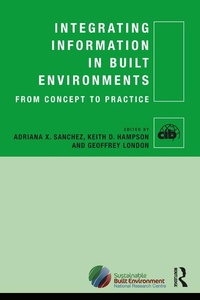
Integrating Information in Built Environments
Published on 20. July 2017
320 pages
978-1-351-78328-6 (ISBN)
Description

In an increasingly globalised built environment industry, achieving higher levels of integration across organisational and software boundaries can lead to improved economic, social and environmental outcomes. This book is the direct result of a collaborative global network of industry and academic researchers spread across nine countries as part of CIB's (International Council for Research and Innovation in Building and Construction) Task Group 90 (TG90) Information Integration in Construction (IICON).
The book provides a broad view of some of the opportunities and challenges brought by integrating information across organisational and system boundaries in the built environment industry. Chapters cover a large range of topics and are separated into three sections: resources, processes and added value. They provide a much-needed international perspective on a current global evolution in the industry and present leading original research and valuable lessons for researchers, industry practitioners, government clients and policy makers across the industry.
Key features include:
a broad range of topics that are not covered elsewhere in the literature;
contributions from a diverse group of industry research leaders from across the globe;
exemplar case studies providing real-world examples of where information integration has been a key factor for success or lack thereof has been at the root cause of failure;
an analysis of future priority areas for research and development investment as well as their strategic implications for public and private decision-makers;
the book will deliver innovation in best practice methodology for information sharing across disciplines and between the design, construction and asset management sectors.
The book provides a broad view of some of the opportunities and challenges brought by integrating information across organisational and system boundaries in the built environment industry. Chapters cover a large range of topics and are separated into three sections: resources, processes and added value. They provide a much-needed international perspective on a current global evolution in the industry and present leading original research and valuable lessons for researchers, industry practitioners, government clients and policy makers across the industry.
Key features include:
a broad range of topics that are not covered elsewhere in the literature;
contributions from a diverse group of industry research leaders from across the globe;
exemplar case studies providing real-world examples of where information integration has been a key factor for success or lack thereof has been at the root cause of failure;
an analysis of future priority areas for research and development investment as well as their strategic implications for public and private decision-makers;
the book will deliver innovation in best practice methodology for information sharing across disciplines and between the design, construction and asset management sectors.
More details
Series
Language
English
Place of publication
London
United Kingdom
Publishing group
Taylor & Francis Ltd
Target group
College/higher education
Professional and scholarly
Illustrations
14 s/w Tabellen
14 Tables, black and white
File size
5,61 MB
ISBN-13
978-1-351-78328-6 (9781351783286)
Copyright in bibliographic data and cover images is held by Nielsen Book Services Limited or by the publishers or by their respective licensors: all rights reserved.
Schweitzer Classification
Other editions
Additional editions
Adriana X. Sanchez | Keith Hampson | Geoffrey London
Integrating Information in Built Environments
From Concept to Practice
Book
12/2020
1st Edition
Routledge
€74.00
Shipment within 15-20 days
Adriana X. Sanchez | Keith Hampson | Geoffrey London
Integrating Information in Built Environments
From Concept to Practice
Book
07/2017
1st Edition
Routledge
€238.09
Shipment within 10-20 days
Persons
Adriana X. Sanchez is currently a research associate at the Australian Sustainable Built Environment National Research Centre and a PhD Candidate at the University of New South Wales through the Cooperative Research Centre for Low Carbon Living. She is one of the coordinators of the CIB Task Group 90: Information Integration in Construction.
Keith D. Hampson is CEO of the Australian Sustainable Built Environment National Research Centre, and Professor of Construction Innovation at Curtin University, Australia. He has a Bachelor of Engineering with Honours and an MBA from Queensland University of Technology (QUT) and a PhD in Civil and Environmental Engineering from Stanford University, USA.
Geoffrey London currently works at the University of Western Australia. He served as Government Architect for the last 13 years in Victoria and Western Australia; this is a role that nourishes the production of well-produced sustainable buildings.
Keith D. Hampson is CEO of the Australian Sustainable Built Environment National Research Centre, and Professor of Construction Innovation at Curtin University, Australia. He has a Bachelor of Engineering with Honours and an MBA from Queensland University of Technology (QUT) and a PhD in Civil and Environmental Engineering from Stanford University, USA.
Geoffrey London currently works at the University of Western Australia. He served as Government Architect for the last 13 years in Victoria and Western Australia; this is a role that nourishes the production of well-produced sustainable buildings.
Content
Chapter 1. Integrating information across built environment boundaries Adriana X. Sanchez, Keith D. Hampson and Geoffrey London
Part 1: Resources
Chapter 2. Integrating information for more productive social housing outcomes: An Australian perspective Judy A. Kraatz, Annie Matan and Peter Newman
Chapter 3. Resilient policies for wicked problems: Increasing resilience in a complex and uncertain world through information integration Adriana X Sanchez, Paul Osmond and Jeroen van der Heijden
Chapter 4. Internet of things for urban sustainability Fonbeyin H. Abanda and Joseph H. M. Tah
Chapter 5. Digital technologies improving safety in the construction industry Wen Yi, Peng Wu, Xiangyu Wang and Albert P.C. Chan
Chapter 6. Information integration and interoperability for BIM-based life-cycle assessment Ruben Santos and Antonio Aguiar Costa
Part 2: Process
Chapter 7. A precinct information modelling: A new digital platform for integrated design, assessment and management of the built environment Peter Newton, Jim Plume, David Marchant, John Mitchell and Tuan Ngo
Chapter 8. Information integration for asset and maintenance management Sonia Lupica Spagnolo
Chapter 9. IT support for contractor monitoring of refurbishment projects Jan Broechner and Ahmet A. Sezer
Chapter 10. Experience with the use of commissioning advisor in design: A Danish context Marianne Forman
Chapter 11. Turning energy data into actionable information: The case of energy performance contracting Frederic Bougrain
Chapter 12. Stakeholder perspectives and information exchange in AEC projects Torill Meistad, Marit Store-Valen, Vegard Knotten, Ali Hosseini, Ole Jonny Klakegg, Oystein Mejlaender-Larsen, Eilif Hjelset, Fredrik Svalestuen, Ola Laedre, Geir K. Hansen and Jardar Lohne
Part 3: Added Value
Chapter 13. The concept of value of buildings in use Marit Store-Valen, Torill Meistad, Knut Boge, Margrethe Foss, Leif D. Houck and Jardar Lohne
Chapter 14. Information integration and public procurement: The role of monitoring, benchmarking and client leadership Adriana X. Sanchez, Jessica Brooks and Keith D. Hampson
Chapter 15. Four metaphors on knowledge and change in construction Kim Haugbolle
Chapter 16. Contrasting aspects of information integration Adriana X. Sanchez, Geoffrey London and Keith D. Hampson
Part 1: Resources
Chapter 2. Integrating information for more productive social housing outcomes: An Australian perspective Judy A. Kraatz, Annie Matan and Peter Newman
Chapter 3. Resilient policies for wicked problems: Increasing resilience in a complex and uncertain world through information integration Adriana X Sanchez, Paul Osmond and Jeroen van der Heijden
Chapter 4. Internet of things for urban sustainability Fonbeyin H. Abanda and Joseph H. M. Tah
Chapter 5. Digital technologies improving safety in the construction industry Wen Yi, Peng Wu, Xiangyu Wang and Albert P.C. Chan
Chapter 6. Information integration and interoperability for BIM-based life-cycle assessment Ruben Santos and Antonio Aguiar Costa
Part 2: Process
Chapter 7. A precinct information modelling: A new digital platform for integrated design, assessment and management of the built environment Peter Newton, Jim Plume, David Marchant, John Mitchell and Tuan Ngo
Chapter 8. Information integration for asset and maintenance management Sonia Lupica Spagnolo
Chapter 9. IT support for contractor monitoring of refurbishment projects Jan Broechner and Ahmet A. Sezer
Chapter 10. Experience with the use of commissioning advisor in design: A Danish context Marianne Forman
Chapter 11. Turning energy data into actionable information: The case of energy performance contracting Frederic Bougrain
Chapter 12. Stakeholder perspectives and information exchange in AEC projects Torill Meistad, Marit Store-Valen, Vegard Knotten, Ali Hosseini, Ole Jonny Klakegg, Oystein Mejlaender-Larsen, Eilif Hjelset, Fredrik Svalestuen, Ola Laedre, Geir K. Hansen and Jardar Lohne
Part 3: Added Value
Chapter 13. The concept of value of buildings in use Marit Store-Valen, Torill Meistad, Knut Boge, Margrethe Foss, Leif D. Houck and Jardar Lohne
Chapter 14. Information integration and public procurement: The role of monitoring, benchmarking and client leadership Adriana X. Sanchez, Jessica Brooks and Keith D. Hampson
Chapter 15. Four metaphors on knowledge and change in construction Kim Haugbolle
Chapter 16. Contrasting aspects of information integration Adriana X. Sanchez, Geoffrey London and Keith D. Hampson
