

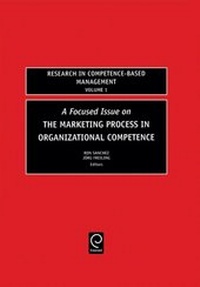
Focused Issue on The Marketing Process in Organizational Competence
1st Edition
Published on 2. December 2005
282 pages
978-0-08-045663-8 (ISBN)
Description

This first volume of "e;Research in Competence-Based Management (RCBM)"e; signals the launch of a long-awaited outlet for peer-reviewed research papers contributing to advancement of competence-based management theory. Each volume in "e;RCBM"e; will be focused on a key aspect of competence theory. The focus in this volume on "e;The Marketing Process in Organizational Competence"e; reflects the fundamental market orientation in competence theory's foundational concepts and theoretical development. Papers in this volume explore key aspects of the common conceptual foundations of competence and marketing theories, and help to make clear the great relevance of marketing theory for competence-based management theory and practice, as well as the relevance of competence theory for marketing theory and practice. Papers by authors from both the marketing and competence fields elaborate the nature of the marketing process and clarify the ways in which the marketing process is integral to building and leveraging organizational competences.
More details
Series
Language
English
Place of publication
London
United Kingdom
Publishing group
Elsevier Science & Technology
Target group
Professional and scholarly
File size
3,20 MB
ISBN-13
978-0-08-045663-8 (9780080456638)
Copyright in bibliographic data and cover images is held by Nielsen Book Services Limited or by the publishers or by their respective licensors: all rights reserved.
Schweitzer Classification
Other editions
Additional editions
Ron Sanchez | Jorg Freiling
Focused Issue on The Marketing Process in Organizational Competence
Book
12/2005
JAI Press Inc.
€166.00
Shipment within 15-20 days
Content
- Intro
- The Marketing Process in Organizational Competence
- Contents
- List of Contributors
- Editors' Introduction
- Competence-Based Management and Marketing: Building on a Common Ground for Theory, Research, and Practice
- Marketing Theory's Relevance to Competence Theory
- Competence Theory's Relevance to Marketing Theory
- Papers in this Volume
- Open Questions and On-Going discussions
- Notes
- References
- Relating Customer Value to Strategic Competence: A Discrete Choice Measurement Approach
- Introduction
- Competences: Conception and Measurement
- The Concept of a Competence
- The Measurement of Competences
- Competences: Logic for Measurement
- A Methodology for Measuring Competences and Customer Value
- Data Collection Methodology
- Analytic Models
- An Empirical Application of the Methodology: Fast-Food Restaurants
- Empirical Results
- Discussion
- Future Development of the Methodology
- Acknowledgment
- References
- Selected Sections of the Customer Survey
- Selected Sections of the Manager Survey
- Capability Implications of Different Forms of Value Creation
- Introduction
- Value Creation
- Examples of Alternative Forms of Value Creation
- Product/Market Strategy: UPM-Kymmene
- Designing Value Constellations: Elcoteq Network
- Mobilizing Productive Knowledge Flows: Nautor
- Capability Implications of Alternative Forms of Value Creation
- Product/Market Strategy: UPM-Kymmene
- Designing Value Constellations: Elcoteq Network
- Mobilizing Productive Knowledge Flows: Nautor
- Discussion
- Notes
- References
- Managing in Emergence: Capabilities for Influencing the Birth of New Business Fields*
- Introduction
- Characteristics of Innovations and the Environment of Emerging Networks
- Innovation Types
- Cycles of Technological Change
- Phases of Network Emergence
- Synthesis of the Environment of Emerging Business Networks
- Firms in Emerging Business Networks: Tasks and Capabilities
- Early Emergence: Exploration for Future Business Options
- Focusing and Selecting
- Mid Emergence: Mobilization for Designs and Applications
- From Emergence to Market Competition: Mobilization for Dissemination
- Discussion
- References
- The Relation between Firms' Strategic Orientation and Capabilities: What do their Strategic Marketing Plans Tell Us?
- Introduction
- A Competence-Based Perspective on Strategic Marketing Plans
- Strengths and Weaknesses
- Opportunities and Threats
- Strategic Choices
- Strategic Orientation
- The Study
- Data Collection and Sample
- Content Analysis
- Findings
- Strategic Orientations
- Strengths and Weaknesses
- Opportunities and Threats
- Strategic Choices
- Capabilities versus Other Kinds of Resources
- What do Strategic Marketing Plans Tell Us?
- The Role of Capabilities in SWOT Analyses
- Strategic Orientation and Strength and Weaknesses
- Opportunities and Threats and Strategic Choices
- Notes
- Acknowledgments
- References
- Mobilising Consumer Competence to Create Technology Transition Paths: The Example of the Nordea Internet Bank
- Introduction
- Research Questions
- Methodology
- Theoretical Framework
- Innovation in Services
- Self-service Technologies
- Adopting the Internet Bank
- The Problem of Timing
- The Problem of Managing the Co-Evolutionary Process through the Construction of a Transition Path
- Distance and Internet Banking at Nordea
- Merita
- Nordbanken
- The Telephone Bank at Nordbanken
- The Internet Bank at Nordbanken
- Discussion - Adoption of the Complex Innovation Internet Banking
- Construction of a Transition Path
- Timing
- A Revisit of Normann's Model - from Adoption to Competence Co-Evolution
- Notes
- References
- Documents from Nordea
- Interviews at Nordea
- Competence-based Management of Co-location Arrangements
- Introduction
- Role of Spatial Closeness in Industrial Service Markets
- The Concept of Co-Location
- Empirical Observations in Business-to-Business Markets
- Case Study 1: MCC's Industrial Park 'Smartville'
- Case Study 2: Oracle's modular software solutions
- A Combined Resource and Competence Perspective on Co-Location
- Routines
- Interconnectedness/Social Complexity
- Asset Mass Efficiencies
- Implications Concerning the Marketing of Industrial Services
- Notes
- References
- Strategic Implications of a Competence-Based Management Approach to Account Management
- Introduction
- Concepts Behind Account Management
- What is a Key Account?
- Key Account: Definitions
- What is Account Management?
- Account Management: Definition
- A Competence Perspective on Account Management
- Competence Building and Competence Leveraging
- Strategic Account: Proposed Definition
- Strategic Account Management: Proposed Definition
- Implications
- Conclusion and Further Research
- References
- Standardization Strategy in Modular and Network Markets: Capabilities and Critical Success Factors in Competences
- Introduction
- The Dimensions of Standardization Strategy
- Tactics
- Second Sourcing
- Building an Early Lead
- Influencing Forecasts of Future Sales
- Attracting the Suppliers of Complementary Goods
- Product Preannouncements
- Price Commitment
- Timing
- Form of Cooperation
- The Empirical Study
- Critical Success Factors for Standardization Strategy
- Critical Success Factors in Decisions about Tactics
- Second Sourcing
- Building an Early Lead
- Influencing Forecasts of Future Sales
- Attracting Suppliers of Complementary Goods
- Product Preannouncements
- Price Commitment
- Critical Success Factors in Decisions About Timing
- Ex-ante Standardization
- Ex-post Standardization
- Critical Success Factors in Decisions about Cooperation
- Developing Alliances
- Sponsoring Alliances
- Critical Capabilities for Successful Standardization Strategy
- Conclusions
- Notes
- References
- Modular Design as a Key Capability for Creating Future Products Under Uncertainty
- Introduction
- Modular Design Capability
- Research Questions and Proposed Approach
- Constructing Future Scenarios
- Analysis of Appropriateness of Modular Designs
- Evaluation of Degree of Modularity
- Identifying Future Needs
- The Modular Design Process
- Function-Based Design
- Modularization Rules (Function and Variety Heuristics)
- Construction of the Product-Scenario Matrix
- Application of the Methodology
- Determining Appropriateness to Modularity and Degree of Modularity
- Constructing Future Scenarios
- Scenario 1: Biological Complexity
- Scenario 2: Provocative
- Scenario 3: Reign of Mechanics
- Scenario 4: Tiny-Mini
- Identifying Future Needs
- Market Needs and Corresponding Product Characteristics Emerging from Biological Diversity Scenario
- Market Needs and Corresponding Product Characteristics Emerging from the Provocative Scenario
- Needs and Corresponding Product Characteristics Emerging from the Reign of Mechanics Scenario
- Needs and Corresponding Product Characteristics Emerging from the Tiny-Mini Scenario
- The Modular Design Process
- Module-Scenario Matrix
- Consistency Analysis
- The Product-Scenario Matrix
- Conclusion
- Notes
- References
