

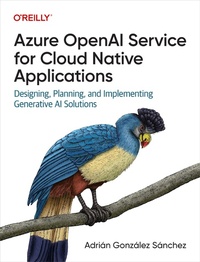
Azure OpenAI Service for Cloud Native Applications
Designing, Planning, and Implementing Generative AI Solutions
Published on 27. June 2024
248 pages
978-1-0981-5496-7 (ISBN)
Description

Get the details, examples, and best practices you need to build generative AI applications, services, and solutions using the power of Azure OpenAI Service. With this comprehensive guide, Microsoft AI specialist Adrin Gonzlez Snchez examines the integration and utilization of Azure OpenAI Serviceusing powerful generative AI models such as GPT-4 and GPT-4owithin the Microsoft Azure cloud computing platform.To guide you through the technical details of using Azure OpenAI Service, this book shows you how to set up the necessary Azure resources, prepare end-to-end architectures, work with APIs, manage costs and usage, handle data privacy and security, and optimize performance. You'll learn various use cases where Azure OpenAI Service models can be applied, and get valuable insights from some of the most relevant AI and cloud experts.Ideal for software and cloud developers, product managers, architects, and engineers, as well as cloud-enabled data scientists, this book will help you:Learn how to implement cloud native applications with Azure OpenAI ServiceDeploy, customize, and integrate Azure OpenAI Service with your applicationsCustomize large language models and orchestrate knowledge with company-owned dataUse advanced roadmaps to plan your generative AI projectEstimate cost and plan generative AI implementations for adopter companies
More details
Other editions
Additional editions
Adrian Gonzalez Sanchez
Azure OpenAI Service for Cloud Native Applications
Designing, Planning, and Implementing Generative AI Solutions
Book
07/2024
O'Reilly
€60.00
Available immediately
Content
- Intro
- Copyright
- Table of Contents
- Preface
- How This Book Is Organized
- Conventions Used in This Book
- Using Code Examples
- O'Reilly Online Learning
- How to Contact Us
- Acknowledgments
- Introduction
- Chapter 1. Introduction to Generative AI and Azure OpenAI Service
- What Is Artificial Intelligence?
- Current Level of AI Adoption
- The Many Technologies of AI
- Typical AI Use Cases
- Types of AI Learning Approaches
- About Generative AI
- Primary Capabilities of Generative AI
- Relevant Industry Actors
- The Key Role of Foundation Models
- Road to Artificial General Intelligence
- Microsoft, OpenAI, and Azure OpenAI Service
- The Rise of AI Copilots
- Azure OpenAI Service Capabilities and Use Cases
- LLM Tokens as the New Unit of Measure
- Conclusion
- Chapter 2. Designing Cloud Native Architectures for Generative AI
- Modernizing Applications for Generative AI
- Cloud Native Development with Azure OpenAI Service
- Microservice-Based Apps and Containers
- Serverless Workflows
- Azure-Based Web Development and CI/CD
- Understanding the Azure Portal
- General Azure OpenAI Service Considerations
- Available Azure OpenAI Service Models
- Architectural Elements of Generative AI Systems
- Conclusion
- Chapter 3. Implementing Cloud Native Generative AI with Azure OpenAI Service
- Defining the Knowledge Scope of Azure OpenAI Service-Enabled Apps
- Generative AI Modeling with Azure OpenAI Service
- Azure OpenAI Service Building Blocks
- Potential Implementation Approaches
- Approach Comparison and Final Recommendation
- AI Performance Evaluation Methods
- Conclusion
- Chapter 4. Additional Cloud and AI Capabilities
- Plug-ins
- LLM Development, Orchestration, and Integration
- LangChain
- Semantic Kernel
- LlamaIndex
- Bot Framework
- Power Platform, Microsoft Copilot, and AI Builder
- Databases and Vector Stores
- Vector Search from Azure AI Search
- Vector Search from Cosmos DB
- Azure Databricks Vector Search
- Redis Databases on Azure
- Other Relevant Databases (Including Open Source)
- Additional Microsoft Building Blocks for Generative AI
- Azure AI Document Intelligence (formerly Azure Form Recognizer) for OCR
- Microsoft Fabric's Lakehouse
- Microsoft Azure AI Speech
- Microsoft Azure API Management
- Ongoing Microsoft Open Source and Research Projects
- Conclusion
- Chapter 5. Operationalizing Generative AI Implementations
- The Art of Prompt Engineering
- Generative AI and LLMOps
- Prompt Flow and Azure ML
- Securing LLMs
- Managing Privacy and Compliance
- Responsible AI and New Regulations
- Relevant Regulatory Context for Generative AI Systems
- Company-Level AI Governance Resources
- Technical-Level Responsible AI Tools
- Conclusion
- Chapter 6. Elaborating Generative AI Business Cases
- Premortem, or What to Consider Before Implementing a Generative AI Project
- Defining Implementation Approach, Resources, and Project Roadmap
- Defining Project Workstreams
- Identifying Required Resources
- Estimating Duration and Effort
- Creating a "Living" Roadmap
- Creating Usage Scenarios
- Calculating Cost and Potential ROI
- Conclusion
- Chapter 7. Exploring the Big Picture
- What's Next? The Evolution Toward Microsoft Copilot
- Expert Insights for the Generative AI Era
- David Carmona: AI Adoption and the Future of Generative AI
- Brendan Burns: The Role of Cloud Native for Generative AI Developments
- John Maeda: About AI Design and Orchestration
- Sarah Bird: Responsible AI for LLMs and Generative AI
- Tim Ward: The Impact of Data Quality on LLM Implementations
- Seth Juarez: From Generative AI Models to a Full LLM Platform
- Saurabh Tiwary: The New Microsoft Copilot Era
- Conclusion
- Appendix. Other Learning Resources
- Relevant O'Reilly Books for Your Upskilling Journey
- Other Resources and Repositories
- Index
- About the Author
- Colophon
