

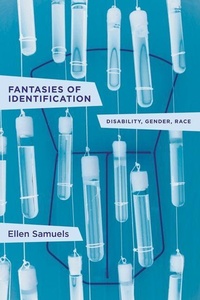
Fantasies of Identification
Disability, Gender, Race
Published on 25. April 2014
273 pages
978-1-4798-5504-9 (ISBN)
Description

Explores the roots of modern understandings of bodily identity
In the mid-nineteenth-century United States, as it became increasingly difficult to distinguish between bodies understood as black, white, or Indian; able-bodied or disabled; and male or female, intense efforts emerged to define these identities as biologically distinct and scientifically verifiable in a literally marked body. Combining literary analysis, legal history, and visual culture, Ellen Samuels traces the evolution of the "fantasy of identification"-the powerful belief that embodied social identities are fixed, verifiable, and visible through modern science. From birthmarks and fingerprints to blood quantum and DNA, she examines how this fantasy has circulated between cultural representations, law, science, and policy to become one of the most powerfully institutionalized ideologies of modern society.
Yet, as Samuels demonstrates, in every case, the fantasy distorts its claimed scientific basis, substituting subjective language for claimed objective fact. From its early emergence in discourses about disability fakery and fugitive slaves in the nineteenth century to its most recent manifestation in the question of sex testing at the 2012 Olympic Games, Fantasies of Identification explores the roots of modern understandings of bodily identity.
In the mid-nineteenth-century United States, as it became increasingly difficult to distinguish between bodies understood as black, white, or Indian; able-bodied or disabled; and male or female, intense efforts emerged to define these identities as biologically distinct and scientifically verifiable in a literally marked body. Combining literary analysis, legal history, and visual culture, Ellen Samuels traces the evolution of the "fantasy of identification"-the powerful belief that embodied social identities are fixed, verifiable, and visible through modern science. From birthmarks and fingerprints to blood quantum and DNA, she examines how this fantasy has circulated between cultural representations, law, science, and policy to become one of the most powerfully institutionalized ideologies of modern society.
Yet, as Samuels demonstrates, in every case, the fantasy distorts its claimed scientific basis, substituting subjective language for claimed objective fact. From its early emergence in discourses about disability fakery and fugitive slaves in the nineteenth century to its most recent manifestation in the question of sex testing at the 2012 Olympic Games, Fantasies of Identification explores the roots of modern understandings of bodily identity.
Reviews / Votes
"In this smart and readable book, Samuels traces her subject from the nineteenth century into the early twenty-first, where it persists in debates over blood quantum, DNA testing, and disabled parking permits." * American Literature * "[Samuels] shows the impossibility of talking about, say, race or gender, without showing their formation through a body under inspection. She is less engaged with tilting against identify politics than showing how socially constructed identities are lived and situated within specific cultural parameters." * American Literary History * "Fantasies of Identification, which sits at the intersection of US literary history, disability, gender, queer, and critical race studies, will have a powerful impact, not only on disability studies but also on intersectional and transgender studies in general. Scholars of transgender studies and disability studies alike will appreciate such a fine model of vital contributions each makes to the other as they are, indeed, in integral relationships." * TSQ: Transgender Studies Quarterly * "A beautifully written, ambitiously imagined, and wonderfully nuanced book. Samuels provides brilliantly argued case studies that demonstrate the discursive and visual processes by which Americans have, since the mid-nineteenth century, lived under various regimes of identification both those imposed and those claimed through ones subjective understanding of the world. Fantasies of Identification will be a marvelous contribution to disability studies, American studies, and literary historical studies." * David Serlin, author of Replaceable You: Engineering the Body in Postwar America * "Whether through measures of blood quantum, disability assessment, or sex/gender testing in athletics, Ellen Samuels makes clear that what she terms biocertification continues to operate everywhere in contemporary cultures, regulating social worth, citizenship, and group membership. We have long needed Fantasies of Identification to understand more fully the ways in which disability is thickly interwoven with histories of race, sexuality, and gender in the United States." * Robert McRuer, author of Crip Theory: Cultural Signs of Queerness and Disability * "Samuels examines in depth how stereotypes relating to disability, gender, and race are first created through literature, which shapes basic schema held by society. These stereotypes are then reinforced by media through cinematic representations of what Samuels calls fantasy of identity or cultural tropes, often idealized with tangential relation to actual bodies. Summing Up: Highly recommended." * Choice * "Fantasies of Identification is enormously suggestive, bringing together disability studies, comparative racialization, queer theory, and cultural analysis in new and exciting ways." * MELUS *More details
Series
Edition
Library
Language
English
Place of publication
New York
United States
Target group
Professional and scholarly
Illustrations
12 black and white illustrations
File size
4,74 MB
ISBN-13
978-1-4798-5504-9 (9781479855049)
DOI
8574/nyu/9781479855049.001.0001
Copyright in bibliographic data and cover images is held by Nielsen Book Services Limited or by the publishers or by their respective licensors: all rights reserved.
Schweitzer Classification
Other editions
Additional editions

Book
04/2014
New York University Press
€97.99
Shipment within 10-20 days

Book
04/2014
New York University Press
€36.50
Shipment within 10-20 days
Person
Ellen Samuels is Assistant Professor of Gender and Women's Studies and English at the University of Wisconsin at Madison.
