

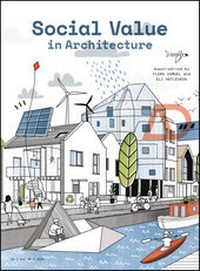
Social Value in Architecture
1st Edition
Published on 14. September 2020
144 pages
978-1-119-57659-4 (ISBN)
Description

This groundbreaking edition of AD brings together a range of global expertise on social value, exploring its potential for demonstrating the positive impact of both architecture and architects on homes and communities in terms of social justice, sustainability and wellbeing.
There has been a recent groundswell of interest in the mapping and measuring of social value caused by developments in legislation and planning, as well as a revival of interest in the ethical dimensions of architectural practice. Not only do architects promote wellbeing through the development of carefully conceived and appropriate designs, they can also add social value through the processes of consultation, visioning, briefing, co-design, co-creation, user manuals, soft landings (helping people to make the most of their buildings in use) and post-occupancy evaluation. These are, however, poorly recognised aspects of an architect's role.
We live in an audit culture where organisational performance is measured against predetermined targets. Unfortunately, the focus of architectural practice is generally on the financial cost of what it does in the short term rather than its long-term social value, arguably its market niche. This AD posits that the mapping and measuring of social value provides a real opportunity for the architectural profession to make its key contribution heard.
Contributors: Nabeela Ahmed and Ayona Datta, Nicola Bacon and Paul Goodship, Irena Bauman, Cristina Garduno Freeman, Mat Hinds, Anthony Hoete, Karen Kubey, Mhairi McVicar, Aoibheann Ní Mhearáin and Tara Kennedy, Jenni Montgomery, Edward Ng and Li Wan, Doina Petrescu, and Peter Andreas Sattrup
Featured architects: Atelier d'Architecture Autogérée (AAA), Barton Willmore, Bauman Lyons Architects, Jateen Ladd, John McLaughlin Architects, and Taylor and Hinds Architects
There has been a recent groundswell of interest in the mapping and measuring of social value caused by developments in legislation and planning, as well as a revival of interest in the ethical dimensions of architectural practice. Not only do architects promote wellbeing through the development of carefully conceived and appropriate designs, they can also add social value through the processes of consultation, visioning, briefing, co-design, co-creation, user manuals, soft landings (helping people to make the most of their buildings in use) and post-occupancy evaluation. These are, however, poorly recognised aspects of an architect's role.
We live in an audit culture where organisational performance is measured against predetermined targets. Unfortunately, the focus of architectural practice is generally on the financial cost of what it does in the short term rather than its long-term social value, arguably its market niche. This AD posits that the mapping and measuring of social value provides a real opportunity for the architectural profession to make its key contribution heard.
Contributors: Nabeela Ahmed and Ayona Datta, Nicola Bacon and Paul Goodship, Irena Bauman, Cristina Garduno Freeman, Mat Hinds, Anthony Hoete, Karen Kubey, Mhairi McVicar, Aoibheann Ní Mhearáin and Tara Kennedy, Jenni Montgomery, Edward Ng and Li Wan, Doina Petrescu, and Peter Andreas Sattrup
Featured architects: Atelier d'Architecture Autogérée (AAA), Barton Willmore, Bauman Lyons Architects, Jateen Ladd, John McLaughlin Architects, and Taylor and Hinds Architects
More details
Other editions
Additional editions
Persons
Flora Samuel is Professor of Architecture in the Built Environment at the new University of Reading School of Architecture and the RIBA's first Vice President for Research. She is former Head of the University of Sheffield School of Architecture. She wrote several well-received books on Le Corbusier before turning her attention to public perception of design and how architects need to be able to demonstrate their value to the public and policy makers with clear, convincing evidence. She received over £500K in research funding for this initiative, which culminated in the book: Why Architects Matter: Evidencing and Communicating the Value of Architects (Routledge, 2018). Samuel trained as an Architect at Cambridge University and Princeton.
Eli Hatleskog is a Norwegian architect and theorist who likes to work through participatory architectural processes. She is currently based at the University of Reading working with Samuel on the Newton funded project "Mapping Eco-Social Assets (MESA)", a collaboration with Santo Tomas University in the Philippines.
Eli Hatleskog is a Norwegian architect and theorist who likes to work through participatory architectural processes. She is currently based at the University of Reading working with Samuel on the Newton funded project "Mapping Eco-Social Assets (MESA)", a collaboration with Santo Tomas University in the Philippines.
Content
1 Measuring Architecture's Social Value in the United States
2 Design for Impact: Measuring Architecture's Social Value in the United States
3 Documenting Value Creation: A Business Opportunity for Architects, Their Clients and Society
4 Resilience Value in the Face of Climate Change
5 New Infrastructure for Communities Who Want to Build
6 'Engender the Confidence to Demand Better': The Value of Architects in Community Asset Transfers
7 Mapping Eco-social Assets
8 Changing Patterns of Resilience: Exploring the Local
9 Greenkeeper: Establishing the Full Value of Green
10 High Science and Low Technology for Sustainable Rural Development
11 Architecture from the Ground Up: Designing and Delivering Social Value in Southern India
12 In the Eye of the Beholder
13 Reframing Social Value in 20th-Century Conservation
14 Mapping Gendered Infrastructures: Critical Reflections on Violence Against Women in India
15 The House as Ancestor: A Tale of Maori Social Value
16 Walk With Us: The Architecture of Reconciliation
17 From Another Perspective - Against a Convenient Mediocrity
2 Design for Impact: Measuring Architecture's Social Value in the United States
3 Documenting Value Creation: A Business Opportunity for Architects, Their Clients and Society
4 Resilience Value in the Face of Climate Change
5 New Infrastructure for Communities Who Want to Build
6 'Engender the Confidence to Demand Better': The Value of Architects in Community Asset Transfers
7 Mapping Eco-social Assets
8 Changing Patterns of Resilience: Exploring the Local
9 Greenkeeper: Establishing the Full Value of Green
10 High Science and Low Technology for Sustainable Rural Development
11 Architecture from the Ground Up: Designing and Delivering Social Value in Southern India
12 In the Eye of the Beholder
13 Reframing Social Value in 20th-Century Conservation
14 Mapping Gendered Infrastructures: Critical Reflections on Violence Against Women in India
15 The House as Ancestor: A Tale of Maori Social Value
16 Walk With Us: The Architecture of Reconciliation
17 From Another Perspective - Against a Convenient Mediocrity
