

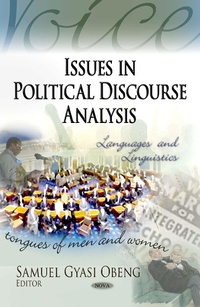
Issues in Political Discourse Analysis
Published on 22. August 2011
264 pages
978-1-5361-1754-7 (ISBN)
Description

This new book examines the analysis of language (possibly in conjunction with other semiotic systems) in the course of our lives as citizens of established politics of various scopes. Topics discussed include the cultural consequences of economic migration from Nigeria to the West; language, politics and democratic governance in Nigeria; legitimization and coercion in political discourse; language endangerment; drawing an analytical framework in search of "e;postmodern"e; Chinese and discursive strategies in political speech.
More details
Other editions
Additional editions
Samuel Gyasi Obeng
Issues in Political Discourse Analysis
Book
10/2011
Nova Science Publishers Inc
€329.78
Shipment within 15-20 days
Content
- Intro
- Contents
- Prologue
- The Tongue That Could Not Be Silenced
- Chapter 1
- Introduction
- Chapter 2
- The Cultural Consequences of Economic Migration from Nigeria to the West
- Abstract
- Introduction
- Definitions of Culture
- A Broad Typology of Culture
- Factors that Influence Culture
- Types of Influence
- Before Migration
- After Migration
- Conclusion
- Appendix
- Questionnaire on the Cultural Consequences of Economic Migration
- References
- Chapter 3
- Cognitive Strategies in Nigerian and German Political Cartoons: A Comparative Study
- Abstract
- Introduction
- Political Cartoons and their Contents
- Cognitive Strategies in Political Cartoons
- Language as a Social, Political, and Cultural System
- The Humour Process and Stereotypes
- Humour
- Stereotypes
- Findings
- Conclusion
- References
- Chapter 4
- Turn-Taking Strategies in Nigerian Legislative Discourse
- Abstract
- Turn-Taking Strategies in Nigerian Legislative Discourse
- Theoretical Preliminaries
- Framework for Turn Mechanism
- Data Analysis
- Mr. Speaker Selects Next Speaker
- Next Speaker Self Selects
- Turn Allocation Cues in LID
- Turn-Yielding Cues
- Turn-Requesting Cues
- Turn-Accepting Cues
- Thank You as a Turn Signal in LID
- Turn Structure in Motions
- Conclusion
- References
- Chapter 5
- Pragmatic Features of Political Speeches in English by Some Prominent Nigerian Leaders
- Abstract
- Introduction
- Summary of the Selected Speeches
- Data Analysis
- Sample 1
- Sample 2
- Sample 3
- Sample 4
- Sample 5
- Sample 6
- Sample 7
- Sample 8
- Sample 9
- Sample 10
- Discussion and Conclusion
- Appendix
- Excerpts from the Selected Speeches
- References
- Chapter 6
- Legitimization and Coercion in Political Discourse: A Case Study of Olusegun Obasanjo Address to the PDP Elders and Stakeholders Forum
- Introduction
- Language and Politics
- Background: The Nigerian Political Scenery
- Obasanjo and His Utterances
- Discussion
- Conclusion
- Appendix
- References
- Chapter 7
- Language, Politics and Democratic Governance in Nigeria: A Sociolinguistic Perspective
- Abstract
- Introduction
- Background to the Study: Language, Federalism and Electoral Process in Nigeria
- Theoretical Framework
- The Speech Act Theory
- The English Language in the Multilingual Nigerian Context: A Brief Sociohistorical Perspective
- English As Language of Politics and Governance in Nigeria: An Analysis
- Political Communication in the Nigerian Democracy: Language Policy vs. Linguistic Situation
- Conclusion
- References
- Chapter 8
- Language Endangerment: A Statistical Analysis of Language Shift and Language Death with Particular Reference to Erushu, Akoko
- Abstract
- Introduction
- Language Contact and Language Endangerment
- Language Contact and Language Death
- The Study Area
- Objectives of the Study
- Specific Hypotheses
- Methodology
- Demographic Information
- Data Analysis and Verification of Hypotheses
- Discussion
- Implications and Conclusion
- References
- Chapter 9
- Bush Versus Blair: Keywords Heading the Nation
- Introduction - Opening Keywords
- Sketching a Background
- Gathering Materials
- Drawing an Analytical Framework
- Preliminary Considerations:
- Bush and Blair Approval Ratings
- What Keywords Tell Us
- Questioning Words Preferences:
- Looking at Some Relevant Collocations
- Intercollocating Keywords Around the
- 'Nation-Self'
- Re-framing Discourse and Concluding Remarks
- References
- Chapter 10
- Drawing an Analytical Framework In Search of "Postmodern" Chinese: Language and Politics in Taiwan
- Abstract
- Introduction
- Taiwan: A Brief History and Sociolinguistics
- Language or Dialect?
- Unresolved Issues Posed by Southern Varieties
- Problems in the 'Family'
- Challenges in the 21st Century
- 'Postmodern' Chinese
- References
- Chapter 11
- Intertextuality and Metaphor in Puerto Rican Political Discourse: Statehood and Language Policy
- Abstract
- Introduction
- Context
- The Political Status of Puerto Rico
- The Language of Puerto Rico
- The Amendment
- Method
- Participants and Data
- Framework
- Analysis
- Political Actors
- Nonpolitical Actors
- Discussion
- Conclusion
- References
- Chapter 12
- Discursive Strategies in Political Speech: The Words of Dr. Bingu wa Mutharika
- Abstract
- Introduction
- Data
- Theoretical Framework
- Analysis
- Pronouns and Position
- Pronouns and Lexicon
- Structural Organization
- Conclusion
- References
- Chapter 13
- Codeswitching in Tanzanian Parliamentary Discourse: A Communicative Innovation
- Abstract
- Preamble:
- Language Use Pattern in Bilingual Parliaments
- The Bunge's Swahili-English Bilingualism
- Codeswitching in the Bunge Discourse: Identification
- Codeswitching in the Bunge Discourse: Justification
- A Macro-Politics Frame
- Pre-Ujamaa Bunge (1961-1967)
- From 'English Only' to 'Swahili or English'
- {[L2] + [L2]} ----( {[L2] + [L1]} pattern
- The Ujamaa Bunge
- From 'Swahili or English' to 'Swahili/English'
- {[L1] + [L2]} ----( {[L1/L2] + [L1]} pattern
- The [L1] Pattern as a Communicative Schema
- The [L1/L2] Pattern as a Marked Choice
- Post-Ujamaa Bunge 1985 to Date
- The {[L1/L2] + [L1]} Pattern: Continuity and Change
- Conclusion
- References
- Index
- Blank Page
