

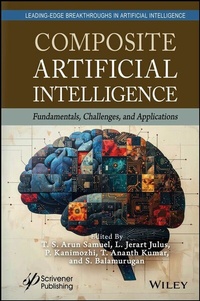
Composite Artificial Intelligence
Description

Unlock the full potential of context-aware AI while navigating critical hurdles like bias mitigation and ethical governance with this definitive resource on the future of composite artificial intelligence.
In the rapidly evolving landscape of artificial intelligence, the demand for more adaptive, intelligent, and context-aware systems has led to the emergence of composite artificial intelligence: a paradigm that integrates multiple AI techniques to solve complex real-world problems with higher efficiency and intelligence. This book is a groundbreaking exploration of the next evolution in AI, where diverse methodologies like machine learning, symbolic reasoning, and cognitive computing converge to solve complex, real-world problems with unprecedented intelligence and adaptability. Unlike traditional AI approaches that rely on singular techniques, composite AI harnesses the strengths of multiple paradigms, enabling systems that are more robust, interpretable, and capable of human-like decision-making. This book provides a comprehensive roadmap for understanding and implementing these advanced systems, from foundational theories to cutting-edge applications across industries such as healthcare, finance, and smart manufacturing. It delves into critical challenges, including bias mitigation, integration hurdles, and ethical governance, while showcasing real-world case studies that demonstrate the transformative potential of composite AI. With its balanced blend of theory, technical depth, and actionable insights, this book is a definitive resource for unlocking the full potential of AI in an increasingly complex world.
Readers will find the volume:
- Explores the intersection of machine learning, symbolic reasoning, and cognitive computing for solving real-world challenges smarter and faster;
- Introduces cutting-edge techniques for bias reduction, optimization, and seamless multi-method integration;
- Provides real-world case studies and scalable frameworks to demonstrate how composite AI is transforming industries;
- Presents ethical implications and current innovations to build trustworthy, compliant AI systems that align with regulations;
Audience
Academics, policymakers, AI researchers, data scientists, AI and machine learning engineers and developers, and??industry professionals working in healthcare, finance, manufacturing, and cybersecurity who need robust, explainable, and adaptive AI solutions.
More details
Other editions
Additional editions
Persons
T. S. Arun Samuel, PhD is a Professor on the Department of Electronics and Communication Engineering, National Engineering College, Tamil Nadu, India with more than two decades of experience. He has authored more than 65 research articles published in prestigious international journals, 15 articles in international conferences, one patent, and three edited books. His research interests are focused on advancing the frontiers of nanoelectronic device technologies through innovative modeling and simulation techniques.
L. Jerart Julus, PhD is an Assistant Professor in the Department of IT, School of Computer Science Engineering and Information Systems, Vellore Institute of Technology, Vellore, India. He is a member of IEEE, the Computer Society of India, and the Optical Society of India. His research interests include multicarrier communications systems, radio over fiber, and visible light communication.
P. Kanimozhi, PhD is a Professor of Computer Science and Engineering, IFET College of Engineering, Tamil Nadu, India with more than 19 years of teaching experience. She has published more than 17 research papers in national and international journals. Her current areas of interest include cloud computing security, data mining, and blockchain.
T. Ananth Kumar, PhD is an Associate Professor of Computer Science and Engineering, IFET College of Engineering, Tamil Nadu, India. He has presented papers in national and international conferences and journals, holds patents in various domains, and has edited six books and numerous book chapters. His fields of interest are networks on chips, computer architecture, and application-specific integrated circuit design.
S. Balamurugan, PhD is the Director of Research at iRCS, an Indian Technological Research and Consulting Firm. He has published more than 100 books, 300 papers in international journals and conferences, and 300 patents. With 20 years of research on various cutting-edge technologies, he provides expert guidance in technology forecasting and decision-making for leading companies and startups.
