

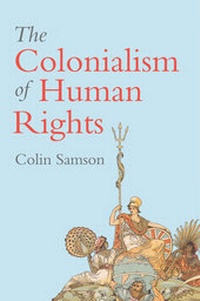
The Colonialism of Human Rights
Description

This trenchant book brings human rights into conversation with the histories and afterlives of Western colonialism and slavery. Colin Samson examines the paradox that the nations that credit themselves with formulating universal human rights were colonial powers, settler colonists and sponsors of enslavement. Samson points out that many liberal theorists supported colonialism and slavery, and how this illiberalism plays out today in selective, often racist processes of recognition and enforcement of human rights.
To reveal the continuities between colonial histories and contemporary events, Samson connects British, French and American colonial theories and practice to the notion of non-universal human rights. Vivid illustrations and case studies of racial exceptions to human rights are drawn from the afterlives of the enslaved and colonized, as well as recent events such as American police killings of black people, the treatment of Algerian harkis in France, the Windrush scandal in Britain and the militarized suppression of the Standing Rock Water Protectors movement. Advocating for reparative justice and indigenizing law, Samson argues that such events are not a failure of liberalism so much as an inbuilt racial dynamic of it.
More details
Other editions
Additional editions
Person
Content
Chapter 1: Non-Universal Human Rights and Rightlessness
Chapter 2: The Uneasy Present of Colonialism
Chapter 3: Slavery and Its Afterlives
Chapter 4: The Less Than Human
Chapter 5: The Impossibility of Indigenous Human Rights
Chapter 6: Decolonizing Human Rights
Bibliography
Index
Introduction
As a white person, I have been privileged. This is so although I had no privileged upbringing in any conventional sense of the word. Born of an unknown US enlisted serviceman and the teenage daughter of an elderly farm-labouring couple, mine was not a childhood for which there were many templates. I remember the Americans who came up our lonely stretch of road lined with Scotch pines on the edge of the Norfolk Fens to see my mother. They drove their Chevvies and Fords to a cottage without electricity or plumbing, and then later when the landowner got my grandparents on the housing list, they came to see my mother in our council house in a nearby village. Many visitors were brown and black, friends to my mother's various white boyfriends. To a child grappling to understand the world, they were friendly and fun and I soon got used to the fact that Americans all looked different.
One day, a great-uncle known for his sporting and ribald humour was in conversation with a black airman in our living room. What he said to the airman stopped the talking just for a second. There was a pause after the short, nasal-voiced elderly man exclaimed: 'Of course, a 100 year ago, you buggers were all slaves.' It must have been hurtful to the airman, even though he had probably heard similar in his life. As a child of about 7, I didn't know what he meant. It was probably a digression in a story, which was the main form of communication among older East Anglians. Over the years, my grandmother would remember it to me as she relayed episodes of her life with each visit I made back to the village. I laughed with her, but didn't know whether it was the great-uncle or the airman or the sentiments that we were laughing at.
Some years later, I got a US military loan to attend the London School of Economics (LSE) for a Master's degree. On weekends, I returned to the village to stay with my grandmother. She virtuously made vegetarian adaptations of meals that I remembered as a child before my adolescence had been punctuated by migration. My mother, sister, Texan stepfather and I went off in 1969 to an air base in California, and then to apartment complexes in Arizona populated by white drifters like we had become. When I saved money to return to England several years later, I liked the contrast of being around my grandmother and childhood friends in the village. They made me think that, despite years outside the desert city of Phoenix, and despite being unplaceable within British class taxonomy, I was still somehow English. In those days, I used to go to the pub my grandfather once frequented and got into conversations about politics with a wealthy landowner. When I defended decolonization - it was 1981 and the time of the transition to African majority rule in Southern Rhodesia - the dapper, well-mannered man some twenty years my senior calmly asked me which African countries were better-off now that the British had withdrawn. Having the bulk of my education in Arizona, and not being exposed to regular international news bulletins like my more solidly British and middle-class fellow students at the LSE, I had no answer. I had no facts on which to pin any kind of response. I did not immediately connect the corruption and strife in much of Africa with what the colonists had left behind. The virtue of the British just hung there.
Conversations with the jocular great-uncle and the snappily dressed landowner were just two of the incidents I remember that made me question who I am and with whom I stand aligned in the unequal world I was born into. The sense of moral integrity of white people who must in some way reckon with slavery and colonialism puzzled me. Thinking about it now, it seemed that my great-uncle was saying that slavery was nothing to be ashamed of. In fact, it was the black airman who should feel shame. Similarly, colonial rule, whether under Ian Smith's Rhodesian apartheid government or otherwise, was not just benign but it improved the lot of Africans. Their subsequent descents en masse into poverty, war and corruption were an inevitable consequence of their own failings. Africans should be grateful to the British, and perhaps even petition for the return of an Empire that once controlled about a quarter of the globe. The credit for unselfish progress is borne by the nation itself, and the insults to others, the presumed beneficiaries, is merely the reverse side of the same coin. White privilege is - or at least it has been until recently - the ability to be cocooned in a virtue so unquestioned that others can be condescendingly dismissed, denounced and despised without repercussion.
Over the centuries, national pride and moral authority have been derived from the equation of Western civilization with liberal virtues such as human rights. Despite the many situations in everyday life in which white privilege - or, more properly, white dominance - is manifest,1 original rectitude has remained a deeper underlying sensibility of many white people. Until recently the privileges, which often translate into differences in how people are treated, have been submerged by a discourse in which 'progressive' Western principles are globalized, administered by governments and declared to apply equally to all. Many of those adhering to liberalism have refrained from insults to those regarded as their beneficiaries - now, these are only the preserve of populists - and have envisioned a world of rights scraped clean of slavery and colonialism. This perspective is displayed in human rights discussions, scholarly and official. According to Karima Bennoune, UN Special Rapporteur on Cultural Rights, universal human rights are a 'basic tenet of international law'. This is so fundamental that there can be 'no second-class citizens' she said.2
While the UN is outwardly unambiguous about universal human rights, it has of course committed human rights offences, among them the 1999 bombing of Yugoslavia causing 500 'second-class' civilian deaths.3 By contrast, states that are charged with enforcing human rights are more equivocal, proclaiming rights that their actions often deny. American Defense Secretary General James Mattis spoke of 'the unwavering respect for human rights' of the USA and larger international community in relation to the state-authorized murder and dismemberment of journalist Jamal Khashoggi in the Saudi Arabian consulate in Istanbul.4 Mattis made these commitments in Bahrain where, a year earlier, the leading human rights advocate in the country had been jailed, the only independent newspaper was closed by the government, death penalties had been meted out after forced confessions, and access to the country had been denied to the Office of the UN High Commissioner for Human Rights and the UN Special Rapporteur for Torture.5 A few months later, the President whom Mattis served reiterated his support for the Saudi regime that ordered the killing of Khashoggi, a US resident and critic of the Saudi autocracy, citing billions of dollars in Saudi investments in US companies as a rationale.6 Since this time, the US Congress has blocked the sending of arms to Saudi Arabia and the Gulf autocracies, but this was easily sidestepped through a Presidential veto in July 2019.
The British government's confusion over human rights is equally profound. In 2018, on the seventieth anniversary of the United Nations (UN) Universal Declaration on Human Rights (UDHR), UK Foreign Office minister Lord Ahmad of Wimbledon declared that 'Britain is a global defender of human rights, fundamental freedoms, and democratic values, and has championed campaigns to end modern slavery and human trafficking, to prevent sexual violence in conflict, and to ensure at least 12 years of quality education for girls.'7 A few months later, the International Court of Justice (ICJ) ruled that Britain had violated the human rights of approximately 2,000 residents of the Chagos Islands, whom it deported to Mauritius to lease out their lands to the US military in 1965. That same day, Lord Ahmad announced that the UK would be seeking re-election to the UN Human Rights Council (HRC) in view of, among other things, a 'rising tide of impunity' around the world.8 No reference was made to the ICJ ruling, and no apology to the Chagossians has been forthcoming. Indeed, the British government ignored the demand to end its colonial control over the islands as soon as possible, and when the UN General Assembly voted by a margin of 116-6 on a resolution for Britain to surrender the Chagos archipelago to Mauritius so that the Chagossians could return to their lands, the Foreign Office could only register its disappointment and underline that the US base on the Chagos Islands keeps the world safe from terrorism.9 Ensuring safety has meant that the islands were used, contrary to basic human rights standards enshrined in the UDHR and many other instruments, for secret renditions of terrorist suspects to detention camps or military ships there.10 Retaining control of the islands as a leased-out military colony further violated UN Resolution 1514 which prevented the breaking up of colonies before independence. Britain's impunity co-exists with its enthusiasm for human rights.
Expressed in many ways today,11 human rights call for universal application through national and international institutions recognizing specific, sometimes 'inalienable', rights that accord to people either as individuals or as collectives. Broad rights to equality,...
