

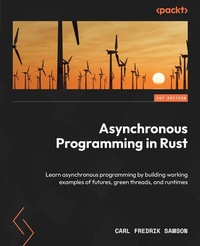
Asynchronous Programming in Rust
Learn asynchronous programming by building working examples of futures, green threads, and runtimes
Published on 23. September 2024
306 pages
978-1-80512-662-1 (ISBN)
Description

No detailed description available for "Asynchronous Programming in Rust".
More details
Edition
Digital original
Language
English
Place of publication
Birmingham
United Kingdom
Target group
Professional and scholarly
US School Grade: College Graduate Student
Edition type
Digital original
File size
7,47 MB
ISBN-13
978-1-80512-662-1 (9781805126621)
Copyright in bibliographic data and cover images is held by Nielsen Book Services Limited or by the publishers or by their respective licensors: all rights reserved.
Schweitzer Classification
Other editions
Additional editions
Carl Fredrik Samson
Asynchronous Programming in Rust
Learn asynchronous programming by building working examples of futures, green threads, and runtimes
Book
02/2024
Packt Publishing
€55.60
Shipment within 3-4 weeks
Person
Samson Carl Fredrik :
Carl Fredrik Samson is a popular technology writer and has been active in the Rust community since 2018. He has an MSc in Business Administration where he specialized in strategy and finance. When not writing, he's a father of two children and a CEO of a company with 300 employees. He's been interested in different kinds of technologies his whole life and his programming experience ranges from programming against old IBM mainframes to modern cloud computing, using everything from assembly to Visual Basic for Applications. He has contributed to several open source projects including the official documentation for asynchronous Rust.
Carl Fredrik Samson is a popular technology writer and has been active in the Rust community since 2018. He has an MSc in Business Administration where he specialized in strategy and finance. When not writing, he's a father of two children and a CEO of a company with 300 employees. He's been interested in different kinds of technologies his whole life and his programming experience ranges from programming against old IBM mainframes to modern cloud computing, using everything from assembly to Visual Basic for Applications. He has contributed to several open source projects including the official documentation for asynchronous Rust.
Content
Table of Contents
An Introduction to Asynchronous Programming
Epoll, Kqueue and IOCP
Epoll example
Different strategies for modelling asynchronous program flow
Stackfull Coroutines/Green Threads/Fibers [Example]
Callbacks and promises [Example]
Futures in Rust
Coroutines and async/await
Runtimes, Wakers, and the Reactor-Executor Pattern
Coroutines, Self-Referential Structs, and Pinning
Creating Your Own Runtime
An Introduction to Asynchronous Programming
Epoll, Kqueue and IOCP
Epoll example
Different strategies for modelling asynchronous program flow
Stackfull Coroutines/Green Threads/Fibers [Example]
Callbacks and promises [Example]
Futures in Rust
Coroutines and async/await
Runtimes, Wakers, and the Reactor-Executor Pattern
Coroutines, Self-Referential Structs, and Pinning
Creating Your Own Runtime
