

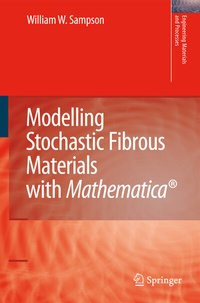
Modelling Stochastic Fibrous Materials with Mathematica®
Description

Developments in the use of electrospun fibrous materials, for application in tissue engineering and in carbon fibrous materials in fuel cells, has generated new interest in the dependence of the properties and structure of these materials on those of their constituent fibres. "Modelling Stochastic Fibrous Materials with Mathematica" provides an overview of the structure of stochastic fibrous materials, and the use of Mathematica® to develop models describing their structure and performance. The book introduces the techniques of statistical geometry and probabilistic modelling for non-mathematicians, and assumes no previous experience of Mathematica®. Using accessible notation and by providing examples of Mathematica® code, expressions are derived for the structural characteristics of stochastic fibrous materials providing insights into the ways these depend upon each other and the extent to which they can be modified in the laboratory or in a manufacturing environment.
Reviews / Votes
From the reviews:
"This book provides an overview of the structure of stochastic fibrous materials, and the use of Mathematica code to develop models describing their structure and performance. . This well-written book is a reader-friendly and good-organised manual in the field of composite materials. It can be highly recommended to experts in mechanics of solids, engineers, and to graduate, postgraduate and doctoral students." (Igor Andrianov, Zentralblatt MATH, Vol. 1166, 2009)
More details
Other editions
Additional editions
Person
Bill Sampson is a Senior Lecturer in the School of Materials at the University of Manchester, with more than 15 years experience modeling the structure and performance of stochastic fibrous materials. His interest in these materials developed at UMIST and the University of Toronto where he first used the computer mathematics software Mathematica to develop theories applying statistical geometry to the study of the pore size distribution in paper. Subsequent work has yielded theories describing the distributions of porosity and pore size in two- and three-dimensional networks, and the extent and configuration of fiber contacts in general classes of stochastic fibrous materials. These models have been applied to the study of the structures of non-woven textiles, electrospun polymer networks, and fibrous filters, and the influence of structure on their mechanical, optical and transport behaviors.
