

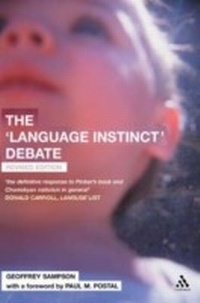
The 'Language Instinct' Debate
1st Edition
Published on 1. May 2005
240 pages
978-1-4411-0764-0 (ISBN)
Description

When it was first published in 1997, Geoffrey Sampson's Educating Eve was described as the definitive response to Steven Pinker's The Language Instinct and Noam Chomsky's nativism. In this revised and expanded new edition, Sampson revisits his original arguments in the light of fresh evidence that has emerged since the original publication.
Since Chomsky revolutionized the study of language in the 1960s, it has increasingly come to be accepted that language and other knowledge structures are hard-wired in our genes. According to this view, human beings are born with a rich structure of cognition already in place. But people do not realize how thin the evidence for that idea is.
The 'Language Instinct' Debate examines the various arguments for instinctive knowledge, and finds that each one rests on false premisses or embodies logical fallacies. The structures of language are shown to be purely cultural creations.
With a new chapter entitled 'How People Really Speak' which uses corpus data to analyse how language is used in spontaneous English conversation, responses to critics, extensive revisions throughout, and a new preface by Paul Postal of New York University, this new edition will be an essential purchase for students, academics, and general readers interested in the debate about the 'language instinct'.
Since Chomsky revolutionized the study of language in the 1960s, it has increasingly come to be accepted that language and other knowledge structures are hard-wired in our genes. According to this view, human beings are born with a rich structure of cognition already in place. But people do not realize how thin the evidence for that idea is.
The 'Language Instinct' Debate examines the various arguments for instinctive knowledge, and finds that each one rests on false premisses or embodies logical fallacies. The structures of language are shown to be purely cultural creations.
With a new chapter entitled 'How People Really Speak' which uses corpus data to analyse how language is used in spontaneous English conversation, responses to critics, extensive revisions throughout, and a new preface by Paul Postal of New York University, this new edition will be an essential purchase for students, academics, and general readers interested in the debate about the 'language instinct'.
Reviews / Votes
Title mention in Anuario Filosofico, Vol XXXIX/1 2006 "Now we have a much revised, corrected and expanded version which answers Sampson's many critics and makes ever clearer the fact that all the Chomsky and Pinker theories are not nearly as well supported as most psychologists and linguists seem to imagine. Sampson has a sharp eye for scholarly fudging of facts, illogical arguments, and towering theories tottering on weak foundations. At the very least Sampson's no-nonsense book, remarkable for its lucidity and readability in a field not notable for these virtues, forces upon us a recognition of the parlous state of a lot of linguistic argument and compels us to return the Scottish verdict of "not Proven." We realize that in linguistics the problem is not so much what we do not know as that much of what we pretend to know is simply not supported by sufficient evidence. Sampson may not bring down the temple of a false god but he has most certainly shaken the pillars. Anyone interested in language and culture will find the book captivating."- Leonard R. N. Ashley, Geolinguistics, Vol. 31 2005 "Sampson's book is worth reading, because it provides a view of how human languages work without appealing to nativist assumptions...I have recommended Pinker (1994) to my colleagues and students, and almost all of them have told me that it is one of the best books that they have read about language. Sampson agrees that Pinker's book "is superbly well written", but he also says "a book can be well written, and its conclusions quite wrong" (p. 14). I will now also recommend Sampson's book to my colleagues and students, and let them judge between the two." * Linguist List, The *More details
Edition
1. Auflage
Language
English
Place of publication
New York
United States
ISBN-13
978-1-4411-0764-0 (9781441107640)
Copyright in bibliographic data and cover images is held by Nielsen Book Services Limited or by the publishers or by their respective licensors: all rights reserved.
Schweitzer Classification
Other editions
Additional editions
Book
05/2005
Continuum International Publishing Group Ltd.
€79.00
Shipment within 15-20 days
Geoffrey Sampson
The 'Language Instinct' Debate
Book
05/2005
Continuum International Publishing Group Ltd.
€262.10
Shipment within 15-20 days
Person
Geoffrey Sampson is Professor Emeritus of Natural Language Computing at the School of Informatics, University of Sussex, UK.
Content
Preface
1. Culture or Biology?
2. The Original Arguments for a Language Instinct
3. How People Really Speak
4. The Debate Renewed
5. The Creative Mind
6. Conclusion
Notes
Index
1. Culture or Biology?
2. The Original Arguments for a Language Instinct
3. How People Really Speak
4. The Debate Renewed
5. The Creative Mind
6. Conclusion
Notes
Index
