

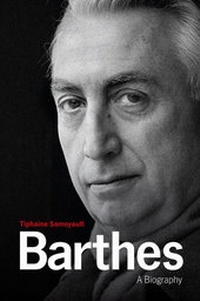
Barthes
Description

This major new biography of Barthes, based on unpublished material never before explored (archives, journals and notebooks), sheds new light on his intellectual positions, his political commitments and his ideas, beliefs and desires. It details the many themes he discussed, the authors he defended, the myths he castigated, the polemics that made him famous and his acute ear for the languages of his day. It also underscores his remarkable ability to see which way the wind was blowing D and he is still a compelling author to read in part because his path-breaking explorations uncovered themes that continue to preoccupy us today.
Barthes's life story gives substance and cohesion to his career, which was guided by desire, perspicacity and an extreme sensitivity to the material from which the world is shaped D as well as a powerful refusal to accept any authoritarian discourse. By allowing thought to be based on imagination, he turned thinking into both an art and an adventure. This remarkable biography enables the reader to enter into Barthes's life and grasp the shape of his existence, and thus understand the kind of writer he became and how he turned literature into life itself.
More details
Other editions
Additional editions

Persons
Content
Bibliographical note x
Foreword by Jonathan Culler xi
Prologue: The death of Roland Barthes 1
Introduction 13
The voice 13
'Life' 15
1 Setting off 24
A father dead at sea 27
The mother as replacement father 35
2 'Gochokissime' 48
From the seaside. . . 48
. . . to the heart of Paris 55
3 His whole life ahead of him 64
The years of apprenticeship 64
Elective affinities 75
4 Barthes and Gide 83
The beginning and the end 84
Music on the large scale and the small 87
Homosexuality 90
Journal 92
5 His whole life behind him 99
From Antiquity to Greece 99
From the Mediterranean to the Atlantic 106
From the Atlantic to behind the lines 110
6 New vistas 121
The body and its illness 121
'At the sanatorium, I was happy' 126
The first texts 133
7 Sorties 143
Far from the sanatorium 143
'Nadeau, to whom I owe that capital thing, a debut . . .' 147
Far from Paris (1). Bucharest 150
Far from Paris (2). Alexandria 159
Modes of writing: the Ministry and 'Degree Zero' 164
8 Barthes and Sartre 177
The argument about responsibilities 178
Childhood and history 184
An invitation to the imaginary 188
9 Scenes 193
Liquidations 194
Theatre 205
The year 1955 216
Theatricality 221
10 Structures 231
The sign 232
The École 237
Structure 248
The house 257
11 Literature 268
Encounters 269
Literary criticism 274
Barthes explains himself 283
The year 1966 291
Thinking the image 300
12 Events 306
Absences 307
The book on May: 'Sade, Fourier, Loyola' 317
Changes 320
Cut-ups 331
13 Barthes and Sollers 343
Friendship 346
Everyone's off to China 354
14 The body 367
The eye and the hand 371
Taste 379
Hearing and vision 384
Loving loving 391
15 Legitimacy 401
The professor 401
The Collège de France 409
Roland Barthes by Roland Barthes 413
The colloque de Cerisy 425
16 Barthes and Foucault 430
Parallel lives 431
An accompaniment 435
Two styles 437
17 Heartbreak 445
1977 445
Love 447
Death 458
The Mourning Diary 460
18 'Vita Nova' 470
15 April 1978 470
New life? 479
Clarity 484
The end 489
Notes 499
Image credits 565
Index 567
Foreword by Jonathan Culler
In 1979 Wayne Booth called Roland Barthes 'the man who may well be the strongest influence on American criticism today'. Booth did not mean this as a compliment, I hasten to add. He was complaining about the nefarious temptations to which he thought American criticism was succumbing. If Barthes bore the blame, it was because he had done more than anyone else, first, to convey the idea that literary criticism necessarily involves literary theory: conceptions of what a literary work is, how it functions and what readers do with it. And second, with his essays in Mythologies on other cultural practices, from wrestling and ads for detergents to the creation of images that become mythic - Einstein's brain or Greta Garbo - he had helped to bring into being what we now call Cultural Studies, in which literary study risked being submerged.
The Barthes who first became known to English and American readers in the 1960s presented himself as a semiologist or analyst of cultural sign systems, in the lively brief essays of Mythologies, which are still fun to read today, or in compact essays on works and authors, from La Bruyère to Brecht and Robbe-Grillet, some published in the Times Literary Supplement and collected in Critical Essays, that discussed literature as a practice designed to upset cultural stereotypes by experimenting with language. (The task of literature, he wrote, is not to 'express the inexpressible' but to 'unexpress the expressible', a tantalizing idea.) As the author of short essays with snappy punchlines, he was the most accessible of those French thinkers, grouped together first as 'structuralists' and then as 'poststructuralists', who were transforming the study of culture. But while thinkers like Michel Foucault, Jacques Lacan and Jacques Derrida pursued ongoing, coherent projects through a series of writings, Barthes was different. He enjoyed announcing the importance of some new mode of investigation or angle of approach, but he was quick to turn his back on the systematic projects he had himself championed - such as semiology or narratology - and write something quite different, in which he often mocked his previous declarations. His most popular books in the US and the UK are his early Mythologies and his last book, Camera Lucida, reflections on photography centred around a single photograph of his mother. Other unconventional books include A Lover's Discourse, which he calls not an analysis but a simulation of the ways a lover thinks and talks about the vexed relation to the beloved, and The Empire of Signs, about 'Japan as I imagine it', an alternative to western culture. He is hard to pin down, hard to associate with any particular theory for very long. In some ways, he is both the archetypal structuralist, with his writings on semiology and narratology, and the model poststructuralist, with his rejections of systematizing projects, his love of the fragment and his increasing evocations of the personal and affective dimensions of thought. And the range of interests reflected in his writings is particularly remarkable.
Barthes is a very accessible yet mysterious figure, whose life and projects are splendidly revealed in this magisterial biography, admirably translated by Andrew Brown, himself an authority on Barthes. Tiphaine Samoyault, writer (essayist and novelist) and literary critic, has had access to a lifetime of letters, diaries and notes, and has made good use of them in reconstructing for us the projects, engagements and resistances of this singular figure, whose life always seemed in various ways marginal, until he was elected to a professorship at the Collège de France, the nation's most distinguished institution.
Son of a naval officer, who was killed in action before Roland's first birthday, Barthes was raised by his mother, with whom he lived until her death in 1977. 'His formative problem', he writes of himself, 'was money, not sex', as they scrimped to buy shoes or schoolbooks. Then he contacted tuberculosis, and two lengthy stays in a sanatorium in the Alps prevented him from following normal studies for an academic career and also made him miss being involved in the Second World War, which was formative in different ways for most Frenchmen of his generation. Finally, from 1946 to 1962, Barthes lived by short-term measures with no clear direction or assured job - his time as a cultural affairs officer in Romania, which Samoyault describes in detail for the first time, was probably the most interesting - until eventually he got a position at an academic institution in Paris. One result of these uncertain situations was his readiness to accept almost any sort of writing commission, from prefaces for book club selections to interviews with Playboy. This habit continued after the need for these little jobs had vanished, as if, although complaining all the while, he needed the challenge, the intellectual stimulation of an odd commission. In the five volumes of his collected works, the occasional pieces outweigh the published books and reinforce the impression that Barthes was above all a writer - driven by a desire to write in order to, as he once put it, 'construct the intelligibility of our time'. He was above all responsive to the conflicting, often clashing cultural forces of the past and present. 'The full meaning of Barthes's intellectual enterprise', writes Samoyault, 'the full dramaturgy of his career, lies in the way he was always listening to the languages of his period, their difference and the exclusions they impose.'
Tiphaine Samoyault seems to have all Barthes's writing at her fingertips, which is a great boon for readers who might want to follow up this or that intriguing essay. What she gives us is not a biography that places his books in a chronological sequence and summarizes them, but an analysis of his projects in their intellectual context, accompanied by a narrative where no important details are ignored. She begins, in an eloquent and often elegiac Prologue, with the drama - and the puzzle - of Barthes's death (in March 1980, on his way back from a lunch with presidential candidate François Mitterrand, he was hit by a van and suffered injuries first judged not serious but that, given the weakness of his lungs, led to his death). Samoyault rightly judges that a detailed evocation of the man Barthes had become, and his situation in these final weeks, will be particularly engaging, especially since several of his friends wrote about his death in lightly disguised novels. She judiciously sifts through the many writings on Barthes to give us the main assessments of his career, before turning to the life itself and its unusual circumstances. But while providing detailed narratives of key moments in Barthes's life, such as the tense, close-fought contest for election to a chair at the Collège de France, she aims above all to let us see how Barthes develops his projects and negotiates the French intellectual scene, and she chooses to explore his very different relations, some more intellectual, some more personal, with a series of major figures - Gide and Sartre, both important influences - and also his contemporaries - Foucault (who led the campaign to elect him to the Collège de France), Lévi-Strauss (who declined to direct his doctoral thesis), and Sollers (novelist and editor, to whom Barthes was very loyal). Samoyault's biography thus gives us a shrewd, focused and personalized account of forty years of French intellectual life.
One of the mysteries of Barthes is that someone with such broad interests should have found so little joy in life, especially once he had reached a pinnacle of success. Can this be linked to another curious fact, that someone would be attracted to literature who has so little interest in plots and characters (he perversely takes the notational style of the haiku as a model for thinking about novels)? Samoyault allows us to see that what drives him above all is a desire to write that is not connected with imagining scenarios of action, endings, outcomes: when not constrained by a particular commission, he tended to write fragments. I particularly admire her willingness to offer theories and propose explanations without attempting to attribute them to Barthes himself, as biographers so often do ('doubtless he imagined that . . .', or 'he told himself that . . .'). She stresses the radical, transformative character of many of his projects, set against the rather melancholy figure of the man: 'We need to register the violence of the oeuvre, in its striking contrast with the gentleness of the person (all the eye-witness evidence is in complete agreement here) and the relative insignificance of the life.'
This unusual biography explores a whole range of issues and problems that Barthes tackled, and analyses a series of intellectual enterprises and their significance, including his late flirtations with the idea of writing a novel, or at least of thinking and writing about literature as if he were going to write a novel. I myself have always been a partisan of the early, structuralist Barthes, who championed the idea of a poetics that would not interpret literary works but would explore the signifying systems and conventions that make them possible, and who offered a host of new ideas about literature; and I have always regretted that...
