

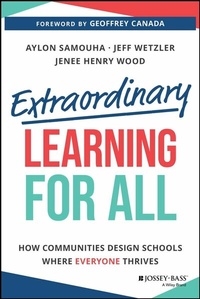
Extraordinary Learning for All
Description

Proven methods, hard-won lessons, and practical tools to create a better future of education
Extraordinary Learning for All: How Communities Design Schools Where Everyone Thrives delivers a hopeful, humane, realistic, and compelling portrait for how we must reinvent schooling for a new century, drawing on the voices and experiences of real school communities who are on that journey and illuminating the specific actions that school and system leaders can take to spark these journeys in their communities. The frameworks, concepts, and stories in this book, emanating from direct, in-the-trenches partnerships with innovators on the ground, show, in genuine detail, what makes this work hard-but also what makes it possible.
Written by the co-founders and Chief Learning Officer of Transcend, a leading nonprofit in school innovation, this book provides solutions to the major problems we face in education, including approaches that:
- Reverse declining enrollment rates and chronic truancy, especially in large urban districts, through better student engagement
- Mitigate our national mental health crisis through school designs that address higher-than-ever-rates of boredom, stress, and chronic anxiety
- Engage and collaborate with parents and communities to improve local schools
- Uplift the voices and expertise of teachers, 300,000 of whom left the profession between 2020-2022
For educational leaders in communities of all shapes and sizes, Extraordinary Learning for All: How Communities Design Schools Where Everyone Thrives is your blueprint to break free from the traditional model of schooling and build a better future for all.
More details
Other editions
Additional editions
Persons
Aylon Samouha (Chicago, IL) is Co-Founder & Co-CEO of Transcend Education. Prior to co-founding Transcend, Aylon was an independent designer providing strategy and design services to education organizations, schools, and foundations. Aylon also served as Chief Schools Officer at Rocketship Education; leading the highest performing network of low-income schools in the state of California, designing the academic model and blended learning approach, and growing the network from 3 to 7 schools.
Jeff Wetzler (Hastings on Hudson, NY) is Co-Founder & Co-CEO of Transcend Education. Prior to Transcend, Jeff spent a decade in senior leadership roles at Teach For America. Jeff was a founding board member of Leadership Prep Charter Schools and has served on the boards of Uncommon Schools NYC and the National Academy of Advanced Teacher Education. He currently serves as board chair of New Classrooms Innovation Partners.
Jenee Henry Wood (New Haven, CT) is Head of Learning at Transcend Education, an organization which helps schools across the country build & share innovative new models of learning. Transcend has served over 800,000 students through their work with nearly 400 districts & schools. Transcend directly supports schools and systems in their design work, democratizes design support through resources, tools, and professional learning, and catalyzes systemic change by engaging funders and system leaders to understand and advance innovation.
Content
About the Authors xv
Acknowledgments xvii
Authors' Note xxi
Foreword xxiii
Introduction 1
Two Schools, Two Districts, Two Possible Futures 1
Our Case for Change 2
School and Its Industrial-Era Design 4
How to Read This Book 7
Who Is This Book For? 8
About Us 9
Part I Extraordinary Learning for All
Chapter 1 Extraordinary Experiences and Outcomes 13
Extraordinary Outcomes for All 14
Extraordinary Experiences for All 16
Chapter 2 Community-Based Design 33
The Basics of Community-Based Design 35
Part II Stories from Four Community Design Journeys
Chapter 3 DC Public Schools' Van Ness Elementary | Washington, DC 55
Community and Leadership Context 59
The Blueprint: Overview of the Whole Child Model Learning Environment Design 60
The Blueprint: Goals and Guiding Concepts 62
The Blueprint: Student Experience 69
The Blueprint: School and System Elements 75
Chapter 4 Northern Cass | Hunter, North Dakota 81
Community and Leadership Context 84
Early Innovations Toward Competency-Based Learning: Pursuing Greater Learner Customization 85
How the Design Cycle Guided and Supported Northern Cass's Design Journey 92
Chapter 5 Brooklyn STEAM Center | Brooklyn, New York 103
Community and Leadership Context 106
The Blueprint: Overview of Brooklyn STEAM's Learning Environment Design 108
The Blueprint: Goals and Guiding Concepts 109
The Blueprint: Student Experience 115
Chapter 6 Intrinsic Public Schools | Chicago, Illinois 127
Community and Leadership Context 129
The Academic Model: How Community-Based Design Strengthened Learning 132
Part III How to Embark on a Community-based Design Journey
Chapter 7 Launching Your Design Journey 143
"Gear Up": Lay the Foundation for Your Community Design Journey 145
"Map It": Craft a High-Level Vision for the Entire School or System 150
Chapter 8 Deepening Your Design Journey 167
"Zoom In": Craft a Detailed Vision for a Specific Aspect of the Student Experience 168
"Test-Drive": Test and Refine the Student Experience 177
"Look Ahead": Prepare to Continue the Journey 185
Chapter 9 Advancing and Sustaining Your Design Journey 189
Shift from "Test-Drive to Full Speed": Advance a Component of the Student Experience from Testing to Multiple Cycles of Implementation 191
"Zoom In Again": Design Additional Components of the Student Experience 199
"Map It Again": Continue to Refine the High-Level Vision for the Entire School or System 202
"Perform Routine Maintenance": Maintain the Process and Leadership Over the Long Haul 207
Part IV How to Turbocharge Your Community Design Journey
Chapter 10 Your Leadership Matters 213
A Special Kind of Leadership for a Special Kind of Challenge 215
What Do Learner-Centered Leaders Do? 215
How Do Learner-Centered Leaders Have Impact on Conditions? 220
The Source of This Framework 223
Be a Learner-Centered Leader 225
Chapter 11 The Policy Environment Around You Matters 229
Policy Impact 230
Assessment and Accountability Systems 231
Seat Time and Graduation Requirements 236
Funding for Innovation 238
Navigating Your Policy Environment 241
Conclusion 245
Conclusion: You Are Not Alone 247
Explore New Models that Make the Leaps 247
Find a Design Partner 248
Where Do I Find Design Partners? 250
Build Your Own Capacity 251
Join a Growing Network 252
Extraordinary Learning for All 252
Endnotes 255
Index 271
Introduction
You've come to this book because you believe that all children have infinite potential. But to realize this potential, we must redefine "schooling" as we know it. Perhaps you have already witnessed the power of extraordinary learning in your school or an out-of-school experience and it has ignited a spark within you. While the current educational system may seem intractable, you refuse to be discouraged. You recognize that our young people deserve nothing less than the very best, and you are ready to be a catalyst for this transformation.
TWO SCHOOLS, TWO DISTRICTS, TWO POSSIBLE FUTURES
Joanna is a ninth grader at General High School. All her life she has been artistic, creative, and curious. Her family moved to this community because all the common wisdom said that it was a "good school district." Test scores were high, as were graduation rates. By all measures, this was an enviable place to be. But over time, Joanna's family notices that their artistic and adventurous child appears stressed and withdrawn. Her creative spirit has dimmed. She is buried underneath homework, grades, and test prep.
Joanna's school day is typical of many American students. She arrives around 8 : 30 a.m., sits in fifty-five-minute content subjects with students her same age, takes notes from a teacher at the front of the room, hurries through lunch, and completes mountains of work that she finds disconnected from the issues she cares about most. Joanna likes her teachers, who are thoughtful and hardworking, but school is tedious.
Across town, Ali is having a very different experience at Discovery High School. Like Joanna, he is highly creative and has long shown interest in filmmaking. When he was in middle school, he participated in a yearlong learning experience that helped him to understand his passions and sense of purpose. He discovered that he loved interviewing people and telling stories. He created a thirty-minute documentary about the experiences of small business owners in his downtown. The experience was transformative. Now, Ali's high school experience looks very different from Joanna's.
When Ali arrives, he's already completed a math and science class, focused on the fundamentals. His school offers online courses for students who want to expedite their learning and have shown they can master competencies. In person, Ali attends a math and science hybrid seminar-his working group is attempting to create efficient solar ovens. They are applying concepts from geometry, optics, and energy. They are varying the designs, angles, and thickness of materials to test hypotheses. Ali's team is solving a challenge he and his classmates care about: life on a warming planet.
Ali's next experience is a small-group Advisory Circle, where he reflects on his weekly goals with peers. He then attends a writing workshop where he tests ideas for a documentary series he's creating. His friends from Advisory encouraged him to expand his horizons, so he is taking a hands-on construction class where he and a small group are exploring how to prevent flooding in a greenhouse they are building.
Ali is motivated to be at school. His learning environment allows him to practice new skills, learning from his triumphs and failures. Ali has a sense of control over his learning, being able to pick how fast or slow he progresses through content. Every day, he has opportunities to increase his self-understanding and feels that he belongs here.
Joanna and Ali are not radically different young people with wildly divergent dreams for their futures. However, they are immersed in fundamentally different learning environments that are creating different outcomes and experiences. Joanna attends a high school that many of us recognize. It is what we call "industrial-era education"-schooling that reflects the needs and structures of a bygone age when jobs in factories or fields were the expectation. Her learning is characterized by a set of experiences that are often narrow, inflexible, and confined to the four walls of the school building.
When you think about the learning environment that you want for your own children or the children in your district, which would you choose? While Joanna and Ali still have so much more life to experience, their life trajectories could be different. Students from Ali's high school are not guaranteed a perfect future, but they are armed with myriad experiences that have cultivated growth in all kinds of transformative ways. Ali's learning environment is one nearly everyone would choose for their children and themselves.
What makes Discovery High School and the school system that supports it so extraordinary? It's the design.
OUR CASE FOR CHANGE
In this book, we ask and answer one big question: How do communities create extraordinary learning for all?
As educators, we know the reality for most young people in school today is merely fine. School is neither awful nor extraordinary. Students make their way through the education system as it was intended to unfold. But when we reflect and allow ourselves to think expansively about what matters, for all children, we see in Ali's journey something extraordinary happening that is worth learning from.
This book has three big ideas. If you read no further, take these with you:
- Big Idea #1: School has a design, and it can be redesigned. A set of basic practices, structures, and assumptions has historically shaped the American public school system: students grouped by age progress through a subject-based curriculum, assessed at the same time, within a singular building structure. Scholars have called this the "grammar of schooling"1-practices ingrained in the education system and resistant to change, much like the grammar of a language. School as we know it was designed more than a century ago for efficiency and control over students. It incorporated ideas at the time-that emphasized managerial philosophy, such as standardization and specialization, in an economy built on factories or farms-but that are far from sufficient for developing the skills and habits that young people need today.
- Big Idea #2: We must redesign school from the ground up by making big "Leaps" away from outdated approaches. We have developed the Leaps for Equitable 21st Century Learning framework to describe the key ways we believe the student experience must change so that schools can prepare all young people to thrive in and transform the world. These ten Leaps invite us to reimagine how we educate young people-centering on personal growth and equal opportunity for every child-so that all young people will not only maximize their own potential but also tackle society's greatest challenges.
- Big Idea #3: Community-based design is a proven process by which communities can make these Leaps. It is a strengths-based approach to school change that draws upon our proximity to real communities making these strides as well as a century of learning and progress in the education sector. This approach combines the latest in learning and cognitive science with a community's wisdom, needs, and goals. Through community-based design, schools rethink every aspect of teaching and learning, from curriculum and culture to scheduling and facilities. The result is a 21st-century learning environment that leaves students more intellectually engaged, emotionally connected, and personally empowered.
For many of us, our conception of school change has one of two archetypes: we are pursuing either "top-down" initiatives headed by visionary leaders or "bottom-up" change emanating from classrooms, schools, or parents. Community-based design offers a third way: a local process where young people, educators, administrators, and caregivers come together-supported by expertise in learning science and design thinking, as well as evidence-backed models-to collaboratively pursue better learning experiences and outcomes. This process is grounded in the belief that young people deserve learning environments that cultivate comprehensive human development and value communities as a powerful resource for building better schools.
At this point you may be thinking, "Terrific, I've purchased another out-of-touch, fanciful education book that can be achieved only if my community is wealthy, connected, and preferably both." Suspend that skepticism! Innovation and change have never been more possible in all schools than now, today.
The last ten to twenty years have brought tremendous insights from the interdisciplinary field of the science of learning and development. It is teaching us how humans actually learn.2 Technology is increasingly enabling personalized, self-paced learning that accommodates each learner's unique strengths and weaknesses. Teachers are embracing new technologies in the classroom, which have the potential to revolutionize learning.3 Platforms that allow young people to see their progression on learning competencies and self-pace toward mastery empower students to own their learning in profound new ways. AI-powered tutoring systems can provide individualized support, answer questions, explain complexities, provide high-quality feedback, and enable practice. By the time you read this book, there could be even more significant advancements that we cannot yet foresee.
This book is about inspiration and hope, not only a...
