

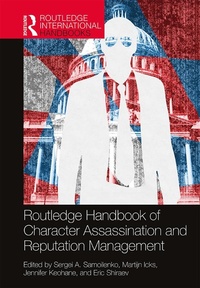
Routledge Handbook of Character Assassination and Reputation Management
1st Edition
Published on 5. December 2019
454 pages
978-1-351-36833-9 (ISBN)
Description

In modern politics as well as in historical times, character attacks abound. Words and images, like symbolic and psychological weapons, have sullied or destroyed numerous reputations. People mobilize significant material and psychological resources to defend themselves against such attacks. How does character assassination "work," and when does it not? Why do many targets fall so easily when they are under character attack? How can one prevent attacks and defend against them?
The Routledge Handbook of Character Assassination and Reputation Management offers the first comprehensive examination of character assassination. Moving beyond studying corporate reputation management and how public figures enact and maintain their reputation, this lively volume offers a framework and cases to help understand, critically analyze, and effectively defend against such attacks. Written by an international and interdisciplinary team of experts, the book begins with a theoretical introduction and extensive description of the "five pillars" of character assassination: (1) the attacker, (2) the target, (3) the media, (4) the public, and (5) the context. The remaining chapters present engaging case studies suitable for class discussion. These include:
Roman emperors;
Reformation propaganda;
the Founding Fathers;
defamation in US politics;
women politicians;
autocratic regimes;
European leaders;
celebrities;
nations;
Internet campaigns.
This handbook will prove invaluable to undergraduate and postgraduate students in communication, political science, history, sociology, and psychology departments. It will also help researchers become independent, critical, and informed thinkers capable of avoiding the pressure and manipulations of the media.
The Routledge Handbook of Character Assassination and Reputation Management offers the first comprehensive examination of character assassination. Moving beyond studying corporate reputation management and how public figures enact and maintain their reputation, this lively volume offers a framework and cases to help understand, critically analyze, and effectively defend against such attacks. Written by an international and interdisciplinary team of experts, the book begins with a theoretical introduction and extensive description of the "five pillars" of character assassination: (1) the attacker, (2) the target, (3) the media, (4) the public, and (5) the context. The remaining chapters present engaging case studies suitable for class discussion. These include:
Roman emperors;
Reformation propaganda;
the Founding Fathers;
defamation in US politics;
women politicians;
autocratic regimes;
European leaders;
celebrities;
nations;
Internet campaigns.
This handbook will prove invaluable to undergraduate and postgraduate students in communication, political science, history, sociology, and psychology departments. It will also help researchers become independent, critical, and informed thinkers capable of avoiding the pressure and manipulations of the media.
Reviews / Votes
"Character assassination is poisoning our civil discourse. The editors have created a book that is essential reading for citizens who must learn how to tell truth from fiction. This book will help guide us on how to handle this issue in the future."Donna Brazile, Democratic Strategist, Former Chairwoman, Democratic National Committee and Adjunct Professor, Georgetown University
"This book is an excellent educational and scientifically sound guide to studying character assassination and reputation management. The team of editors gathered research, insights, and a wide range of cases from prominent scholars across the world. It is a must-read for researchers and practitioners who seek to critically discuss the most notable features of character assassination and find the defenses against it."
Nancy Snow, Professor Emeritus at California State University, Fullerton and Pax Mundi Professor of Public Diplomacy at Kyoto University of Foreign Studies, Japan
"This book is an extremely valuable resource tool that provides a wealth of valuable data, theory, and analysis illustrating how personal attack arguments work as powerful public relations tools in many fields and settings. It shows in fascinating detail how the ad hominem argument has been around for a long time and continues to be a form of attack that is difficult to resist or counter. It is especially relevant and useful at this point in the history of politics where personal attacks on reputation and character, such as allegations of hypocrisy, dishonesty, and other failures of moral character, dominate the media."
Douglas Walton, Distinguished Research Fellow of the Centre for Research in Reasoning, Argumentation and Rhetoric, University of Windsor
"An impressive effort to conceptualise character assassination, embracing a variety of ways of aggressive use of information, as practices stretching across time and space. As old as the world itself, yet also a novel symptom of our times, the informal practices of character assassination is an important indicator of defects of formal institutions in the post-truth era. This handbook is a testimony of how common the information misuse has become, greatly assisted by cyber-possibilities and the increasingly un-governable societies."
Alena Ledeneva, Professor of Politics and Society, University College London, Founder of the UCL Global Informality Project
More details
Series
Edition
1. Auflage
Language
English
Place of publication
London
United Kingdom
Publishing group
Taylor & Francis Ltd
Target group
College/higher education
Illustrations
14 Tables, black and white
ISBN-13
978-1-351-36833-9 (9781351368339)
Copyright in bibliographic data and cover images is held by Nielsen Book Services Limited or by the publishers or by their respective licensors: all rights reserved.
Schweitzer Classification
Other editions
Additional editions
Sergei A. Samoilenko | Martijn Icks | Jennifer Keohane
Routledge Handbook of Character Assassination and Reputation Management
Book
08/2021
1st Edition
Routledge
€72.90
Shipment within 10-20 days
Sergei A. Samoilenko | Martijn Icks | Jennifer Keohane
Routledge Handbook of Character Assassination and Reputation Management
Book
12/2019
1st Edition
Routledge
€326.82
Shipment within 10-20 days
Persons
Sergei A. Samoilenko is a public relations instructor in the Department of Communication at George Mason University. His research focuses on issues in crisis communication, reputation management, and post-Soviet studies. He is a co-editor of Deception, Fake News and Misinformation Online and Traditional and New Media Studies in Eastern Europe and Eurasia.
Martijn Icks is Lecturer in Ancient History at the University of Amsterdam. He specializes in Roman imperial history and the history of character assassination. His study on the Roman emperor Elagabalus has appeared in three languages.
Jennifer Keohane is Assistant Professor in the Klein Family School of Communications Design at the University of Baltimore. Her current research explores the rhetoric of the labor movement in the United States. She is the author of Communist Rhetoric and Feminist Voices in Cold War America, and her other research has appeared in Women's Studies in Communication, Rhetoric Society Quarterly and Rhetoric Review.
Eric Shiraev teaches at George Mason University. He is an author, a co-author, and co-editor of twenty books and numerous publications in the fields of political psychology, international relations, and cross-cultural studies. Besides his teaching and scholarly work, Shiraev writes policy briefs and opinion essays for government agencies, NGOs, and the media.
Martijn Icks is Lecturer in Ancient History at the University of Amsterdam. He specializes in Roman imperial history and the history of character assassination. His study on the Roman emperor Elagabalus has appeared in three languages.
Jennifer Keohane is Assistant Professor in the Klein Family School of Communications Design at the University of Baltimore. Her current research explores the rhetoric of the labor movement in the United States. She is the author of Communist Rhetoric and Feminist Voices in Cold War America, and her other research has appeared in Women's Studies in Communication, Rhetoric Society Quarterly and Rhetoric Review.
Eric Shiraev teaches at George Mason University. He is an author, a co-author, and co-editor of twenty books and numerous publications in the fields of political psychology, international relations, and cross-cultural studies. Besides his teaching and scholarly work, Shiraev writes policy briefs and opinion essays for government agencies, NGOs, and the media.
Content
Introduction. PART I: The Theory of CA and Reputation Management. 1 Character Assassination: Theoretical Framework. 2 Inoculation Theory Against/As Character Assassination. 3 The Traumatic Psychological Impact of Character Attacks on Targets. 4 Character Assassination as a Structurational Phenomenon. 5 Cross-Cultural Comparisons of Character Assassination. PART II: National and International Dynamics. 6 Character Attacks on Dutch Revolutionary Adam Gerard Mappa (1754-1828). 7 Character Assassination in the Soviet Union and Russia. 8 Character Assassination of Activists in Egypt: ElBaradei as a Target. 9 Character Assassination and the Contemporary Anti-Corruption Campaign in the Chinese Military. 10 Character Attacks by Dutch Populist Radical Right Leader Geert Wilders. 11 Ad Hominem Attacks in Greek Politics: The Case of the 2015 Referendum. 12 The Role of Propaganda in the Character Assassination of World Leaders in International Affairs. PART III: Individual and Collective Targets. 13 Agrippina, Theodora and Fredegund as Evil Empresses in the Historiographic Tradition. 14 The Character Assassination of Marie-Antoinette: Defamation in the Age of the French Revolution. 15 Argumentum ad Carricare as a Mode of Character Attack: Alec Baldwin as Donald Trump on Saturday Night Live. 16 Corporate Character Assassination and Crisis Communication. 17 Country Reputation Assassination during the Greek Memorandum Re-Negotiations. PART IV: Strategies of Attack and Defence. 18 The Fight for Public Opinion and Memoria in the Early Roman Principate. 19 The Rhetorical and Ethical Implications of Character Assassination in the Age of McCarthy. 20 Character Assassination and the Nixon White House. 21 Character Assassination and Persuasive Attack on CBS's Face the Nation. 22 Reductio ad Hitlerum as a New Frame for Political and Geopolitical Conflicts. 23 Show Trials in Communist Countries: Psychology of the Ultimate Cases of Character Assassination. PART V: The Cultures of Emergent Media. 24 Character Assassination in Reformation Propaganda. 25 Late-Night TV Humor and the Culture of Ridicule. 26 Character Assassins and Moral Entrepreneurs: Social Media and the Regulation of Morality. 27 Psychological Traits of Character Assassins: Studies in Cyber-Aggression. 28 Character Assassination as Scapegoating: The Dentist Who Killed Cecil the Lion. 29 Character Assassination by Memes: Mosquitos versus Elephants. Conclusions and Future Research.
