

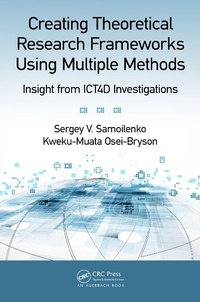
Creating Theoretical Research Frameworks using Multiple Methods
Insight from ICT4D Investigations
Published on 30. October 2017
420 pages
978-1-4987-7996-8 (ISBN)
Description

By now, it is commonly accepted that investments in information and communication technologies (ICTs) can facilitate macroeconomic growth in developed countries. Research standards in ICT for development (ICT4D) are high, and it is a basic expectation that a theoretically sound conceptual investigation should yield actionable results. An additional expectation is that an on-the-ground study conducted in each setting should add to the common body of knowledge based on theory. In other words, one is expected to make a connection between the world of concepts and the world of reality. Middle-range theories and frameworks could help connect the case studies with grand theories, by helping to create a theoretically sound and practically applicable research architecture of ICT4D.
This book demonstrates how creative use of various data analysis methods (e.g., data mining [DM], data envelopment analysis [DEA], and structural equation modeling [SEM]) and conceptual frameworks (e.g., neoclassical growth accounting, chaos and complexity theories) may be utilized for inductive and deductive purposes to develop and to test, in step-by-step fashion, theoretically sound frameworks for a large subset of ICT4D research questions. Speci?cally, this book showcases the utilization of DM, DEA, and SEM for the following purposes:
Identi?cation of the relevant context-speci?c constructs (inductive application)
Identi?cation of the relationships between the constructs (inductive application)
Development of a framework incorporating the constructs and relationships discovered (inductive application)
Testing of the constructed framework (deductive application)
The book takes a multi-theoretical perspective to economic development research. It starts with an overview of ICT4D. Next it covers such frameworks and theories as neoclassical growth accounting and the theory of complementarity, complex systems and chaos theories, and the product life cycle (PLC) theory. There are also nontechnical overviews of the DM and data analytic methods that can be used in this research. Also presented is evidence that human capital and investment capital are complementary and are reliable sources of economic growth. The book concludes with methodological frameworks to guide investment decisions and the formulation of strategic policy.
This book demonstrates how creative use of various data analysis methods (e.g., data mining [DM], data envelopment analysis [DEA], and structural equation modeling [SEM]) and conceptual frameworks (e.g., neoclassical growth accounting, chaos and complexity theories) may be utilized for inductive and deductive purposes to develop and to test, in step-by-step fashion, theoretically sound frameworks for a large subset of ICT4D research questions. Speci?cally, this book showcases the utilization of DM, DEA, and SEM for the following purposes:
Identi?cation of the relevant context-speci?c constructs (inductive application)
Identi?cation of the relationships between the constructs (inductive application)
Development of a framework incorporating the constructs and relationships discovered (inductive application)
Testing of the constructed framework (deductive application)
The book takes a multi-theoretical perspective to economic development research. It starts with an overview of ICT4D. Next it covers such frameworks and theories as neoclassical growth accounting and the theory of complementarity, complex systems and chaos theories, and the product life cycle (PLC) theory. There are also nontechnical overviews of the DM and data analytic methods that can be used in this research. Also presented is evidence that human capital and investment capital are complementary and are reliable sources of economic growth. The book concludes with methodological frameworks to guide investment decisions and the formulation of strategic policy.
More details
Language
English
Place of publication
Philadelphia, PA
United States
Publishing group
Taylor & Francis Inc
Target group
College/higher education
Illustrations
111 Tables, black and white; 75 Illustrations, black and white
File size
14,33 MB
ISBN-13
978-1-4987-7996-8 (9781498779968)
Copyright in bibliographic data and cover images is held by Nielsen Book Services Limited or by the publishers or by their respective licensors: all rights reserved.
Schweitzer Classification
Other editions
Additional editions
Sergey V. Samoilenko | Kweku-Muata Osei-Bryson
Creating Theoretical Research Frameworks using Multiple Methods
Insight from ICT4D Investigations
Book
01/2023
1st Edition
Auerbach
€79.41
Shipment within 10-20 days
Sergey V. Samoilenko | Kweku-Muata Osei-Bryson
Creating Theoretical Research Frameworks using Multiple Methods
Insight from ICT4D Investigations
Book
10/2017
1st Edition
Auerbach Publishers Inc.
€187.40
Shipment within 15-20 days
Persons
Sergey Samoilenko is an associate professor and the Chair of the Department of Computer Science and Computer Information Systems at Averett University, in Danville, Virginia. Sergey's current research interests include IT and productivity, data mining, and IS development. He holds his PhD and MS in information systems from Virginia Commonwealth University. He has published in the European Journal of Operational Research, Journal of Global Information Technology Management, International Journal of Production Economics, Expert Systems with Applications, and Information Systems Frontiers, among other journals, as well as in numerous conference proceedings.
Kweku-Muata Osei-Bryson is professor of Information Systems at Virginia Commonwealth University. Previously he was professor of information systems and decision analysis in the School of Business at Howard University, Washington, DC, USA. He has also worked as an information systems practitioner in both industry and government. His research areas include: Data Mining, Decision Support Systems, Knowledge Management, IS Security, e-Commerce, IT for Development, Database Management, IS Outsourcing, Multi-Criteria Decision Making. He has published in various leading journals including: Decision Support Systems, Information Systems Journal, Expert Systems with Applications, European Journal of Information Systems, Information Systems Frontiers, Knowledge Management Research & Practice, Information Sciences, Information & Management, Journal of the Association for Information Systems, Journal of Information Technology for Development, Journal of Database Management, Computers & Operations Research, Journal of the Operational Research Society, & the European Journal of Operational Research.
Kweku-Muata Osei-Bryson is professor of Information Systems at Virginia Commonwealth University. Previously he was professor of information systems and decision analysis in the School of Business at Howard University, Washington, DC, USA. He has also worked as an information systems practitioner in both industry and government. His research areas include: Data Mining, Decision Support Systems, Knowledge Management, IS Security, e-Commerce, IT for Development, Database Management, IS Outsourcing, Multi-Criteria Decision Making. He has published in various leading journals including: Decision Support Systems, Information Systems Journal, Expert Systems with Applications, European Journal of Information Systems, Information Systems Frontiers, Knowledge Management Research & Practice, Information Sciences, Information & Management, Journal of the Association for Information Systems, Journal of Information Technology for Development, Journal of Database Management, Computers & Operations Research, Journal of the Operational Research Society, & the European Journal of Operational Research.
Content
Introduction. Overview on ICT4D Research. Overview on Neo-Classical Growth Accounting. Overview on Chaos & Complex Systems Theory. Product Life Cycle Theory. Overview on Decision Tree Induction. Overview on Cluster Analysis. Overview on Data Envelopment Analysis (DEA). Overview on Structural Equation Modeling (SEM). Overview of Neural Networks (NN). Inquiry into heterogeneity of the competitive environment (by using CA). Investigation of the sources of heterogeneity of the competitive environment (by using DT). Assessment of the relative efficiency of competitors in heterogeneous environment(by using DEA and DT). Finding sources of relative inefficiencies in heterogeneous environment (by using DEA with MI and DT). Study of the role of a human capital in growth in productivity (by using DEA with SEM). Formulation of investment strategies driven by relative efficiency and growth in productivity (by using DEA with MI). Allocation of investments to optimize economic performance of the product (by using DEA applied to Product Life Cycle theory). Assessing the role of resources vs. utilization of resources in efficient production of economic outputs (by using NN).
