

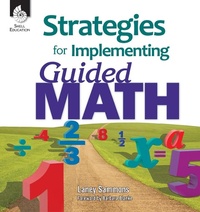
Strategies for Implementing Guided Math
Published on 15. July 2012
344 pages
978-1-4258-9466-5 (ISBN)
Description

In this resource, Laney Sammons, author of Guided Math, delves into the strategies necessary to effectively implement the Guided Math Framework. It provides specific strategies for implementing the seven elements of the Guided Math Framework. In addition, this professional resource includes digital resources, sample lessons, activities, and classroom snapshots of strategy implementation at three grade level spans: K-2, 3-5, and 6-8. Strategies for Implementing Guided Math is correlated to College and Career Readiness and other state standards.
More details
Series
Language
English
Place of publication
Huntington Beach
United States
Target group
Professional and scholarly
US School Grade: From Kindergarten to Eighth Grade
File size
25,87 MB
ISBN-13
978-1-4258-9466-5 (9781425894665)
Copyright in bibliographic data and cover images is held by Nielsen Book Services Limited or by the publishers or by their respective licensors: all rights reserved.
Schweitzer Classification
Other editions
Additional editions

Laney Sammons
Strategies for Implementing Guided Math
Book
07/2012
Shell Educational Publishing
€93.00
Shipment within 5-8 weeks
Content
- Cover
- Credits
- Page 3 - Table of Contents
- Page A - Introduction
- Page 4 - Foreword
- Page 6 - Acknowledgments
- Page 7 - Developing Mathematical Literacy
- Page 9 - Differentiation in Mathematics Education
- Page 11 - Mathematical Communication
- Page 12 - The Foundational Principles of Guided Math
- Page 15 - Components of the Guided Math Framework
- Page 18 - Levels of Instructional Support
- Page 20 - Putting It into Practice
- Page 28 - How to Use This Resource
- Page 30 - Correlation to Standards
- Page 38 - About the Author
- Page 39 - Strategies for Creating a Classroom Environment of Numeracy
- Page 41 - Strategies for Building a Community of Young Mathematicians
- Page 41 - Characteristics of a Mathematics Classroom Community
- Page 42 - Strategies for Establishing a Classroom Community
- Page 45 - Math Huddles
- Page 46 - Math Huddle Snapshots
- Page 52 - Strategies for Classroom Arrangement and Organization
- Page 53 - Sample Classroom Arrangements
- Page 56 - Math Alcoves
- Page 57 - Organizing and Storing Materials
- Page 59 - Strategies for Using Anchor Charts
- Page 61 - Anchor Chart Sample Lessons
- Page 67 - Strategies for Building Vocabulary with Math Word Walls
- Page 67 - Creating and Using Math Word Walls
- Page 68 - Math Word Wall Sample Lessons
- Page 77 - Strategies for Math Warm-Ups
- Page 79 - Understanding and Implementing Math Warm-Ups
- Page 79 - Tips for Planning Math Warm-Ups
- Page 80 - Math Warm-Ups Around the Classroom
- Page 80 - Taking Daily Attendance
- Page 81 - Monitoring Progress in Meeting Personal Academic Goals
- Page 82 - Supporting Classroom and Community Projects
- Page 83 - Planning Field Trips
- Page 84 - Math Warm-Ups with Current Events
- Page 85 - Math Warm-Ups with Calendar Board
- Page 87 - Math Warm-Ups with Problems of the Week
- Page 87 - The Problem-Solving Process
- Page 89 - Sample Problems of the Week
- Page 90 - Graphic Organizers
- Page 92 - Math Stretches as Warm-Ups
- Page 92 - What Are Math Stretches?
- Page 92 - Math Stretches Versus Traditional Math Daily-Review Work
- Page 92 - Planning Math Stretches
- Page 96 - Sample Math Stretches
- Page 141 - Strategies for Whole-Class Instruction
- Page 143 - Effective Whole-Class Instruction
- Page 144 - Strategies for Mathematics Mini Lessons
- Page 144 - The Architecture of a Mathematics Mini Lesson
- Page 145 - Tips for Effective Mini Lessons
- Page 146 - Sample Mini Lessons
- Page 158 - Strategies for Activating Prior Knowledge
- Pag 158 - Talking Drawings
- Page 160 - Math Rules!
- Page 162 - Talk It Up!
- Page 164 - Pose a Problem
- Page 166 - Strategies for Using Mathematics-Related Literature
- Page 166 - Tips for Using Literature to Teach Mathematics
- Page 168 - Sample Lessons
- Page 183 - Strategies for Small-Group Instruction
- Page 185 - Effective Small-Group Instruction
- Page 186 - Organizing and Planning Small-Group Instruction
- Page 188 - Sample Daily Schedule for Math Groups
- Page 189 - Sample Weekly Schedule for Math Groups
- Page 190 - Strategies for Teaching a Small-Group Lesson
- Page 193 - Recording Anecdotal Notes
- Page 194 - Guided Math Small-Group Lesson Template
- Page 195 - Sample Lessons
- Page 221 - Strategies for Math Workshop
- Page 223 - Implementing Math Workshop
- Page 223 - Strategies for Organizing the Classroom
- Page 227 - Strategies for Managing Math Workshop
- Page 230 - Strategies for Creating Effective Math Workstations
- Page 232 - Sample Tasks for GUIDE Math Workstations
- Page 232 - G: Games for Mathematicians
- Page 243 - U: Using What We Know
- Page 254 - I: Independent Math Work
- Page 259 - D: Developing Fluency
- Page 263 - E: Expressing Mathematical Ideas
- Page 275 - GUIDE Recording Sheets
- Page 277 - Strategies for Conferring with Students
- Page 279 - The Importance of One-on-One Mathematical Conferences
- Page 280 - Strategies for Scheduling Conferences
- Page 281 - Weekly Math Conference Schedule
- Page 282 - Finding Time for Conferring with Students
- Page 283 - Strategies for Planning Math Conferences
- Page 284 - Questions for Conferences
- Page 286 - Conference Snapshots
- Page 294 - Strategies for Keeping Records of Conferences
- Page 294 - Math Conference Checklist
- Page 294 - Math Conference Note
- Page 295 - Sticky-Note Organizer
- Page 295 - Mailing Labels
- Page 299 - Strategies for Planning Conference Follow-Up
- Page 299 - Follow-Up Strategies for the Whole Class
- Page 299 - Follow-Up Strategies for Small Groups
- Page 300 - Follow-Up Strategies for Individual Students
- Page 301 - Strategies for Assessment
- Page 303 - An Overview of Assessment
- Page 305 - Assessment in the Teaching Cycle
- Page 306 - Strategies for Descriptive Feedback
- Page 308 - Examples of Descriptive Feedback
- Page 310 - Strategies for Gathering Evidence of Learning
- Page 311 - Strategies for Involving Students in the Assessment Process
- Page 313 - Math Journals
- Page 315 - Tickets Out the Door
- Page 316 - Problem-Solving Checklists
- Page 321 - Sample Self-Assessment Rubrics
- Page 326 - Strategies for Using Assessment Data for Small-Group Instruction
- Page 326 - Flexible, Dynamic, and Fluid Grouping
- Page 327 - Determining Group Composition
- Page 328 - Instructional Groups Example
- Page 330 - Grouping Guide Template
- Page 331 - Instructional Groups Template
- Page 332 - Planning Differentiated Lessons for Small Groups
- Page 335 - Appendices
- Page 335 - Appendix A: References Cited
- Page 339 - Appendix B: Recommended Children's Literature
- Page 341 - Appendix C: Contents of the Digital Resources CD
- Thank You Page
