

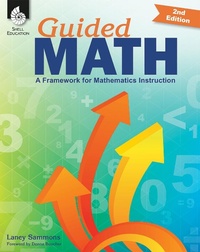
Guided Math
A Framework for Mathematics Instruction
2nd Edition
Published on 22. March 2019
392 pages
978-1-64290-378-2 (ISBN)
Description

This instructional math framework provides an environment for mathematics that fosters mathematical thinking and understanding while meeting the needs of all students. Educators will learn how to effectively utilize small-group and whole-group instruction, manipulatives, math warm-ups, and math workshop to engage students in connecting mathematics to their own lives. Maximize the impact of your instruction with ideas for using ongoing assessment and differentiation strategies. This second edition resource provides practical guidance and sample lessons for grade-level bands K-2, 3-5, 6-8, and 9-12. Promote a classroom environment of numeracy and mathematical discourse with this essential professional resource for K-12 math teachers!
More details
Series
Edition
Second Edition
Language
English
Place of publication
Huntington Beach
United States
Target group
Professional and scholarly
US School Grade: From Kindergarten to Twelfth Grade
File size
18,70 MB
ISBN-13
978-1-64290-378-2 (9781642903782)
Copyright in bibliographic data and cover images is held by Nielsen Book Services Limited or by the publishers or by their respective licensors: all rights reserved.
Schweitzer Classification
Other editions
Additional editions
Book
03/2019
2nd Edition
Shell Educational Publishing
€42.50
Shipment within 5-8 weeks
Content
- Front Cover
- Page 2 - Credits
- Page 3 - Table of Contents
- Page 4 - Table of Contents (cont.)
- Page 5 - Table of Contents (cont.)
- Page 6 - Foreword
- Page 9 - Preface to the Second Edition
- Page 15 - Guided Math: A Framework for Mathematics Instruction
- Page 19 - Instructional Components of Guided Math
- Page 27 - Guided Math in Practice
- Page 29 - Levels of Teacher Support
- Page 34 - Scheduling Guided Math Components
- Page 37 - Review and Reflect
- Page 39 - Creating an Environment of Numeracy
- Page 41 - Foundational Principles of a Guided Math Classroom
- Page 44 - Building a Classroom Learning Community
- Page 56 - A Numeracy-Rich Environment
- Page 59 - Concrete-Representational-Abstract Instruction
- Page 62 - Math Word Wall and Vocabulary Displays
- Page 67 - Math Journals
- Page 70 - Graphic Organizers
- Page 72 - Class-Made Anchor Charts
- Page 73 - Tools for Measuring
- Page 75 - Math-Related Literature
- Page 79 - Connecting Math to Other Content Areas
- Page 80 - Chapter Snapshot
- Page 81 - Review and Reflect
- Page 83 - Guided Math Warm-Ups
- Page 85 - Math Stretches
- Page 107 - Planning Math Stretches
- Page 109 - Mathematical Current Events
- Page 111 - Math-Related Classroom Responsibilities
- Page 114 - Daily Task/Calendar Board
- Page 123 - Planning for Math Warm-Ups
- Page 124 - Review and Reflect
- Page 125 - Chapter Snapshot
- Page 127 - Whole-Class Instruction in a Guided Math Class
- Page 128 - The Advantages of Whole-Class Instruction
- Page 130 - The Challenges of Whole-Class Instruction
- Page 133 - Choosing When to Use Whole-Class Instruction
- Page 134 - Activating Strategies
- Page 139 - Mathematical Connections to Literature
- Page 142 - Setting the Stage for Math Workshop
- Page 143 - Math Huddle Conversations
- Page 144 - Practice and Review Sessions
- Page 148 - Testing and Assessments
- Page 149 - Mini Lessons
- Page 159 - Review and Reflect
- Page 159 - Chapter Snapshot
- Page 161 - Teaching Small-Group Lessons
- Page 163 - The Advantages of Small-Group Lessons
- Page 167 - The Challenges of Small-Group Lessons
- Page 170 - Effective Uses of Small-Group Lessons
- Page 183 - Forming Small Groups for Lessons
- Page 189 - Organizing for Small-Group Lessons
- Page 192 - Planning Small-Group Math Lessons
- Page 214 - Preparing for Small-Group Lessons
- Page 218 - Teaching an Effective Small-Group Math Lesson
- Page 226 - The Value of Teacher Reflection
- Page 235 - Review and Reflect
- Page 235 - Chapter Snapshot
- Page 237 - Supporting Guided Math Workshop
- Page 238 - Math Workshop in the Classroom
- Page 240 - Implementing Math Workshop
- Page 252 - Deciding How Much Choice Students Will Have
- Page 254 - The Nuts and Bolts of Organizing Math Workshop
- Page 260 - Managing Math Workshop
- Page 265 - Math Workstation Tasks
- Page 271 - Co-Teachers and Teaching Assistants
- Page 273 - Review and Reflect
- Page 273 - Chapter Snapshot
- Page 275 - Math Conferences
- Page 276 - What Are Math Conferences?
- Page 277 - The Differences between Helping and Conferring
- Page 279 - Conferring During Math Workshop
- Page 281 - The Overall Structure of a Math Conference
- Page 295 - Keeping Records of Conferences
- Page 298 - Using Conference Notes to Plan Instruction
- Page 299 - Strategies for Effective Math Conferences
- Page 303 - Chapter Snapshot
- Page 303 - Review and Reflect
- Page 305 - Guided Math Assessments
- Page 307 - Rationales for Formative and Summative Assessment
- Page 309 - Assessment and Learning in Guided Math
- Page 309 - A Vision for Learning
- Page 311 - Establishing Criteria for Success with Checklists and Rubrics
- Page 317 - The Value of Descriptive Feedback
- Page 319 - Involving Students in the Assessment Process
- Page 320 - Formative Assessment
- Page 322 - Using Assessments to Inform Guided Math Groups
- Page 325 - Review and Reflect
- Page 325 - Chapter Snapshot
- Page 327 - Putting Guided Math into Practice
- Page 328 - Nurturing Student Mathematicians
- Page 330 - Creating a Guided Math Schedule
- Page 334 - Getting Started with Guided Math
- Page 337 - The First 15 Days
- Page 352 - Determining Student Readiness for Math Workshop
- Page 353 - Addressing Math Workshop Problems
- Page 355 - Teacher Collaboration for Guided Math Implementation
- Page 359 - Review and Reflect
- Page 359 - Chapter Snapshot
- Page 360 - Appendix A:
- Page 361 - Appendix A:
- Page 363 - Appendix B:
- Page 366 - References Cited
- Page 374 - Index
- Back Cover
