

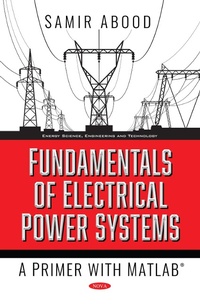
Fundamentals of Electrical Power Systems: A Primer with MATLAB
Published on 23. November 2020
507 pages
978-1-5361-8789-2 (ISBN)
Description

Fundamentals of Electrical Power Systems: A Primer With MATLAB® is a textbook that provides an excellent review of the fundamentals of power systems and presents exciting analysis methods. Each chapter begins with an abstract that states the chapter's objectives. All principles are presented with a lucid, logical, step-by-step approach. As much as possible, the author avoids wordiness and detail overload that could hide concepts and impede understanding. And in each chapter, the author presents some of the solved examples and applications using a computer program. Toward the end of each chapter, the author discusses some applications of the concepts covered in the chapter using a computer program. In recognition of the requirements of the Accreditation Board for Engineering and Technology (ABET) on integrating computer tools, the use of MATLAB® is encouraged in a student-friendly manner. MATLAB® is introduced in Appendix C and is applied gradually throughout the book. Each example is immediately followed by practice problems. Students can follow the examples step by step to solve the practice problems without flipping pages or looking at the end of the book for answers. These practice problems test students' comprehension and reinforce key concepts before they move on to the next section. The book is intended as a textbook for senior-level undergraduate students in electrical and computer engineering departments, and is appropriate for juniors, undergraduate students, graduate students, industry professionals, researchers, and academics. The prerequisites for a course based on this book are knowledge of standard mathematics, including calculus and complex numbers.
More details
Other editions
Additional editions
Book
12/2020
Nova Science Publishers Inc
€408.52
Shipment within 15-20 days
Content
- Intro
- Contents
- Abstract
- Preface
- Acknowledgments
- Chapter 1
- Electrical Energy Sources
- 1.1. Structure of Electrical Power Systems
- 1.2. Energy Resources
- 1.3. Location of the Power Station
- 1.4. Types of Power Stations
- 1.4.1. Thermal Power Station (Steam Power Station)
- 1.4.1.1. Main Parts of the Thermal Power Station
- 1.4.1.2. Selection Site of the Thermal Power Station
- 1.4.2. Hydro-Electric Power Station
- 1.4.2.1. Choice of the Site
- 1.4.2.2. Hydro-Electric Plants Classification
- 1.4.2.3. Main Parts of Hydro-Electric Plants
- 1.4.2.4. Hydrology
- 1.4.3. Nuclear Power Station
- 1.4.3.1. Choice of the Site
- 1.4.3.2. Fuels
- 1.4.3.3. Elements of a Nuclear Power Station
- 1.4.4. Diesel Power Station
- 1.4.4.1. The Advantages of Diesel Power Station
- 1.4.4.2. The Disadvantages of Diesel Power Station
- 1.4.5. GAS Turbine Power Plant
- 1.4.5.1. The advantages of GAS Turbine Power Plant
- 1.4.5.2. The Disadvantages of GAS Turbine Power Plant
- 1.4.6. Solar Cell
- 1.4.6.1. Equivalent Circuit Model of Ideal and Practical Solar Cell
- 1.4.6.2. Performance Analysis
- 1.4.6.3. Series and Parallel Wiring
- Example 1.1
- Solution
- Example 1.2
- Solution
- Example 1.3
- Solution
- Example 1.4
- Solution
- Example 1.5
- Solution
- 1.4.6.4. Sizing of the Solar Array
- 1.4.6.5. Sizing of the Battery
- 1.4.6.6. Sizing of the Voltage Controller
- 1.4.6.7. Sizing of the Inverter
- 1.4.6.8. Sizing of the System Wiring
- Example 1.6
- 1.4.7. Modelling of Wind Power
- 1.4.7.1. Efficiency in Extracting Wind Power (Betz Limit & Power Coefficient)
- 1.4.7.2. Power Curve of Wind Turbine
- 1.4.7.3. Technical Speci cations E-82 ENERCON Wind Energy Converters
- 1.5. Load Curves and Factors
- Important Terms and Factors
- Example 1.7
- Solution
- 1.6. Load Duration Curve
- 1.7. Load Curves and Selection of the Number and Sizes of the Generation Units
- Example 1.8
- Solution
- Example 1.9
- Solution
- 1.8. Prediction of load and Energy Requirements
- 1.9. Choice of Type, Size, and Number of Generator Units
- 1.10. Power Calculation in Single-Phase AC Circuits
- 1.11. Balanced Three-Phase Circuits
- 1.11.1. Delta Connection
- 1.11.2. Wye Connection
- 1.11.3. Power Calculations in Balanced Three-Phase Circuits
- Example 3.11
- Solution
- Example 3.12
- Solution
- Example 3.13
- Solution
- 1.12. Per Unit Quantity
- Problems
- Chapter 2
- Elements of Power Systems
- 2.1. Generating Unit
- 2.2. Transmission Network
- 2.3. Grounding Transformer
- 2.4. Distribution System
- 2.5. Power Consumption / Load
- 2.6. Conductors
- 2.7. Power Electronics Devices
- 2.8. Protective Devices
- 2.9. Economic Choice of Transmission Voltage
- 2.10. Conductor material Characteristics of the Material
- Example 2.1
- Solution
- 2.11. Parameters of Overhead Transmission Lines
- 2.11.1. Resistance
- 2.11.2. Inductance
- 2.11.2.1. Inductance of a Solid Cylindrical Conductor due to Internal Flux
- 2.11.2.2. Inductance of Single-Phase Two - Wireline
- 2.11.2.3. The Inductance of Composite Conductor Lines
- 2.11.2.4. The Inductance of Three-Phase Lines
- 2.11.2.5. Inductance of Bundled Conductors
- Example 2.2
- Solution
- Example 2.3
- Solution
- 2.11.3. Capacitance of Transmission Lines
- 2.11.3.1. Capacitance of a Two Wire Line
- 2.11.3.2. Capacitance of Three-Phase Line
- 2.11.3.3. Effect of the Earth on the Capacitance of a Line
- 2.11.3.4. Charging Current due to Capacitance
- 2.11.3.5. Capacitance of Bundle Conductors
- Example 2.4
- Example 2.5
- Solution
- 2.12. Performance of Transmission Lines
- 2.12.1. Short Transmission Line
- 2.12.2. Medium Transmission Line
- 2.12.2.1. Nominal p Circuit
- 2.12.2.2. Nominal T Circuit
- 2.12.3. Long Transmission Line
- 2.12.3.1. Nominal p Circuit
- 2.12.3.2. Transmission Efficiency
- 2.13. Generalized Constants
- Example 2.6
- Solution
- Example 2.7
- Solution
- 2.14. Underground Cables
- Problems
- Chapter 3
- Load Flow Analysis
- 3.1. Incidence and Network Matrices
- 3.2. Power System Representation
- 3.3. Incidence Matrices
- 3.3.1. Element-Node Incidence Matrix , .
- 3.3.2. Bus Incidence Matrix A
- 3.4. Primitive Network
- 3.5. Formation of Network Matrices by Singular Transformations
- 3.6. Bus Admittance and Bus Impedance Matrices
- 3.7. Step by Step Formation of the Bus Admittance Matrix
- 3.8. Load Flow Analysis
- 3.8.1. The Power Flow Mathematical Model
- 3.8.2. Iterative Solutions to Linear Algebraic Equations
- 3.8.3. Iterative Solutions to Nonlinear Algebraic Equations (Newton - Raphson)
- 3.8.4. Power - Flow Equations
- 3.8.5. Power - Flow Solution by Gauss-Seidel
- 3.8.5.1. Divergence of Gauss-Seidel Method
- 3.8.6. Power- Flow Solution by Newton-Raphson
- 3.8.6.1. Divergence of Newton's Method
- 3.9. Voltage Controlled Bus
- 3.10. Voltage-Controlled Buses with Tap Changing Transformers
- 3.11. Fast Decoupled Power Flow Solution
- 3.12. Gauss-Iterative Method Using Zbus
- 3.13. Gauss-Seidel Iterative Method Using Zbus
- 3.14. Acceleration of Convergence
- 3.15. Line Flows and Losses
- Example 3.1
- 3.16. Load Flow Program
- 3.16. Design and Develop Program Stage
- Example 3.2
- Solution
- Example 3.3
- Solution
- Example 3.4
- Solution
- Problems
- Chapter 4
- Optimum Power Flow
- 4.1. Voltage Stability and Reactive Power Flow Problem
- 4.2. Power Loss and Power Flow Control
- 4.3. The Optimization Problem
- 4.4. Mathematical Formulation of the Optimization Problem
- 4.5. Optimization Techniques
- 4.5.1. Quadratic Programming (QP)
- 4.5.2. Linear Programming (LP)
- 4.5.3. fmincon Function
- 4.6. Optimal Power Flow
- 4.6.1. Mathematical Formulation of the OPF Problem
- 4.6.2. Classification of the OPF Algorithms Solution
- 4.6.3. Comparison of the OPF Algorithms Solution Classes
- 4.7. Non-Linear Function Optimization
- 4.8. Computer Solution Methods Using the Impedance Matrix
- 4.8.1. Impedance Matrix in Shunt Computation
- 4.8.2. Algorithm for Formulating [Zbus]
- Type 1 Modification (Addition of Tree Branch Zs from a New Bus q to Reference)
- Type 2 Modification (Addition of a Tree Brunch Zs from a New Bus q to Old Bus k)
- Type 3 Modification (Addition of a Link Zs Between an old Bus k and Reference)
- Type 4 Modification (Addition of Link Zs between Two Old Buses)
- 4.9. Matrices of Special Interest in Network Analysis
- Example 4.1
- Example 4.2
- 4.9.1. The 6-Bus Power System
- 4.9.1.1. The Optimum Power Flow of 6 Bus Results
- 4.9.1.2. Bus Results
- Example 4.3
- Solution
- 4.2.1.3. Applied Case Study Results
- Problems
- Chapter 5
- Faults Analysis
- 5.1. Fault Concept
- 5.2. Types of Faults
- 5.3. Symmetrical Fault Analysis
- 5.4. Unsymmetrical Faults Analysis
- 5.5. Symmetrical Components
- 5.5.1. Positive Sequence Components
- 5.5.2. Negative Sequence Components
- 5.5.3. Zero Sequence Components
- 5.6. Effect of Symmetrical Components on Impedance
- 5.7. Phase Shift ? / ? Connection ? / ?
- 5.8. Sequence Network of Unloaded Generator
- 5.9. Analysis of Unsymmetrical Faults by Using the Method of Symmetrical Component
- 5.9.1. Single Line-to-Ground Fault
- 5.9.2. Line-to-Line Fault
- 5.9.3. Double Line-to-Ground Fault
- 5.10. Fault Classification
- 5.11. Assumptions and Simplifications
- 5.12. Fault Voltage-Amps
- 5.13. Fault Levels in a Typical System
- Example 5.1
- 5.2.1. Balanced Three-Phase Fault: Fault Impedance Zf = 0
- 5.2.2. Single Line-to-Ground Fault
- 5.2.4. Double Line-to-Ground Fault
- Example 5.2
- Problems
- Chapter 6
- Power System Stability
- 6.1. Stability Concept
- 6.2. Steady-State Stability
- 6.3. Power Limit of Transmission System
- 6.4. Transient stability
- 6.5. Swing Equation
- Example 6.1
- Solution
- Example 6.2
- Solution
- 6.6. Transient Stability Analysis Methods
- 6.6.1. Indirect Methods
- 6.6.1.1. Step by Step Method
- 6.6.2. Direct Methods
- 6.6.2.1. Equal-Area Criterion
- 6.7. Determination of Maximum Sudden Increases of Generator Output
- 6.8. Switching Operation
- 6.9. Fault Condition
- 6.10. Determination of Critical Clearing Angle
- Example 6.3
- Solution
- Example 6.4
- Example 6.5
- 6.11. Multimachine Stability
- 6.12. Computer Solution Program of the Flow Chart of the Case Study
- 6.13. Stability Analysis by MATLAB
- Example 6.5
- Example 6.6
- Example 6.7
- Example 6.8
- Problems
- Chapter 7
- Power System Reliability
- 7.1. Concept of Reliability
- 7.2. Power System Reliability
- 7.3. Reliability Evaluation
- 7.4. Measuring Reliability
- 7.5. Series Systems
- 7.6. Parallel Systems
- 7.7. Network Modeling and Evaluation of Simple Systems
- 7.7.1. Reliability as a Probability Function
- 7.7.2. Reliability Indices
- 7.7.3. Availability Concepts
- 7.7.4. Reliability as a Function of Time
- 7.8. General Reliability Functions
- 7.9. Reliability Analysis
- 7.9.1. Deterministic Data
- 7.9.2. Stochastic data
- 7.10. Interconnected Systems
- 7.11. Cut Sets Technique (CST)
- Example 7.1
- Solution
- 7.12. Methods of Reliability Evaluation
- 7.12.1. Path Tracing Method
- 7.12.1.1. Path Tracing Method to Determine MCS
- Example 7.2
- Solution
- Example 7.3
- Solution
- 7.12.2. Fault Tree Analysis (FTA)
- 7.12.2.1. Application of Fault Tree Analysis
- 7.13. Markov Process Analysis
- 7.13.1. Markov Process Method
- 7.13.2. Representation of the General Method
- Example 7.4
- Example 7.5
- Solution
- 7.14. Eigen Value Method
- 7.15. Fussell Algorithm
- 7.15.1. Algorithms
- 7.15.2. Solution of Fussell Algorithm
- 7.15.3. Two-Unit System
- Example 7.6
- Problems
- Chapter 8
- Modeling of Synchronous Generator
- 8.1. Importance of Modeling
- 8.2. Turbogenerator Identification
- 8.3. Thermal Plant
- 8.4. Turbine Model
- 8.5. System Identification
- 8.6. Plant Description
- 8.7. GA Solution
- 8.8. Inertia Constant and Swing Equation
- 8.9. Synchronous Generator Modeling Concept in the Power System
- 8.10. Excitation System Control
- 8.11. Turbine Governor Control
- 8.11.1. Prime Mover and Governing System Controls
- 8.11.2. Relationship of Governor, Turbine, and Generator
- 8.12. Division of Load between Generators
- Example 9.2
- Solution
- 8.13. System Connected by Lines of Relatively Small Capacity
- 8.14. Amplitude and Frequency Estimation of Power System
- 8.14.1. Adaptive Hopf Oscillator (AHO)
- 8.14.2. Power System Signal Modeling
- Problems
- Chapter 9
- Power Distribution System
- 9.1. Generation
- 9.2. Transmission
- 9.3. Distribution
- 9.4. System Operation
- 9.5. Radial and Ring Distribution
- 9.6. Overhead and Underground Distribution
- 9.7. Distribution Equipment
- 9.7.1. Transformers
- 9.7.2. Circuit Breakers
- 9.7.3. Disconnect Switches
- 9.7.4. Metering Equipment
- 9.8. Distribution Inside Large Buildings
- 9.8.1. Single Rising Main
- 9.8.2. Grouped Supply
- 9.8.3. Individual Floor Supply
- 9.8.4. Ring Main Supply
- 9.8.5. Double Feed Supply
- 9.9. Constructional Details of 33/11 kV and 11/0.4 kV Distribution Substations
- 9.10. Emergency Generators
- 9.11. Mains Failure Panel (MFP)
- 9.12. Uninterruptible Power Supply (UPS)
- Case (1): Mains Available (Normal Operation)
- Case (2): Mains Failed (Emergency Operation)
- Case (3): Return of Mains
- 9.13. Parallel Systems
- 9.14. Reactive Power Control in Distribution Networks
- 9.14.1. Individual Compensation
- 9.14.2. Control Methods
- 9.15. Distribution System Configuration
- 9.15.1. Radial Distribution System
- 9.15.2. Ring Distribution System
- 9.15.3. Spike Distribution System
- 9.15.4. Spindle Distribution System
- 9.15.5. Network (or Grid) Distribution System
- 9.15.6. Primary Selective Distribution System
- 9.16. Distribution System Parameters
- 9.16.1. Conductor Resistance
- 9.16.2. Inductive Reactance
- 9.17. Conductor Materials
- 9.18. Transformer Losses
- 9.19. Economic Number of Transformers
- 9.20. Radial Distribution System Calculations
- Example 9.1
- Solution
- Problems
- Chapter 10
- VAR Compensator
- 10.1. Objectives of Load Compensation
- 10.1.1. Power Factor Correction
- 10.1.2. Voltage Regulation
- 10.1.3. Load Balancing
- 10.2. Types of Reactive Power Compensation
- 10.2.1. Series Capacitor
- 10.2.2. Synchronous Condensers
- 10.2.3. Shunt Capacitors
- 10.2.4. Shunt Reactors
- 10.3. Controls of Switched Shunt Capacitors
- 10.4. Harmonic Distortion in Power System
- 10.5. Source of Harmonics
- 10.6. Harmonic Measurement
- 10.6.1. Distortion Factor
- 10.6.2. Telephone Interference Factor
- 10.7. Harmonic Reduction Methods
- 10.7.1. Shunt Filters
- 10.7.2. Series Filters
- 10.8. Operation of Thyristor Controlled SVCs
- 10.9. SVC Parameters Calculation
- 10.9.1. Static VAR Compensator Configurations
- 10.9.2. Calculation of the TCR Firing Angle
- 10.10. Three-Phase Current Balancing
- 10.11. Harmonics Due to SVC Operation
- 10.11.1. Measurement of Harmonic Effects
- 10.12. Real Time Technique
- 10.13. Control of SVC by ANN
- 10.14. Control Network
- 10.15. Structure of the ANNs Based SVC Controller
- 10.16. Training of ANNs
- 10.17. Numerical Test Systems
- 10.17.1. Theoretical Test System
- Control Network of Theoretical Test System
- 10.17.2. Practical Test System
- 10.17.2.1. Arc Furnace Application
- Control Network of Arc Furnace Application
- 10.17.2.2. Radial Distribution System
- Control Network of Radial Distribution System
- 10.17.2.3. Radial Transmission System
- Control Network of Radial Transmission System
- Problems
- Appendices
- Appendix A: Complex Numbers
- A.1. Representation of Complex Numbers
- A.2. Mathematical Operations
- A.3. Euler's Formula
- Appendix B: Mathematical Formulas
- B.1. Quadratic Formulas
- B.2. Trigonometric Identities
- B.3. Trigonometric Substitution
- B.4. Hyberbolic Functions
- B.5. Derivatives
- B.6. Indefinite Integrals
- B.7. Definite Integrals
- B.8. L'Hopital's Rule
- B.9. Summation
- B.10. Numerical Integration Approximations
- B.11. Powers of the Trig Functions
- Appendix C: Introduction to MATLAB®
- C.1. MATLAB Basics
- C.2. Using MATLAB to Plot
- References
- About the Author
- Index
- Blank Page
