


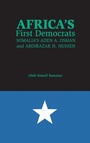
Africa's First Democrats
Somalia's Aden a. Osman and Abdirazak H. Hussen
Published on 26. September 2016
300 pages
978-0-253-02237-0 (ISBN)
Description

Abdi Ismail Samatar provides a clear and foundational history of Somalia at the dawn of the country's independence when Africa's first democrats appeared. While many African countries were dominated by authoritarian rulers when they entered the postcolonial era-and scholars have assumed this as a standard feature of political leadership on the continent-Somalia had an authentic democratic leadership. Samatar's political biography of Aden A. Osman and Abdirazak H. Hussen breaks the stereotype of brutal African tyranny. Samatar discusses the framing of democracy in Somalia following the years of control by fascist Italy, the formation of democratic organizations during the political struggle, and the establishment of democratic foundations in the new nation. Even though this early state of affairs did not last, these leaders left behind a strong democratic legacy that may provide a model of good governance for the rest of the continent.
Reviews / Votes
Africa's First Democrats challenges several stereotypes about the workings and growth of democracy on the African continent. More than that, Africa's First Democrats opens up space for a broader rereading of African history and holds the possibility for a more extensive anti-racist and anti-colonial project that has long animated pan-African politics across the globe.- Joshua Inwood, Pennsylvania State University (Politcal Geography)
Abdi Samatar's book Africa's First Democrats is of significance to geographical studies of Africa for three main reasons: (i) its decolonial approach; (ii) its dissection of democratic political leadership and political parties; (iii) its documentation of a historical period in Somalia, when political leaders advocated a vision of a united Somalia that transcended contemporary representation of the country as a 'failed state' wracked by atavistic tribalism.
- Patricia Daley, Oxford University (Political Geography)
This study is important because it draws attention to the gamut of stereotypes and wisdoms espoused by critics of African leaders. . . . We all must salute Samatar for his courage to exonerate a couple of African leaders from the court of academic vilification.
(American Historical Review)
Going beyond postcolonial analysis, decolonization encourages re-thinking the world from Africa, from Latin America, from indigenous places, and from marginalized academia. Samatar's book does precisely this, rethinking our concepts of statehood, democracy and leadership from Africa, and from Somalia particularly.
- Sarah Radcliffe, Cambridge University (Political Geography) Excellent.13 2014
(African and Asian Studies)
More details
Language
English
Place of publication
Bloomington, IN
United States
Target group
Professional and scholarly
Product notice
Reflowable
Illustrations
16 b&w illus., 3 maps, 11 tables - 16 Illustrations, black and white - 3 Halftones, black and white - 11 Tables, black and white
File size
2,18 MB
ISBN-13
978-0-253-02237-0 (9780253022370)
Copyright in bibliographic data and cover images is held by Nielsen Book Services Limited or by the publishers or by their respective licensors: all rights reserved.
Schweitzer Classification
Other editions
Additional editions
Book
09/2016
Indiana University Press
€88.50
Shipment within 10-20 days
Book
09/2016
Indiana University Press
€35.50
Shipment within 10-20 days
Person
Abdi Ismail Samatar is Professor and Chair of the Department of Geography, Environment, and Society at the University of Minnesota and a research fellow at the University of Pretoria. He is an elected member of the African Academy of Sciences, a former president of the African Studies Association, and a trustee of Mogadishu University. He is the author of four books, including An African Miracle, and more than seventy articles and essays on African development and politics, including "The Dialectics of Piracy in Somalia: The Rich versus the Poor."
Content
Preface & Acknowledgments
List of Selected Dates
1. Leadership in Africa
2. Aden: From an Orphan to a Nationalist Leader
3. Abdirazak: From Camel Boy to Freedom Fighter
4. The Somali Youth League and the Nationalist Project: 1943-1960
5. The First Republic: Institutional Foundations of Democracy 1960-1964
6. The Second Republic: Democratic Trailblazing
7. The March toward Dictatorship: 1967-1974
8. Conclusion
Bibliography
Notes
Index
List of Selected Dates
1. Leadership in Africa
2. Aden: From an Orphan to a Nationalist Leader
3. Abdirazak: From Camel Boy to Freedom Fighter
4. The Somali Youth League and the Nationalist Project: 1943-1960
5. The First Republic: Institutional Foundations of Democracy 1960-1964
6. The Second Republic: Democratic Trailblazing
7. The March toward Dictatorship: 1967-1974
8. Conclusion
Bibliography
Notes
Index
