

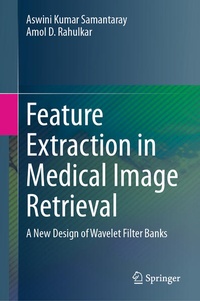
Feature Extraction in Medical Image Retrieval
Description

Firstly, a generalized novel design of a family of multiplier-free orthogonal wavelet filter-banks is presented. In this, the dyadic filter coefficients are obtained based on double-shifting orthogonality property with allowable deviation from original filter coefficients. Next, a low complex symmetric Daub-4 orthogonal wavelet filter-bank is presented. This is achieved by slightly altering the perfect reconstruction condition to make designed filter-bank symmetric and to obtain dyadic filter coefficients. In third contribution, the first dyadic Gabor wavelet filter-bank is presented based on slight alteration in orientation parameter without disturbing remaining Gabor wavelet parameters. In addition, a novel feature descriptor based on the design of adaptive Gabor wavelet filter-bank is presented. The use of Maximum likelihood estimation is suggested to measure the similarity between the feature vectors of heterogeneous medical images. The performance of the suggested methods is evaluated on three different publicly available databases namely NEMA, OASIS and EXACT09. The performance in terms of average retrieval precision, average retrieval recall and computational time are compared with well-known existing methods.
More details
Other editions
Additional editions
Persons
Dr. Aswini Kumar Samantaray received his B.Tech. and M.Tech. degree in electronics and communication engineering from Biju Patanaik University of Technology, Odisha, India in 2008 and 2012 respectively. He received his Ph.D. degree from National Institute of Technology Goa (NIT Goa), India in 2022. He worked as an Assistant Professor with the C. V. Raman College of Engineering from 2008 to 2018. He is currently working as an assistant professor with electronics and communication engineering, Vignan's Foundation for Science, Tecchnology and Research, Guntur, India. His research interests include the design of wavelets and filter-banks, image processing, and FPGA accelerators.
Dr. Amol D. Rahulkar received the B.E. degree in instrumentation engineering from the Shri Guru Gobind Singhji (SGGS) Institute of Engineering and Technology, Nanded, India, in 2000, the M.Tech. degree from the Indian Institute of Technology (IIT) Kharagpur, India, in 2002, and the Ph.D. degree from the SGGS Institute of Engineering and Technology, Nanded, affiliated to Swami Ramanand Teerth Marathwada University Nanded, India, in 2013. He is currently working as an Associate Professor with the Department of Electrical and Electronics Engineering, National Institute of Technology Goa (NIT Goa), India. His current research interests include the design of wavelets and filter-banks, digital signal processing, image processing, biometrics, FPGA accelerators, and soft-computing.
Content
Content Based Medical Image Retrieval.- Fundamentals of Wavelet Filter Banks.- Fundamentals of Gabor Wavelet Filter Banks.- A Family of Multiplier Free Orthogonal Wavelet Filter Banks.- Design of Symmetric and Completely Dyadic db-4 Wavelet Filter Bank.- Design of Dyadic Gabor Wavelet Filter Banks.- Design of Adaptive Gabor Wavelet Filter Banks.
