

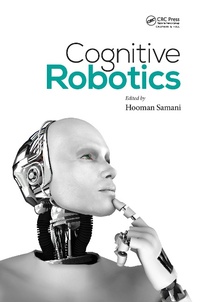
Cognitive Robotics
Description

Reviews / Votes
"...this work serves as an introduction to cognition in the field of artificial intelligence. An interesting discussion occurs in the chapter entitled "When Robots Do Wrong," which can be read and interpreted in different ways by social scientists, as opposed to those in mathematics, computer science, or the hard sciences. The chapter contains fascinating discourse on negligence and product liability, as well as sections on whether to blame the robot or the human developer when an issue arises. The book covers a breadth of topics that investigate cognitive robots and their interaction with elements of philosophy, chemicals, physical science, culture and society, psychology, and general artificial intelligence. Each chapter is authored by a range of individuals and contains its own set of references... Summing Up: Recommended. Graduate students through researchers and faculty; professionals."-J. Beidler, University of Scranton, Choice, November 2016 "...this work serves as an introduction to cognition in the field of artificial intelligence. An interesting discussion occurs in the chapter entitled "When Robots Do Wrong," which can be read and interpreted in different ways by social scientists, as opposed to those in mathematics, computer science, or the hard sciences. The chapter contains fascinating discourse on negligence and product liability, as well as sections on whether to blame the robot or the human developer when an issue arises. The book covers a breadth of topics that investigate cognitive robots and their interaction with elements of philosophy, chemicals, physical science, culture and society, psychology, and general artificial intelligence. Each chapter is authored by a range of individuals and contains its own set of references... Summing Up: Recommended. Graduate students through researchers and faculty; professionals."
-J. Beidler, University of Scranton, Choice, November 2016
More details
Other editions
Additional editions
Person
Hooman Samani is director of the Artificial Intelligence and Robotics Technology Laboratory (AIART Lab) and an assistant professor at the Department of Electrical Engineering, College of Electrical Engineering and Computer Science, National Taipei University, Taiwan.
His career in robotics and artificial intelligence research has spanned many countries including Taiwan, Singapore, Japan, United Kingdom, Germany, the Netherlands, and Iran. He was awarded a PhD from the Graduate School for Integrative Science and Engineering, Electrical & Computer Engineering Department, National University of Singapore. After obtaining his PhD, he became a Research Fellow at the Keio-NUS CUTE Center, which is a collaborative research center with locations in both the National University of Singapore (NUS) and Keio University in Japan.
His proposed research topic is Lovotics, which involves multidisciplinary research in artificial intelligence for human-robot affective relationships. This research comprises several topics including robotics, engineering, computer science, interaction design, philosophy, psychology, mathematics, computational neuroscience, art, and computational intelligence, for developing a truly interactive robot with pragmatic affection. Lovotics robots, Kissenger, Mini-Surrogate, and XOXO are some novel applications of Lovotics research.
