

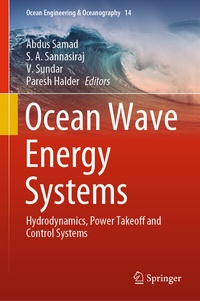
Ocean Wave Energy Systems
Description

Chapters 17 of this book is available open access under a CCBY 4.0 license at link.springer.com
More details
Other editions
Additional editions
Persons
Professor Abdus Samad has been working for the Department of Ocean Engineering at IIT Madras since 2010. He received a Ph.D. in Mechanical Engineering (2008) from Inha University, and a bachelor's and master's degrees from Aligarh Muslim University. Before joining IIT Madras, he worked at the University of Aberdeen (2008-2010). His main research is in the area of fluid machinery, marine energy, and optimization. He has published more than 120 research articles and co-authored a book on Design Optimization of Fluid Machinery published by Wiley (2019). He received a National Award for the Advancement in Mechanical engineering from the Institute of Engineers India in 2014. He has been serving as an editorial board member of the International Journal of Fluid Machinery and Systems, International Journal of Naval Architecture and Ocean Engineering (Elsevier), International Marine Energy Journal, and Mathematical Problems in Engineering (Hindawi). He is a fellow of ASME, IMechE, and Institute of Engineers India (IEI).
Professor S. A. Sannasiraj is a Professor in the Department of Ocean Engineering, IIT Madras. His topics include wave energy, breaking waves, wind-wave modeling, numerical simulation of nonlinear wave-structure interaction, and coastal protection. Since 2003, he has completed 14 research projects sponsored by National and International agencies and supervised 17 Ph.D. students. He published 90 peer-reviewed journal publications and participated in more than 100 technical conferences. He completed more than 250 industrial projects related to the development of ports and harbors, intake/ outfall systems, design of coastal protection structures, and wind-wave prediction. He received the Endeavour India Executive Award from the Australian Government in 2007 and received Fulbright-Nehru Senior research fellowship from USIEF during 2010-11. He also organized about 20 short Courses and Workshops for Researchers, Field Engineers, Faculties & Senior Managers.
Dr. Paresh Halder is a post-doctoral researcher at the Institute of Ocean Energy Saga University, Japan. His research topics include floating body pendulum wave energy converter, fluid machinery, marine renewable energy, and design optimization. He holds a bachelor's degree in mechanical engineering from Jalpaiguri Govt. Engineering College in India, as well as a master's and a doctoral degree from IIT Madras, India. Before joining Saga University, he was a postdoc at Sultan Qaboos University, Oman, IIT Madras, India, and Okinawa Institute of Science and Technology Graduate University, Japan. He published more than 45 articles in conference proceedings and journals.