

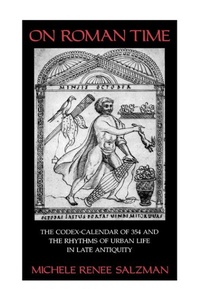
On Roman Time
The Codex-Calendar of 354 and the Rhythms of Urban Life in Late Antiquity
1st Edition
Published on 25. March 1991
335 pages
978-0-520-90910-6 (ISBN)
Description

Because they list all the public holidays and pagan festivals of the age, calendars provide unique insights into the culture and everyday life of ancient Rome. The Codex-Calendar of 354 miraculously survived the Fall of Rome. Although it was subsequently lost, the copies made in the Renaissance remain invaluable documents of Roman society and religion in the years between Constantine's conversion and the fall of the Western Empire.
In this richly illustrated book, Michele Renee Salzman establishes that the traditions of Roman art and literature were still very much alive in the mid-fourth century. Going beyond this analysis of precedents and genre, Salzman also studies the Calendar of 354 as a reflection of the world that produced and used it. Her work reveals the continuing importance of pagan festivals and cults in the Christian era and highlights the rise of a respectable aristocratic Christianity that combined pagan and Christian practices. Salzman stresses the key role of the Christian emperors and imperial institutions in supporting pagan rituals. Such policies of accomodation and assimilation resulted in a gradual and relatively peaceful transformation of Rome from a pagan to a Christian capital.
In this richly illustrated book, Michele Renee Salzman establishes that the traditions of Roman art and literature were still very much alive in the mid-fourth century. Going beyond this analysis of precedents and genre, Salzman also studies the Calendar of 354 as a reflection of the world that produced and used it. Her work reveals the continuing importance of pagan festivals and cults in the Christian era and highlights the rise of a respectable aristocratic Christianity that combined pagan and Christian practices. Salzman stresses the key role of the Christian emperors and imperial institutions in supporting pagan rituals. Such policies of accomodation and assimilation resulted in a gradual and relatively peaceful transformation of Rome from a pagan to a Christian capital.
More details
Other editions
Additional editions
Michele Renee Salzman
On Roman Time
The Codex-Calendar of 354 and the Rhythms of Urban Life in Late Antiquity
Book
03/1991
1st Edition
University of California Press
€86.80
Article not available at the moment
Person
Michele Renee Salzman is Associate Professor of History at University of California, Riverside.
Content
- Intro
- Contents
- List of Illustrations
- List of Abbreviations
- Preface
- Part I. The Book: The Codex-Calendar of 354
- I. INTRODUCTION: ANTECEDENTS AND INTERPRETATIONS OF THE CODEX-CALENDAR OF 354
- The Roman Calendar
- Interpretations of the Paganism in the Calendar of 354
- Principal Considerations of This Study
- II. DESCRIPTION OF THE CONTENTS OF THE CODEX-CALENDAR OF 354
- The Illustrated Sections of the Codex-Calendar of 354
- The Unillustrated Sections of the Codex-Calendar of 354
- Why Produce This Codex-Calendar?
- Part II. The Calendar: A Roman Calendar for A.D. 354
- III. THE ILLUSTRATIONS OF THE MONTHS IN THE CALENDAR OF 354
- Critical Approaches to the Illustrations
- The Instruments of Transmission: The Manuscript Copies
- Illustrations of Pagan Religious Festivals
- Illustrations of Seasonal Themes
- Illustrations Combining Seasonal and Festival Themes
- Diachronic and Local Iconographic Variation in the Illustrations of the Months
- IV. THE TEXT OF THE CALENDAR OF 354
- Festivals, Holidays, and Cults in the Calendar of 354: An Overview
- Group 1. The Imperial Cult
- Group 2. Festivals and Cults Celebrated with Ludi and Circenses: The Most Important Cults
- Group 3. Festivals and Cults Not Celebrated with Ludi and Circenses: Old and New Cults
- Continuity and Change: Calendars and Cults in the Late Empire-The Appeal of a Roman Holiday
- Christian Emperors and Pagan Practices
- Part III. The World: Roman Society and Religion and the Codex-Calendar of 354
- V. CONSUETUDINIS AMOR: ROME IN THE MID-FOURTH CENTURY
- Conflict or Accommodation: Two Theoretical Models
- The Codex-Calendar of 354: The Contents and Context as Emblematic of Roman Society
- The Evidence for Pagan-Christian Conflict
- Other Evidence for Accommodation and Assimilation
- VI. EPILOGUE: THE TURNING OF THE TIDE
- Antipagan Legislation and the Pagan Reactions in the Late Fourth Century
- The Calendar of 354 and the Calendar of Polemius Silvius: Tradition and Innovation
- Appendices
- Appendix 1: The Manuscripts and Their Tradition
- Appendix 2: Comparable Calendar Cycles from the Latin West
- Appendix 3: Latin Poetry of the Months
- Appendix 4: The Text of the Distichs (Anthologia Latina 665) in the Codex-Calendar of 354
- Appendix 5: Dating the Codex-Calendar of 354
- Appendix 6: Consular Dating as a Criterion for Source Analysis of the Codex-Calendar of 354
- Appendix 7: A Fourth-Century Variant Myth
- General Index
- A
- B
- C
- D
- E
- F
- G
- H
- I
- J
- K
- L
- M
- N
- O
- P
- Q
- R
- S
- T
- U
- V
- W
- Y
- Z
- Index of Illustrated Subjects
- A
- B
- C
- D
- F
- G
- H
- J
- L
- M
- N
- O
- P
- R
- S
- T
- V
- Z
