

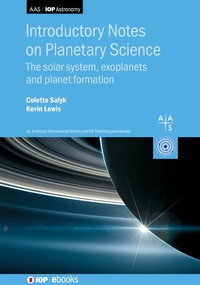
Introductory Notes on Planetary Science
Description

Planets come in many different sizes, and with many different compositions, orbiting our Sun and countless other stars. Understanding their properties and interactions requires an understanding of a diverse set of sub-fields, including orbital and atmospheric dynamics, geology, geophysics, and chemistry. This textbook provides a physics-based tour of introductory planetary science concepts for undergraduate students majoring in astronomy, planetary science, or related fields. It shows how principles and equations learned in introductory physics classes can be applied to study many aspects of planets, including dynamics, surfaces, interiors, and atmospheres. It also includes chapters on the discovery and characterization of extrasolar planets, and the physics of planet formation.
Key Features
- Covers a wide range of planetary science topics at an introductory level
- Coherently links the fields of solar system science, exoplanetary science, and planet formation
- Each chapter includes homework questions
- Includes python templates for reproducing and customizing the figures in the book
More details
Other editions
Additional editions
Persons
Colette Salyk is currently an astronomy professor at Vassar College, where she teaches courses in planetary science, observational astronomy, and introductory physics. Her research focuses on the chemistry of planet formation, and the role it plays in producing planetary diversity. She has performed observations of planet formation using space-based telescopes and telescopes around the world.
Kevin Lewis is currently an assistant professor in the Department of Earth and Planetary Sciences at Johns Hopkins University, where he teaches courses in remote sensing and the geology of the Earth and other planets. His research focuses on the geological evolution of the terrestrial planets, and in particular the climate history of Mars. He has been a science team member on several planetary missions, including the Mars Exploration Rovers, the Curiosity Mars rover, and the InSIght lander.
Content
Foreword
1 Introduction
2 Energy from the Sun
3 Planetary Dynamics for Two Bodies
4 More Complicated Dynamics: More than two bodies, and non-point masses
5 Extrasolar planets
6 Planetary Interiors
7 Planetary Surfaces
8 Planetary Atmospheres
9 Planet Formation
