

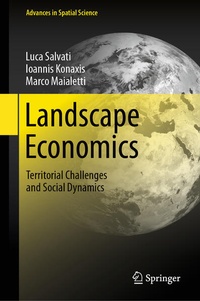
Landscape Economics
Description

This books focuses specifically on an "applied economics" of landscapes. It means that landscape is investigated here in a completely new setting and academic perspective, starting from the economic, social, and geographical perspective, and then moving to planning, ecological and environmental implications. Likely for the first time in the literature, this book is specifically dealing with landscape science in a perspective of geo-economic disciplines. While preferring an applied perspective to a completely theoretical point of view, the book offers a completely novel approach to landscape complexity-not demising the territorial and environmental issues and implications-but re-framing the debate in the perspective of the human impact on landscape transformations: Landscape change is here envisioned as an economic and geographic problem together.
More details
Other editions
Additional editions
Persons
Luca Salvati, Ph.D. Economic Geography, is a professor of Applied Economics and Economic statistics, Department of Methods and Models for Economics, Territory and Finance (MEMOTEF), Faculty of Economics, Sapienza University of Rome, Italy; (H-index: 90 (SCOPUS source); 724 publications on SCOPUS); more than 40 books published with Springer/Springer Nature, Elsevier, River Publishers, Nova Science Publishers, Emerald, Routledge-CRC press, Edward Elgar, Anthem Press. He actually teaches academic classes of regional economics, urban studies, data mining, economic statistics, geographic information systems, economic history, and ecological economics.
Ioannis Konaxis, Ph.D. Landscape and Architecture (Sapienza University of Rome), is an assistant professor of tourism studies at Piraeus University of Greece (Athens). He is a renowned scholar in tourism analysis-spamming from economics to environmental topics. He gives classes of tourism studies, landscape analysis, and environmental conservation strategy. His main research topics include eco-tourism in protected areas and the nexus between landscape and tourism. He teaches in several academic classes of tourism, landscape, nature conservation, environmental issues, and applied economics.
Marco Maialetti, lawyer and independent scholar, is a fellow (contract) researcher at Sapienza University of Rome. Moving from the professional job to science, his main research interests include landscape, environmental conservation laws, and agricultural policies. He published several articles on international scientific journals and academic books with prestigious publishers around the world.
Content
Chapter 1. Local development, landscape economics, and complex territorial dynamics.- Chapter 2. Space, regions, and landscapes: toward a 'territorial' perspective?.- Chapter 3. Envisioning the 'territorial' perspective of landscapes.- Chapter 4. Landscape dynamics and local development.- Chapter 5. Economic growth and landscape change: the development path of local systems.- Chapter 6. A physical-monetary evaluation of ecosystem services and landscape quality.
