

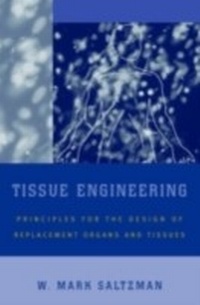
Tissue Engineering
Engineering Principles for the Design of Replacement Organs and Tissues
1st Edition
Published on 15. July 2004
538 pages
978-0-19-803240-3 (ISBN)
Description

Tissue or organ transplantation are among the few options available for patients with excessive skin loss, heart or liver failure, and many common ailments, and the demand for replacement tissue greatly exceeds the supply, even before one considers the serious constraints of immunological tissue type matching to avoid immune rejection. Tissue engineering promises to help sidestep constraints on availability and overcome the scientific challenges, with huge medical benefits. This book lays out the principles of tissue engineering. It will be a useful reference work for those associated with this field and as a textbook for specialized courses in the subject. It is a companion volume to Saltzman's OUP book on drug delivery.
More details
Other editions
Additional editions
W. Mark Saltzman
Tissue Engineering
Engineering Principles for the Design of Replacement Organs and Tissues
Book
08/2004
Oxford University Press Inc
€182.10
Shipment within 15-20 days
Content
- Intro
- Contents
- Part 1 Tissue Exchange and Tissue Development
- 1 The State-of-the-Art in Tissue Exchange
- 1.1 History
- 1.2 Prospects for the Future
- References
- 2 Objecives of Tissue Engineering
- 2.1 Tissue Engineering Is an Alternative to Drug Therapy, Gene Therapy, and Whole-Organ Transplantation
- 2.2 Tissue Engineering Attempts to Inspire or Control the Normal Processes of Tissue Repair and Healing
- 2.3 Tissue Engineering Attempts to Replace Cells that are Missing Within an Otherwise Functional Tissue or Organ
- 2.4 Tissue Engineering Uses Cellular Control Mechanisms to Enhance Drug Delivery
- 2.5 Tissue Engineering Leads to New Models of Human Physiology
- 2.6 Tissue Engineering
- Summary
- Exercises
- References
- 3 Elements of Tissue Development
- 3.1 Early Transformations in the Embryo
- 3.2 Control of Development
- 3.3 Mechanisms of Development
- Summary
- Glossary
- Exercises
- References
- Part 2 Tissue Engineering Fundamentals
- 4 Cell Growth and Differentiation
- 4.1 The Cell Cycle
- 4.2 Stem Cells and Cell Differentiation
- 4.3 Agents that Regulate Cell Growth and Differentiation
- 4.4 Trafficking and Signal Transduction
- 4.5 Kinetics of Cell Proliferation
- Summary
- Exercises
- References
- 5 Cell and Tissue Mechanics
- 5.1 Elementary Solid Mechanics
- 5.2 Elementary Fluid Mechanics
- 5.3 Mechanical Properties of Biological Fluids and Gels
- 5.4 Mechanical Properties of Cells
- 5.5 Mechanical Properties of Tissues
- Summary
- Exercises
- References
- 6 Cell Adhesion
- 6.1 Mechanics of Cell Adhesion
- 6.2 Cell Junctions
- 6.3 Cell Adhesion Receptors
- 6.4 Extracellular Matrix
- 6.5 Cell Adhesion and Intracellular Signalling
- Summary
- Exercises
- References
- 7 Cell Migration
- 7.1 Overview of Cell Migration
- 7.2 Experimental Observations on Cell Motility
- 7.3 Quantitative Methods for Describing the Movement of Individual Cells
- 7.4 Quantitative Methods for Describing the Movement of Cell Populations
- 7.5 Mean Time to Capture
- 7.6 Coordination of Cell Migration
- Summary
- Appendix: Additional Information on Brownian Motion and Random Walks
- Exercises
- References
- 8 Cell Aggregation and Tissue Equivalents
- 8.1 Overview and Significance
- 8.2 Cell Aggregation and Cell Sorting
- 8.3 Models of Cell Aggregation
- 8.4 Cell-Populated Tissue Equivalents
- Summary
- Exercises
- References
- 9 Tissue Barriers to Molecular and Cellular Transport
- 9.1 Mobility of Lipids and Proteins in the Membrane
- 9.2 Permeation of Molecules through Membranes
- 9.3 Permeation of Molecules through Cell Layers
- 9.4 Permeation of Cells through Cell Layers
- Summary
- Exercises
- References
- Part 3 Tissue Engineering Practice
- 10 Cell Delivery and Recirculation
- 10.1 Cell Movement within the Circulatory System
- 10.2 Examples of Cell Trafficking between Body Compartments
- 10.3 Microchimerism
- 10.4 Cell Penetration into Three-Dimensional Tissues
- Summary
- Acknowledgment
- Exercises
- References
- 11 Delivery of Molecular Agents in Tissue Engineering
- 11.1 Technology for Controlled Delivery of Molecular Agents in Tissue Engineering
- 11.2 Controlled Release of Agents in Time and Space
- 11.3 Future Applications of Controlled Delivery in Tissue Engineering
- Summary
- Exercises
- References
- 12 Cell Interactions With Polymers
- 12.1 Characterizing Cell Interactions with Polymers
- 12.2 Cell Interactions with Polymer Surfaces
- 12.3 Cell Interactions with Polymers in Suspension
- 12.4 Cell Interactions with Three-dimensional Polymer Scaffolds and Gels
- Summary
- Exercises
- References
- 13 Approaches to Tissue Engineering
- 13.1 Artificial Organs
- 13.2 Roles of the Synthetic Component
- 13.3 Control of the Biological Component
- 13.4 Replacement of Tissue Structure or Function
- Summary
- Exercises
- References
- 14 Case Studies in Tissue Engineering
- 14.1 Tissue-Engineered Cartilage
- 14.2 Tissue-Engineered Skin
- 14.3 Tissue-Engineering Approaches for Nerve Regeneration
- References
- Appendices
- A: Introduction to Polymers
- A.1 Polymer Properties
- A.2 Non-degradable Polymers
- A.3 Biodegradable Polymers
- A.4 Water-Soluble Polymers
- References
- B: Analysis of Molecular Transport
- B.1 Random Walks
- B.2 Equations for the Diffusive Flux (Fick's Law)
- B.3 Equations of Mass Conservation (Fick's Second Law)
- B.4 Solutions to the Diffusion Equation with no Solute Elimination or Generation
- References
- C: Useful Data
- C.1 Protein Properties
- C.2 Blood and Tissue Cell Properties
- C.3 Mathematical Tables and Functions
- References
- D: Nomenclature and Abbreviations
- D.1 Nomenclature
- D.2 Abbreviations
- D.3 Glossary
- Index
- A
- B
- C
- D
- E
- F
- G
- H
- I
- K
- L
- M
- N
- O
- P
- R
- S
- T
- U
- V
- W
- X
- Y
- Z
