

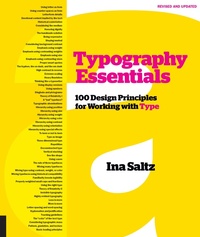
Typography Essentials Revised and Updated
100 Design Principles for Working with Type
Published on 14. February 2019
208 pages
978-1-63159-648-3 (ISBN)
Description

Typography Essentials: 100 Design Principles for Working with Type is a practical, hands-on resource that distills and organizes the many complex issues surrounding the effective use of typography. An essential reference for designers since 2009, Typography Essentials is now completely refreshed with updated text, new graphics and photos, and a whole new look.
Divided into four sections-The Letter, The Word, The Paragraph, and The Page-the text is concise, compact, and easy to reference. Each of the 100 principles, which cover all practical aspects of designing with type, has an explanation and inspiring visual examples drawn from international books, magazines, posters, and more.
Typography Essentials is for designers of every medium in which type plays a major role, and is organized and designed to make the process enjoyable and entertaining, as well as instructional.
Divided into four sections-The Letter, The Word, The Paragraph, and The Page-the text is concise, compact, and easy to reference. Each of the 100 principles, which cover all practical aspects of designing with type, has an explanation and inspiring visual examples drawn from international books, magazines, posters, and more.
Typography Essentials is for designers of every medium in which type plays a major role, and is organized and designed to make the process enjoyable and entertaining, as well as instructional.
More details
Language
English
Place of publication
Beverly
United States
Publishing group
Quarto Publishing Group USA Inc
Product notice
Reflowable
Illustrations
300 color illustrations
File size
30,58 MB
ISBN-13
978-1-63159-648-3 (9781631596483)
Copyright in bibliographic data and cover images is held by Nielsen Book Services Limited or by the publishers or by their respective licensors: all rights reserved.
Schweitzer Classification
Other editions
Additional editions
Book
01/2019
Rockport Publishers
€26.50
Article exhausted; check different version
Person
Ina Saltz is an art director, designer, writer, photographer, and professor (at The City College of New York) whose areas of expertise are typography and editorial publication design. She has written more than 50 articles on design and typography, contributed to 5 books by Steven Heller, and authored 15 essays for Phaidon's Archive of Graphic Design. She currently teaches classes on the business website Lynda.com. Ina served as the Design Director at Time magazine (International Editions), Worth magazine, Golf magazine, and others. Ina frequently lectures on topics related to magazine design and typography and has chaired, co-chaired, and judged numerous design and typography competitions. She is a two-term board member of the Type Directors Club. Ina is the author of the Body Type series of books on typographic tattoos, as well as Typography Essentials: 100 Design Principles for Working with Type. She is a co-author of Typography Referenced: A Comprehensive Visual Guide to the Language, History and Practice of Typography, named one of the best reference books of 2012 across all subject matter by the American Library Association.
Content
- Cover
- Half Title
- Titler
- Copyright
- Dedication
- CONTENTS
- INTRODUCTION
- THE LETTER
- 1 Using letter as form
- 2 Using counter spaces as form
- 3 Letterform details
- 4 Emotional content implied by the text
- 5 Historical connotation
- 6 Considering the medium
- 7 Honoring dignity
- 8 The handmade solution
- 9 Being expressive
- 10 Staying neutral
- 11 Considering background contrast
- 12 Emphasis using weight
- 13 Emphasis using contrasting weights
- 14 Emphasis using size
- 15 Emphasis using contrasting sizes
- 16 Proper smart quotes
- 17 The hyphen, the en dash, and the em dash
- 18 High contrast in reverse
- 19 Extreme scaling
- 20 Heavy flourishes
- 21 Thinking like a typesetter
- 22 Using display versions
- 23 Using numbers
- 24 Dingbats and pictograms
- 25 Theory of Relativity I
- THE WORD
- 26 A "bad" typeface?
- 27 Typographic abominations
- 28 Hierarchy using position
- 29 Hierarchy using size
- 30 Hierarchy using weight
- 31 Hierarchy using color
- 32 Hierarchy using contrast
- 33 Hierarchy using orientation
- 34 Hierarchy using special effects
- 35 To kern or not to kern
- 36 Type as image
- 37 Three-dimensional type
- 38 Repetition
- 39 Deconstructed type
- 40 Vertical stacking
- 41 See the shape
- 42 Using cases
- 43 The rule of three typefaces
- 44 Mixing many typefaces
- 45 Mixing type using contrast, weight, or color
- 46 Mixing typefaces using historical compatibility
- 47 Familiarity breeds legibility
- 48 Properly weighted small caps and fractions
- 49 Using the right type
- 50 Theory of Relativity II
- THE PARAGRAPH
- 51 Invisible typography
- 52 Highly evident typography
- 53 Less is more .
- 54 More is more
- 55 Letter spacing and word spacing
- 56 Hyphenation and justification
- 57 Tracking guidelines
- 58 The "color" of the text type
- 59 Considering typographic mass
- 60 Pattern, gradation, and texture
- 61 Basic leading principles
- 62 Optimum line lengths
- 63 Increasing leading
- 64 Tightly stacked lines
- 65 Indicating paragraphs
- 66 Initial caps and drop caps
- 67 Opening paragraphs
- 68 Orphans and widows
- 69 "Rivers" of space
- 70 Eschew decorative type
- 71 Celebrate decorative type.
- 72 Text overlapping images
- 73 Text overlapping text
- 74 The text block effect
- 75 Theory of Relativity III
- THE PAGE
- 76 Legibility, legibility, legibility
- 77 Legibility taking a back seat
- 78 Limiting typefaces
- 79 One type family
- 80 Six necessary typefaces
- 81 A need for every typeface
- 82 Text typefaces versus display typefaces
- 83 Organized entry points
- 84 Systematizing hierarchy
- 85 Using justified type
- 86 Using flush-left, rag-right type
- 87 Using centered, asymmetrical, and flush-right type
- 88 The multicolumn text grid
- 89 The uneven text grid
- 90 Typographic "furniture"
- 91 Decks, callouts, and pull quotes
- 92 The "birth and death" of the text
- 93 Chaos versus order
- 94 Commentary, marginalia, and alternate languages
- 95 Tables and charts
- 96 Navigational devices
- 97 Margins and gutters
- 98 Framing the text
- 99 Floating in space
- 100 Theory of Relativity IV
- CONTRIBUTORS INDEX
- A
- B
- C
- D
- E
- F
- G
- H
- J
- K
- L
- M
- N
- O
- P
- R
- S
- T
- V
- W
- Y
- Z
- ABOUT THE A UTHOR
- ACKNOWLEDGMENTS
